
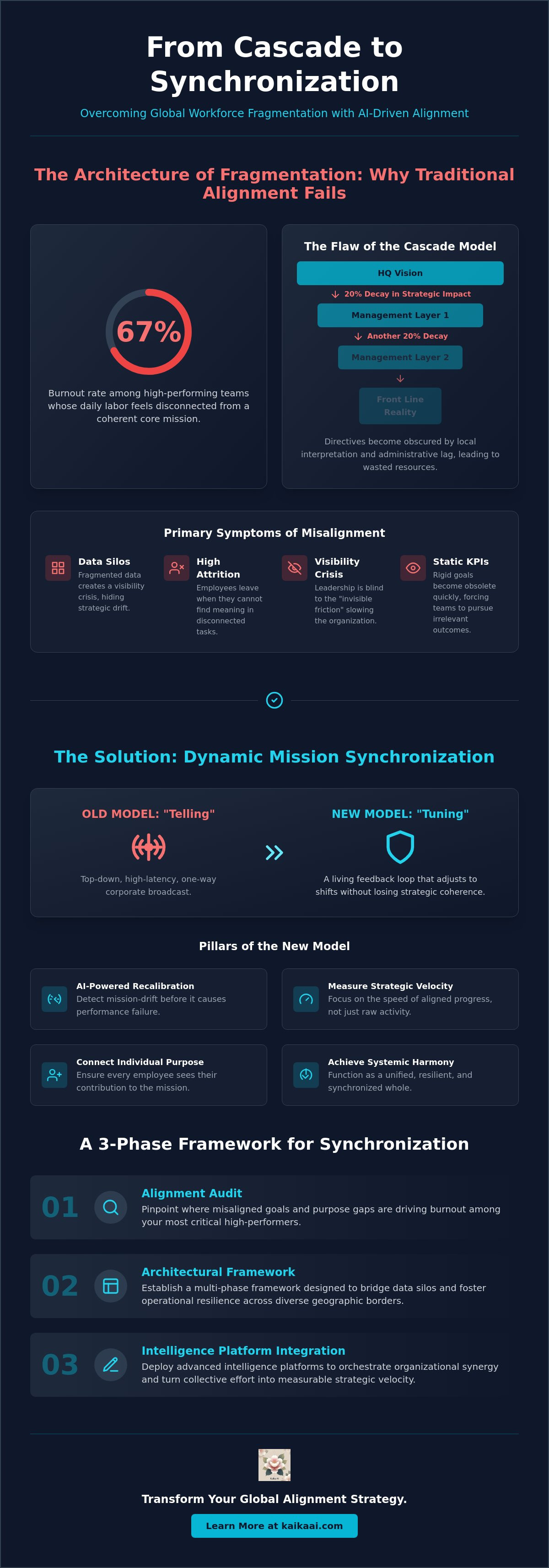
The traditional top-down mission cascade isn't just inefficient; it's a structural liability in a world moving at the speed of agentic intelligence. As leaders grapple with global workforce alignment challenges, the distance between the boardroom's vision and the operational reality of a regional division often becomes a chasm of fragmented culture and high attrition. You've likely seen the symptoms. High-performing teams are burning out at a rate of 67% globally because their daily labor feels disconnected from a coherent core. Purpose remains a vague corporate abstraction rather than a measurable engine of performance.
It's time to shift the paradigm from static communication to dynamic synchronization. This article provides a rigorous framework for aligning global divisions through AI-driven intelligence, transforming your mission into a living architectural standard. We'll examine how to bridge the gap between individual purpose and organizational velocity. You'll discover how to achieve measurable synergy that reduces burnout and ensures your enterprise functions as a unified, resilient whole.
Key Takeaways
- Identify the structural flaws in traditional command-and-control models that create a widening "say-do" gap between headquarters and regional divisions.
- Discover how to navigate complex global workforce alignment challenges by evolving from static broadcast communication to dynamic, real-time mission synchronization.
- Learn to utilize an Alignment Audit to pinpoint exactly where misaligned goals and purpose gaps are driving burnout among your most critical high-performers.
- Establish a multi-phase architectural framework designed to bridge data silos and foster operational resilience across diverse geographic borders.
- Explore the role of advanced intelligence platforms in orchestrating organizational synergy and turning collective effort into measurable strategic velocity.
The Architecture of Fragmentation: Why Global Alignment Fails in 2026
In the high-stakes environment of 2026, the structural integrity of a global enterprise depends on its ability to maintain strategic velocity across borders. Yet, many organizations suffer from a profound "Say-Do" gap. This is the space where executive intent evaporates before it reaches the regional operative. These global workforce alignment challenges aren't merely administrative; they're architectural. When a mission statement lacks local resonance, it becomes a hollow artifact, leading to cultural dilution and a workforce that operates in a state of perpetual friction. It's a systemic failure. This fragmentation is a primary catalyst for the 67% burnout rate currently observed across the global labor market, as employees struggle to find meaning in disconnected tasks.
The Limitations of Traditional Corporate Goal Cascading
The legacy model of top-down goal cascading is fundamentally unsuited for the AI era. Management research frequently highlights a 20% decay in strategic impact at every subsequent management layer. By the time a directive reaches the front line, the original intent is obscured by local interpretation and administrative lag. Static KPIs, once the gold standard of performance measurement, cannot keep pace with dynamic market shifts. In high-velocity sectors, a goal set in January is often obsolete by March, yet the rigid cascade forces teams to pursue irrelevant outcomes. This misalignment doesn't just waste resources; it actively erodes the psychological contract between the employee and the enterprise. Performance suffers. It transforms high-performers into cynical observers of corporate theater rather than active participants in a shared mission.
Data Silos and the Visibility Crisis
Achieving true Strategic alignment requires more than just shared documents. It demands a unified view of organizational health that most current systems fail to provide. Relying on quarterly engagement surveys is a high-risk strategy in a landscape where burnout velocity can destabilize a division in weeks. Fragmented data silos create a visibility crisis for HQ, leaving leadership blind to the strategic drift occurring in autonomous regional hubs. Without enterprise-grade intelligence that transcends geographic boundaries, global workforce alignment challenges will continue to manifest as high attrition and stagnant innovation. Leadership remains blind to the "invisible friction" that slows organizational movement. Regional autonomy, while necessary for local agility, must be balanced with a systemic synchronization that ensures every individual's purpose is calibrated to the collective mission.
Beyond the Cascade: The Shift to Corporate Mission Synchronization
The era of the one-way corporate broadcast is over. Traditional goal cascading, a relic of industrial-age management, is too high-latency for the current market reality. To address modern global workforce alignment challenges, leadership must transition from a model of "telling" to one of "tuning." This shift defines Corporate Mission Synchronization. It is the architectural alignment of organizational trajectory and individual purpose in real-time. Instead of a static document released annually, synchronization creates a living feedback loop that adjusts to environmental shifts without losing strategic coherence. It's about systemic harmony. When the enterprise functions as a synchronized unit, the gap between executive intent and operational execution disappears.
AI plays a critical role in this evolution by identifying mission-critical gaps before they manifest as performance failures. By processing vast streams of operational data, intelligence systems can detect when a regional division's focus begins to drift from the core mission. This allows for proactive recalibration. We're moving beyond raw output as a metric of success. The new standard is velocity. Measuring the speed of aligned progress provides a far more accurate picture of organizational health than measuring activity alone. It ensures that every unit of energy expended contributes directly to the strategic whole.
Connecting Individual Purpose to Organizational Strategy
The science of performance is increasingly rooted in the intersection of individual motivation and corporate objectives. When employees perceive their daily labor as a contribution to a meaningful mission, burnout rates plummet and innovation surges. Our Workforce Alignment Intelligence Platform leverages these psychological drivers by mapping individual purpose to high-level strategic goals. This isn't about superficial engagement; it's about structural integration. By reducing the friction caused by meaningless or misaligned work, organizations can unlock latent human potential that remains dormant in traditional structures. The result is a resilient, purpose-driven workforce that views the company's mission as an extension of their own.
Real-Time Metrics for Strategic Synchronization
Relying on lagging indicators like annual turnover or quarterly revenue is a strategy for the rearview mirror. According to the State of the Global Workplace report, the global cost of disengagement remains staggering, yet most leaders lack the tools to measure alignment as it happens. We must move toward real-time alignment scores that quantify how well cross-departmental efforts are synchronized. This visibility allows for immediate intervention when silos begin to form. Workforce velocity is the rate of goal-aligned progress. By tracking this velocity, leadership gains a predictive view of future performance, ensuring that global workforce alignment challenges are managed with data-driven precision rather than executive intuition.
The Invisible Friction: Addressing Purpose Gaps and Burnout Velocity
Burnout is frequently misdiagnosed as a simple consequence of excessive workload or inadequate compensation. In the high-velocity environment of 2026, the reality is far more structural. True exhaustion often stems from the "invisible friction" of misaligned effort. When a high-performer's daily labor fails to resonate with the broader corporate mission, the resulting psychological strain accelerates attrition. This friction is a central pillar of modern global workforce alignment challenges. It's not just that people are working hard; it's that they're working against the organizational grain. According to current data, 67% of workers globally report burnout symptoms, yet traditional wellness programs fail to address the root cause: a lack of strategic coherence.
To eliminate this friction, leadership must deploy an Alignment Audit. This isn't a subjective survey. It's a rigorous mapping of where individual energy is being diverted into non-strategic tasks. By identifying these purpose gaps, organizations can reclaim lost velocity. Predictive analytics now allow us to identify burnout patterns long before they manifest as a resignation. We're looking at engagement patterns and mission-drift signals in real-time. This structural harmony is the only sustainable path to operational resilience. It moves the enterprise beyond reactive crisis management and into a state of proactive synchronization.
Misalignment as a Primary Driver of Burnout
The psychological toll of working in a strategic vacuum is immense. When employees don't see how their contributions move the needle, they disengage. This "silent attrition" is a leading indicator of systemic failure. Our Workforce Alignment Intelligence Platform serves as a critical governance tool by identifying these early signals. It doesn't just track hours; it tracks the resonance between task and mission. By pinpointing exactly where purpose and strategy diverge, leadership can intervene with precision. This prevents the talent drain that occurs when your most capable divisions lose their sense of direction. It's about protecting your most valuable asset through structural integrity rather than superficial perks.
Operational Resilience for Global Leadership
Building a resilient enterprise requires a fundamental shift in executive mindset. Leaders must navigate the complex challenges of managing a global workforce by fostering a culture of alignment that transcends geographic borders. This isn't a soft skill. It's a disciplined methodology. We integrate Operational Resilience Training directly into our alignment framework to ensure that leadership can maintain strategic focus under pressure. This training focuses on developing psychological stamina and structural agility. When the organization's architecture is sound, resilience becomes an inherent property of the system. Proactive synchronization ensures that even in the face of global volatility, the mission remains clear and the workforce remains engaged.
Strategic Frameworks for Synchronizing Global Divisions
Resolving global workforce alignment challenges requires more than a tactical shift; it demands a rigorous, multi-phase architectural framework. We move beyond the superficiality of cultural awareness training to address the structural root causes of misalignment. This methodology ensures that the enterprise operates as a singular, synchronized organism. By treating organizational alignment as a systems engineering problem, leadership can transform fragmented divisions into a high-velocity collective. This process is divided into three critical phases designed to bridge the gap between high-level vision and local execution.
- Phase 1: The Alignment Audit. This diagnostic stage utilizes our proprietary intelligence to map the current delta between executive mission and operational reality. We identify the specific points where strategic intent is lost in translation.
- Phase 2: Architectural Consultation. We restructure communication flows to eliminate the impact decay inherent in traditional hierarchies. This phase focuses on building the infrastructure for strategic velocity.
- Phase 3: Strategic Integration. By embedding real-time feedback loops into daily operations, we ensure that synchronization becomes a permanent feature of the corporate architecture.
To begin this transformation, leadership should schedule an Executive Consultation to assess their current structural integrity. This framework provides the discipline required to maintain coherence at a global scale.
Implementing Data-Driven Kaizen
The pursuit of alignment is never finished. Through our Collective Kaizen Workshops, we implement a culture of continuous optimization. These sessions focus on solving cross-departmental synergy gaps by identifying small, data-backed adjustments that lead to disproportionate structural gains. It's a move away from radical, disruptive change toward a steady, disciplined refinement of workforce efficiency. This approach ensures that every division remains calibrated to the core mission, even as market conditions fluctuate. When small adjustments are executed with precision, the cumulative impact on organizational velocity is massive.
Privacy-First Intelligence on a Global Scale
Operating a Workforce Alignment Intelligence Platform in 2026 requires a sophisticated approach to data governance. As of June 30, 2026, the Colorado Artificial Intelligence Act mandates strict risk management and impact assessments for AI systems used in employment decisions. Similarly, the Texas Responsible AI Governance Act, effective January 1, 2026, emphasizes the need for algorithmic transparency. We prioritize a privacy-first architecture that navigates these fragmented regulatory landscapes, including the stringent standards of the Illinois Human Rights Act and California’s FEHA amendments. Building trust through transparent, enterprise-grade security is non-negotiable. We balance deep organizational intelligence with uncompromising employee data protection to ensure that your alignment strategy is both effective and legally resilient.
The Kaika Approach: Orchestrating Organizational Synergy with AI
Kaika AI represents the connective tissue of the modern global enterprise. It's not a mere diagnostic tool; it's a structural engine for restoration. While we've analyzed the decay caused by traditional cascades, Kaika proposes a return to organizational integrity through agentic intelligence. Our methodology addresses global workforce alignment challenges by transforming abstract strategic intent into precise operational reality. This isn't just about data collection. It's about the execution of strategy through a purpose-driven lens. We provide the architectural framework necessary to synchronize mission across every geographic border, ensuring that the enterprise functions as a singular, high-velocity organism.
Our three-phase strategic integration methodology moves beyond passive observation. We begin with the diagnostic rigors of the Alignment Audit, proceed through architectural consultation, and culminate in systemic integration. This process ensures that synchronization isn't a temporary state but a permanent feature of your corporate architecture. By embedding intelligence directly into the communication flows of the organization, we eliminate the impact decay that typically plagues large-scale operations. It's a disciplined path toward strategic realization.
The Workforce Alignment Intelligence Platform
The Workforce Alignment Intelligence Platform provides executive leadership with a high-fidelity view of organizational health that was previously impossible to achieve. Key features like real-time alignment scores and granular productivity dashboards replace the lagging indicators of legacy management. The platform identifies early signals of mission drift, allowing for immediate recalibration before performance is compromised. It fosters cross-departmental synergy by ensuring that diverse teams are calibrated to the same strategic frequency. Kaika AI acts as a strategic partner, providing the technical precision required to lead with confidence in a volatile market. It's a tool for leaders who demand measurable structural impact.
Final Strategic Realization
The final realization of this methodology is a state of structural harmony. The long-term ROI of a synchronized global workforce is reflected in reduced attrition and accelerated innovation cycles. When the "invisible friction" of misalignment is removed, the enterprise achieves a state of continuous velocity. We help leaders navigate global workforce alignment challenges by turning collective effort into measurable synergy. This is the evolution of high-performance culture. It's a shift from managing raw activity to orchestrating meaningful impact. By aligning individual purpose with corporate goals, you protect your talent and your trajectory simultaneously.
Request early access to the Kaika AI platform and begin your Alignment Audit to secure your position at the forefront of this organizational evolution and begin building a resilient, synchronized future.
Mastering Organizational Velocity through Strategic Synchronization
The path to enterprise excellence requires a definitive departure from the high-latency management models of the past. You've explored how structural fragmentation erodes performance and why Corporate Mission Synchronization is the necessary architectural evolution for the modern era. By addressing global workforce alignment challenges through a lens of systemic integrity, leadership can finally bridge the gap between visionary intent and regional execution. This shift transforms your workforce from a collection of disparate divisions into a unified, high-velocity organism.
True organizational harmony is achieved when data and purpose intersect with precision. Our framework utilizes a Three-Phase Strategic Integration Methodology to ensure your mission remains a living standard rather than a static artifact. With our AI-Powered Burnout Prediction Engine and uncompromising Japanese Privacy Standard Compliance, you gain the intelligence needed to protect your talent while accelerating your strategic trajectory. The future of leadership is synchronized. Request Early Access to the Kaika AI Alignment Intelligence Platform and begin your transformation today. Your organization's potential is waiting to be unlocked through structural excellence.
Frequently Asked Questions
What is the biggest challenge in global workforce alignment?
The primary hurdle is the structural "Say-Do" gap that occurs when strategic intent evaporates between headquarters and regional divisions. This fragmentation creates global workforce alignment challenges that manifest as cultural dilution and operational drift. Leaders often struggle to maintain a unified trajectory when regional autonomy isn't balanced with systemic synchronization. It's a failure of organizational architecture rather than individual effort.
How does AI help in synchronizing corporate missions across borders?
AI provides the real-time connective tissue necessary to bridge the chasm between global leadership and local operative teams. It functions by processing vast streams of operational data to detect mission drift long before it impacts performance. This allows the enterprise to transition from a model of corporate broadcasting to one of systemic tuning. It's about achieving high-velocity synchronization that respects regional nuance while maintaining core coherence.
Can workforce alignment software actually predict employee burnout?
Software predicts burnout by identifying the early signals of "invisible friction" between an employee's daily labor and the corporate mission. When individual purpose and organizational goals diverge, the resulting psychological strain becomes a leading indicator of attrition. By tracking these resonance patterns, intelligence platforms allow for proactive intervention before high-performers reach a point of exhaustion. It's a data-driven approach to protecting human potential.
What is the difference between HR analytics and workforce alignment intelligence?
HR analytics typically focuses on lagging indicators like turnover and payroll, while workforce alignment intelligence measures the architectural velocity of the entire enterprise. The former is descriptive and often retrospective. The latter is predictive and focused on organizational synergy. It quantifies how effectively collective energy is being converted into goal-aligned progress across different divisions and geographic borders.
How does Kaika AI handle global data privacy standards?
Our platform utilizes a privacy-first architecture designed to navigate the complex regulatory landscapes of 2026. We maintain strict compliance with the Colorado Artificial Intelligence Act, effective June 30, 2026, and the Texas Responsible AI Governance Act. This ensures that deep organizational intelligence never compromises individual data protection or legal resilience. We balance the need for high-fidelity data with uncompromising security standards.
Why do traditional goal-tracking methods fail in large enterprises?
Traditional methods fail because they rely on a static, top-down cascade that loses approximately 20% of its strategic impact at every management layer. In high-velocity markets, these rigid KPIs become obsolete faster than they can be communicated down the chain. Large enterprises require a dynamic synchronization model that can adjust to environmental shifts without losing the integrity of the core mission.
How long does a strategic alignment integration typically take?
A comprehensive integration follows a structured, three-phase methodology that moves from diagnostic assessment to systemic synchronization. The duration depends on the complexity of the global workforce alignment challenges inherent in your specific organizational architecture. We focus on achieving measurable milestones that build cumulative resilience rather than pursuing a rushed, superficial implementation. It's a disciplined investment in long-term structural velocity.
What are the first steps to conducting an organizational alignment audit?
The initial step is a rigorous identification of the delta between high-level mission and operational reality. This involves mapping data flows to pinpoint exactly where strategic intent is being diluted or lost entirely. By uncovering communication bottlenecks and purpose gaps, leadership gains the baseline needed to restructure for maximum synergy. It's the essential first step toward reclaiming organizational coherence and operational resilience.
Disclaimer
#Disclaimer
At Kaika AI, we believe the future belongs to organizations that combine human wisdom with artificial intelligence responsibly. The articles, research, insights, and thought leadership published on this website are intended to educate, inform, and encourage meaningful conversations about the future of work, organizational intelligence, AI, leadership, and innovation.
While our content is developed through rigorous research and may be generated, curated, or enhanced using artificial intelligence, every effort is made to ensure it reflects thoughtful analysis, practical relevance, and responsible AI practices. However, no representation or warranty is made regarding the completeness, accuracy, or suitability of the information for every individual or organizational circumstance.
The ideas, opinions, frameworks, and recommendations shared by Kaika AI are provided for educational and informational purposes only. They should not be interpreted as legal, financial, medical, psychological, human resources, cybersecurity, or other professional advice. Organizations and individuals should seek qualified professional guidance before making strategic, legal, or operational decisions.
Where articles reference third-party organizations, products, services, academic research, industry reports, or public data, such references are provided solely to support discussion and analysis. Unless explicitly stated, they do not imply endorsement, partnership, or affiliation.
Artificial intelligence is a powerful decision-support technology—not a replacement for human judgment. Kaika AI advocates for responsible, transparent, and human-centered AI adoption. We encourage readers to critically evaluate information, consider their unique context, and combine AI-generated insights with professional expertise and sound decision-making.
The content published on this website may be updated, revised, or removed as knowledge, technology, regulations, and best practices continue to evolve.
To the fullest extent permitted by applicable law, Kaika AI, its affiliates, contributors, and partners disclaim liability for any direct, indirect, incidental, consequential, or other losses arising from the use of, or reliance upon, the information provided on this website.
By accessing or using this website, you acknowledge that you have read, understood, and agree to this Disclaimer.
Kaika AI
'Building trusted organizational intelligence for the AI Era'


