
What if the primary catalyst for enterprise decay isn't market volatility, but the invisible friction of misaligned human intent? Most leaders accept silent attrition as an inevitable cost of scale; however, the reality is far more manageable with the right structural intelligence. You likely recognize the limitations of traditional engagement surveys that capture sentiment only after the damage is done. This article explores how AI-driven workforce optimization is transitioning from basic labor scheduling to a rigorous architecture of systemic alignment. You'll learn to quantify the precise intersection of employee purpose and organizational mission to drive measurable ROI. We examine the evolution of alignment frameworks, moving from descriptive data to prescriptive models that can predict turnover with up to 85% accuracy. This transition provides a clear roadmap for executive leadership to synchronize human potential with operational velocity, ensuring that individual growth and corporate mission are no longer mutually exclusive.
Key Takeaways
- Transition from administrative scheduling to AI-driven workforce optimization to achieve deep systemic alignment between human intent and corporate objectives.
- Utilize the Ikigai Intelligence Framework (IIF) to establish a data-driven baseline for organizational harmony through specialized alignment indices.
- Replace lagging engagement metrics with proactive indicators that surface burnout risks and attrition signals before talent resigns.
- Deploy the Sugihara Bridge Model to harmonize technical intelligence with human interpretation, ensuring data precision remains grounded in organizational reality.
- Quantify the impact of alignment on operational resilience to secure a measurable return on human capital investment.
The Evolution of AI-Driven Workforce Optimization: From Scheduling to Alignment
Enterprise leadership often conflates logistical efficiency with organizational health. True AI-driven workforce optimization represents a strategic enterprise capability that transcends mere headcount management. It's a sophisticated architecture designed to synchronize individual potential with the broader institutional mission. By moving beyond the limitations of simple labor forecasting, organizations can achieve a level of structural integrity that traditional models simply cannot support.
To better understand how this technology transforms the modern talent economy, watch this helpful video:
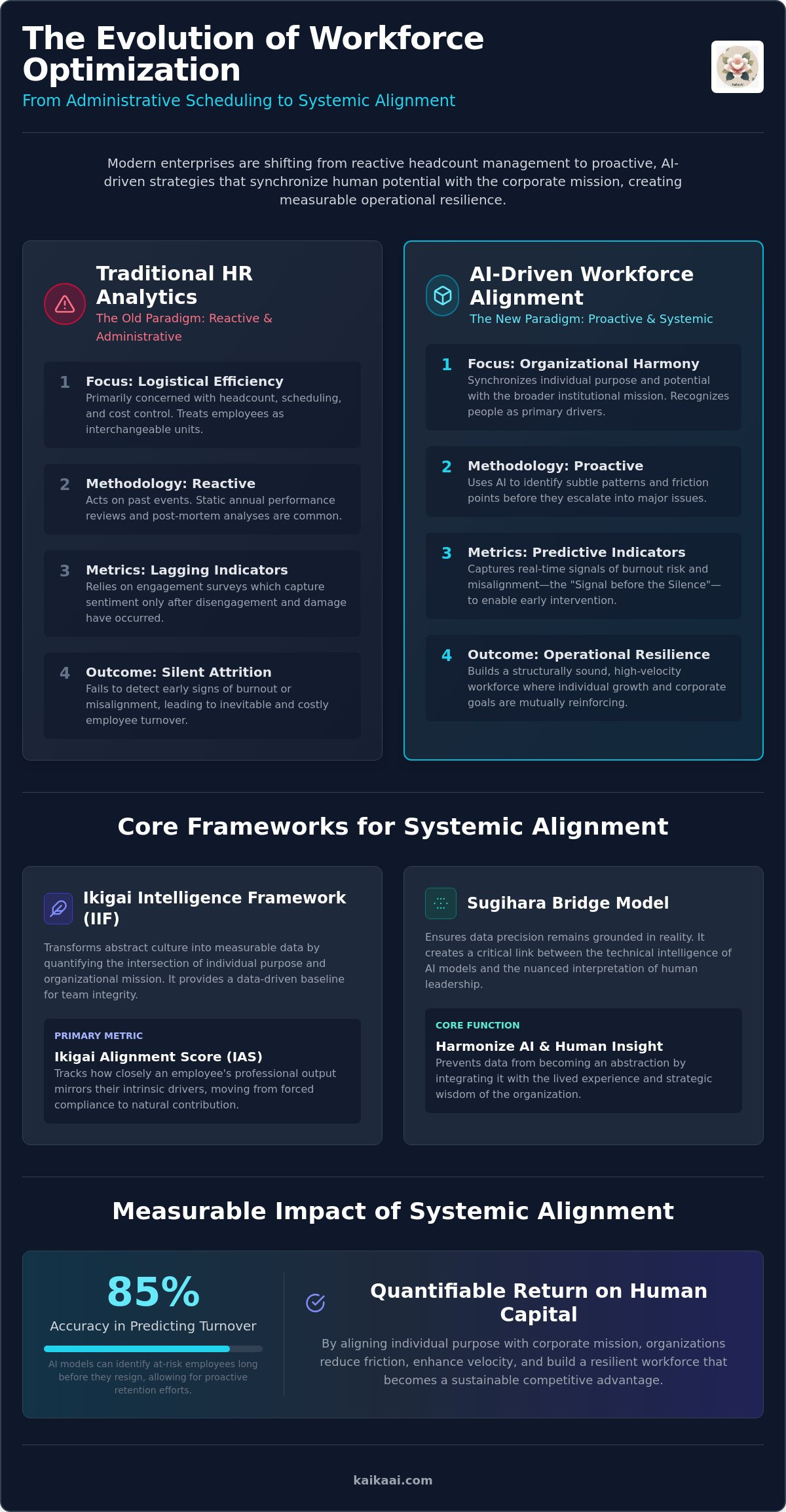
For decades, Workforce Management (WFM) focused exclusively on the "how many" and the "when." It was a cold calculation of headcount versus demand, often utilized in contact centers and retail environments. Modern Workforce Intelligence shifts this focus to the "why" and the "to what end." This evolution marks a critical transition from reactive resource allocation to proactive organizational harmony. While legacy systems treated employees as interchangeable units, modern intelligence frameworks recognize them as the primary drivers of enterprise velocity.
Legacy WFM vs. Modern Workforce Intelligence
Traditional systems rely on top-down scheduling, enforcing a rigid structure that frequently ignores the psychological drivers of excellence. This methodology creates a disconnect between operational needs and human capacity. Static annual performance reviews, a staple of legacy management, act as post-mortem artifacts that fail to capture the fluid reality of high-stakes environments. In contrast, modern intelligence requires real-time, continuous performance metrics to maintain operational resilience. It replaces the top-down mandate with a bottom-up purpose alignment, ensuring that every contributor understands their role within the larger corporate machinery.
The Role of AI in Detecting Organizational Friction
Advanced algorithms identify subtle patterns in cross-departmental synergy gaps that human managers often overlook. These systems surface the precise friction points where communication breaks down or where individual purpose begins to drift from the collective mission. We define this as the "Signal before the Silence" philosophy. By capturing these predictive indicators, leadership can intervene before burnout results in a resignation letter. Traditional engagement surveys fail because they capture sentiment only after disengagement has taken root. AI-driven models identify the decay in real-time. Workforce alignment is the synchronization of individual purpose with corporate architecture.
The Ikigai Intelligence Framework: A New Architecture for Enterprise Alignment
The transition from administrative management to systemic alignment requires a robust, quantifiable architecture. The Ikigai Intelligence Framework (IIF) serves as this foundational structure for CHROs, transforming abstract concepts of organizational culture into measurable dimensions of performance. By deploying AI-driven workforce optimization through the lens of individual purpose, enterprises move beyond superficial engagement scores toward mission-critical synchronization. This framework centers on the Ikigai Alignment Score (IAS), a primary metric that tracks how closely an employee's professional output mirrors their intrinsic drivers.
Strategic leadership recognizes that high-performance environments aren't sustained by pressure, but by the precision of fit. The IAS provides a data-driven baseline for this fit, allowing executives to visualize the structural integrity of their teams. When individual intent and corporate mission align, the resulting workforce velocity creates a competitive moat that's difficult for competitors to replicate. It's about moving from a state of forced compliance to one of natural, high-velocity contribution.
For smaller businesses, a similar competitive advantage is often found in local market dominance, achieved through strategic partnerships with specialized agencies like KD Interactive to optimize search engine visibility.
Measuring the Intersection of Purpose and Performance
The IIF evaluates four distinct pillars within the corporate context: individual skill, personal passion, organizational need, and economic value. When these quadrants overlap, workforce velocity increases. High IAS levels correlate directly with long-term employee retention, as individuals find their contributions validated by the enterprise's strategic trajectory. For a deeper exploration of these mechanics, consult our Definitive Guide to Workforce Alignment Software. This synchronization ensures that talent remains anchored even during periods of rapid transition or market volatility.
Clinical Precision in Burnout Risk Detection
Beyond performance metrics, the framework utilizes the Human Signal Index (HSI) and the Employee Human Signal Index (EHSI) to monitor behavioral shifts. Developed in collaboration with clinical psychologists, the EHSI provides a clinical foundation for identifying psychological strain before it manifests as physical burnout. It functions as a leading indicator, flagging subtle changes in communication patterns and cognitive load without compromising individual privacy. This early detection capability allows leadership to address systemic stressors, significantly reducing enterprise attrition risk. Organizations seeking to validate their current structural health can initiate a comprehensive Alignment Audit to identify latent friction points and recalibrate their human capital strategy.
This clinical approach ensures that the "Signal before the Silence" isn't just a philosophy, but a rigorous operational standard. By utilizing these indices, managers gain a prescriptive toolset to intervene effectively. They don't just see that a team is struggling; they understand the psychological and structural reasons behind the friction, allowing for surgical rather than broad-brush solutions.
Comparative Analysis: Traditional HR Analytics vs. Workforce Alignment Intelligence
The distinction between traditional HR analytics and workforce alignment intelligence lies in the depth of their architectural intent. Legacy systems typically focus on descriptive data, recording what has already occurred within the organizational structure. In contrast, AI-driven workforce optimization utilizes prescriptive intelligence to identify the underlying drivers of performance. This shift allows leadership to move from a defensive posture to a strategic one, focusing on the structural integrity of the entire enterprise rather than just reactive headcount management.
A rigorous comparison reveals that traditional tools often prioritize tactical efficiency over systemic harmony. While a standard dashboard might track absenteeism or output per hour, it fails to capture the psychological synchronization required for long-term excellence. Workforce alignment intelligence evaluates the enterprise through three critical dimensions: data depth, predictive capability, and human centricity. By measuring the resonance between individual purpose and corporate mission, executives gain a high-fidelity view of organizational health that surface-level metrics cannot provide.
Lagging Indicators vs. Leading Signals
Turnover rates and annual engagement scores are "too-late" metrics. By the time these figures reach an executive's desk, the systemic decay has already compromised productivity and morale. Modern leadership requires a transition to leading signals that identify friction before it manifests as attrition. Alignment scores serve as these predictive indicators, surfacing subtle performance dips and disengagement patterns in real-time. For a comprehensive look at these early warning systems, see our executive guide on Leading Indicators of Employee Burnout. These insights allow for surgical interventions that preserve human capital and maintain operational velocity.
Data Integrity and the 'Honesty Gap'
The efficacy of any intelligence platform depends entirely on the integrity of its inputs. Traditional anonymous surveys often suffer from a significant "honesty gap," where employees provide sanitized answers out of fear or apathy. Kaika AI pilots have demonstrated a remarkable 87% honesty rate, a figure that far exceeds industry averages for standard HR tools. This transparency stems from a foundation of psychological safety; employees are more likely to provide authentic feedback when they see it directly influencing their alignment and professional growth rather than being used for punitive assessment.
Maintaining this level of trust requires an uncompromising commitment to data security. Enterprise-grade protection is non-negotiable when handling sensitive alignment data. Our Secure Employee Analytics Platform framework ensures that individual privacy remains protected while providing leadership with the aggregate intelligence needed for collective Kaizen. This balance of transparency and security creates a resilient feedback loop, driving continuous improvement across the entire corporate architecture.
Implementing AI-Driven Workforce Optimization: The Sugihara Bridge Model
Strategic integration of AI-driven workforce optimization requires a methodical transition from legacy management to alignment intelligence. Large enterprises often fail to realize the full potential of advanced analytics because they treat technology as a standalone solution. The Sugihara Bridge Model addresses this implementation gap by pairing high-fidelity AI measurement with sophisticated human judgment. This hybrid approach ensures that technical precision remains grounded in the fluid reality of organizational culture.
The foundational first step for any leadership team is a comprehensive Alignment Audit. This diagnostic phase identifies the latent friction within the corporate architecture, surfacing disalignment before it impacts performance. By establishing this baseline, executives can move beyond guesswork and begin a data-driven evolution toward systemic harmony. This process isn't just about software; it's about recalibrating the very mindset of the enterprise to value synchronization over mere scheduling.
Phase-Based Integration for Global Divisions
Successful deployment across complex, multi-divisional structures requires a disciplined, three-phase methodology:
- Step 1: Structural Audit and Mindset Alignment. Leadership identifies mission-critical objectives and socializes the alignment framework to ensure transparency and psychological safety.
- Step 2: Continuous Measurement and Signal Extraction. The platform begins capturing real-time behavioral indices, providing a steady stream of intelligence on organizational health and individual purpose.
- Step 3: Strategic Adjustment and Collective Kaizen. Insights are translated into iterative structural refinements, fostering a culture of continuous improvement and operational resilience.
The Necessity of Human-AI Synergy
AI lacks the inherent capacity to navigate the intricate cultural nuances found in Japanese or global corporations. While algorithms excel at detecting patterns in raw data, they cannot fully account for the subtle social dynamics that drive human behavior. Trained human consultants, such as the global team at Kagool, are essential for interpreting sensitive workforce signals and providing the context necessary for effective intervention. The Sugihara Bridge Model is the architectural link between raw data and executive action.
These experts utilize AI-generated insights to facilitate Team Alignment Workshops, where data becomes a catalyst for meaningful dialogue. This synergy allows managers to address the root causes of disengagement rather than just managing the symptoms. It transforms cold analytics into a warm, human-centric strategy for excellence. To begin your journey toward systemic synchronization, schedule your initial Alignment Audit today.
Driving ROI Through Operational Resilience and Systemic Alignment
The final measure of any enterprise strategy is its impact on the balance sheet. Systemic alignment isn't a peripheral HR initiative; it's a core pillar of corporate governance that dictates the velocity of the entire organization. By implementing AI-driven workforce optimization, leadership can transform invisible human capital risks into quantifiable assets. This transition ensures that the mission-critical synchronization of talent doesn't just improve morale; it actively drives bottom-line performance through reduced friction and increased output. To further protect your organization's financial health, you can check out Whole King Company Limited for professional commercial debt recovery solutions.
For executives looking to implement these strategies through intelligent automation, you can check out IntellifyAi to see how agentic AI drives enterprise transformation.
Executive leadership must recognize that workforce costs are being reshaped by the current technological landscape. As organizations move toward a skills-first model, the cost of acquiring and retaining specialized talent continues to rise. Furthermore, as enterprises integrate decentralized systems, understanding web3 API pay per call pricing becomes essential for managing the technical side of operational overhead. In this high-stakes environment, the inability to quantify the link between employee purpose and corporate ROI is no longer acceptable. Alignment intelligence provides the precision needed to justify human capital investments, ensuring that every role contributes directly to the overarching strategic trajectory.
Quantifying the Cost of Misalignment
Silent attrition creates a massive, unrecorded drain on enterprise resources. When employees disengage, the loss isn't just limited to the eventual replacement cost, which industry data suggests can range from 1.5 to 2 times an employee's annual salary. It includes the erosion of institutional knowledge and the friction introduced to cross-departmental workflows. High alignment scores, conversely, produce a "Synergy Dividend" that accelerates project completion and innovation cycles.
For a detailed breakdown of these metrics, refer to our guide on Quantifying Team Synergy. Reducing this misalignment friction is essential for maintaining a competitive edge in volatile markets. When departments operate in silos, the resulting disalignment acts as a tax on every operation, slowing down execution and diluting the impact of strategic initiatives.
The Path to Institutional Resilience
Operational resilience is the capacity of an organization to maintain performance despite external shocks or internal transitions. A Data-Driven Kaizen Platform provides the structural intelligence needed to foster this resilience. It allows for continuous performance reimagined as a perpetual cycle of alignment and adjustment. This methodology ensures that the enterprise remains flexible, adapting to shifts in the talent economy without losing its core mission.
As regulatory scrutiny on AI increases, maintaining transparency and ethical data use becomes a prerequisite for resilience. Organizations that prioritize responsible AI and human-centric outcomes are better positioned to navigate the complexities of global scale. True workforce optimization is a commitment to hearing the signal before the silence. It ensures that the human spirit remains the primary engine of organizational growth, providing a foundation of stability that survives even the most disruptive market cycles.
Synchronizing Human Potential with Enterprise Velocity
The evolution of AI-driven workforce optimization marks a definitive end to the era of reactive resource management. Organizations must now embrace a structural architecture that synchronizes individual purpose with the corporate mission to maintain operational velocity. By moving beyond lagging engagement scores and adopting the Ikigai Intelligence Framework, leadership can identify the precise friction points that lead to silent attrition and systemic burnout before they impact the bottom line.
Our methodology is grounded in rigorous academic research through a partnership with Waseda University. Pilot data from a 340-person cohort demonstrates the efficacy of this approach, yielding a remarkable NPS of 72 and an 87% employee honesty rate. This transparency creates a resilient foundation for collective Kaizen, ensuring that your institutional growth is both sustainable and human-centric. It's time to transition from simple scheduling to deep systemic alignment.
Secure your position at the forefront of the talent economy. Request Early Access to the Kaika AI Workforce Alignment Intelligence Platform and begin your journey toward mission-critical synchronization. The future of enterprise excellence belongs to those who hear the signal before the silence.
Frequently Asked Questions
What is AI-driven workforce optimization for enterprises?
AI-driven workforce optimization is a strategic enterprise capability that transcends administrative scheduling to achieve deep systemic alignment. It utilizes advanced algorithms to synchronize individual human potential with the organizational mission. By moving beyond reactive resource allocation, leadership can manage the structural integrity of their workforce in real-time. This approach ensures that talent remains focused on high-value outcomes, driving both operational velocity and long-term sustainability.
How does the Ikigai Intelligence Framework differ from traditional HR tools?
The Ikigai Intelligence Framework (IIF) differs from traditional HR tools by focusing on prescriptive rather than descriptive analytics. While standard software tracks lagging indicators like absenteeism, the IIF measures mission-critical synchronization through specific indices. It evaluates the intersection of skill, passion, need, and value to provide a high-fidelity view of organizational health. This architectural approach allows CHROs to quantify the link between employee purpose and corporate performance.
Can AI really predict employee burnout and attrition?
Advanced AI models can predict employee turnover with up to 85% accuracy by detecting subtle patterns in communication and engagement. These systems identify disengagement signals before they manifest as physical burnout or formal resignations. By capturing the "Signal before the Silence," organizations gain a predictive window to intervene proactively. This capability is a core benefit of AI-driven workforce optimization, reducing enterprise attrition risk and preserving human capital.
How does Kaika AI ensure data privacy and security for large corporations?
Data security is managed through a secure analytics platform that prioritizes individual privacy while delivering aggregate strategic intelligence. The framework is built on clinical foundations that ensure psychological safety during data collection. By utilizing enterprise-grade encryption and strict access controls, the system protects sensitive behavioral signals. This balance of transparency and security allows large corporations to leverage deep workforce insights without compromising their commitment to ethical data use.
What is the Sugihara Bridge Model and why is it necessary?
The Sugihara Bridge Model is a phase-based integration methodology that harmonizes technical intelligence with human judgment. It's necessary because AI alone cannot navigate the complex cultural nuances inherent in global corporate structures. By utilizing trained consultants to interpret data, the model ensures that executive actions are contextually relevant and psychologically sound. This synergy transforms raw workforce signals into actionable strategies for collective Kaizen and long-term organizational harmony.
How does workforce alignment intelligence impact ROI and performance?
Alignment intelligence directly impacts ROI by eliminating the hidden friction of silent attrition and cross-departmental synergy gaps. When individual purpose is synchronized with the corporate mission, the resulting "Synergy Dividend" accelerates project completion and operational velocity. By quantifying these human capital dynamics, leadership can treat workforce optimization as a measurable pillar of corporate governance. This leads to improved bottom-line performance and greater resilience against market volatility.
Is the platform suitable for cross-departmental alignment in global companies?
Yes, the platform is engineered for the complexities of global enterprises with diverse, multi-divisional structures. It identifies friction points across different departments and geographic locations, facilitating synchronization at scale. This capability is vital for maintaining a unified mission in volatile international markets. By surfacing disalignment patterns in real-time, the platform helps global leadership maintain a flexible, high-performance culture that transcends traditional organizational silos.
What are the first steps in conducting a Workforce Alignment Audit?
A Workforce Alignment Audit begins with a structural diagnostic to identify mission-critical objectives and latent friction points. Leadership then works to socialize the framework, establishing the transparency required for psychological safety. This process creates a data-driven baseline for organizational health. Once the initial audit is complete, the enterprise can move into continuous measurement and signal extraction, ensuring that strategic adjustments are grounded in the actual reality of the workforce.
Disclaimer
#Disclaimer
At Kaika AI, we believe the future belongs to organizations that combine human wisdom with artificial intelligence responsibly. The articles, research, insights, and thought leadership published on this website are intended to educate, inform, and encourage meaningful conversations about the future of work, organizational intelligence, AI, leadership, and innovation.
While our content is developed through rigorous research and may be generated, curated, or enhanced using artificial intelligence, every effort is made to ensure it reflects thoughtful analysis, practical relevance, and responsible AI practices. However, no representation or warranty is made regarding the completeness, accuracy, or suitability of the information for every individual or organizational circumstance.
The ideas, opinions, frameworks, and recommendations shared by Kaika AI are provided for educational and informational purposes only. They should not be interpreted as legal, financial, medical, psychological, human resources, cybersecurity, or other professional advice. Organizations and individuals should seek qualified professional guidance before making strategic, legal, or operational decisions.
Where articles reference third-party organizations, products, services, academic research, industry reports, or public data, such references are provided solely to support discussion and analysis. Unless explicitly stated, they do not imply endorsement, partnership, or affiliation.
Artificial intelligence is a powerful decision-support technology—not a replacement for human judgment. Kaika AI advocates for responsible, transparent, and human-centered AI adoption. We encourage readers to critically evaluate information, consider their unique context, and combine AI-generated insights with professional expertise and sound decision-making.
The content published on this website may be updated, revised, or removed as knowledge, technology, regulations, and best practices continue to evolve.
To the fullest extent permitted by applicable law, Kaika AI, its affiliates, contributors, and partners disclaim liability for any direct, indirect, incidental, consequential, or other losses arising from the use of, or reliance upon, the information provided on this website.
By accessing or using this website, you acknowledge that you have read, understood, and agree to this Disclaimer.
Kaika AI
'Building trusted organizational intelligence for the AI Era'


