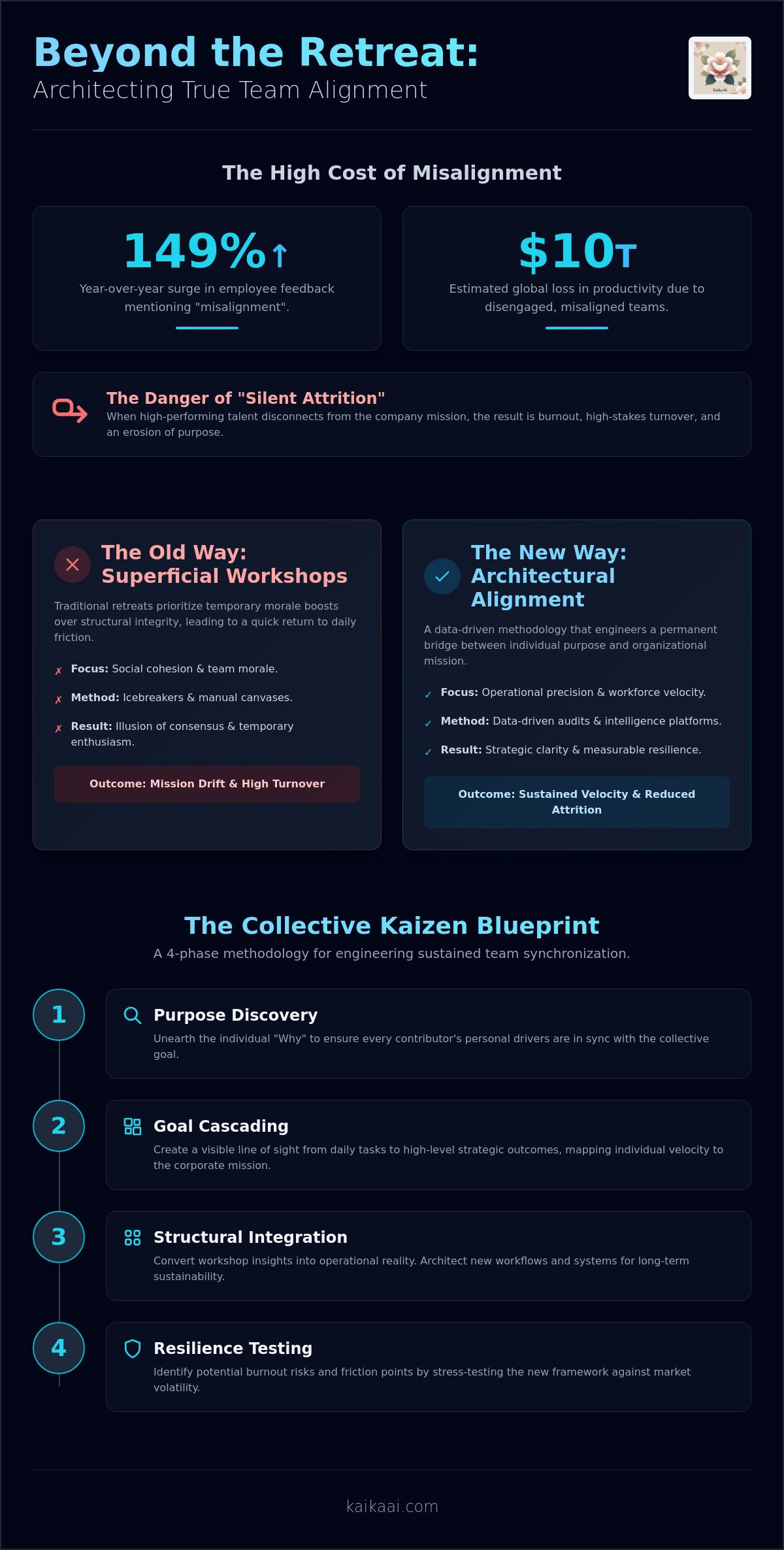
In 2026, mentions of "misalignment" in employee feedback surged by 149% year-over-year, signaling a systemic failure in how leadership bridges the gap between strategy and execution. You've likely experienced the frustration of a high-energy retreat that dissolves into vague consensus within forty-eight hours. It's a costly reality when engaged professionals pull in opposing directions, contributing to a global $10 trillion loss in productivity. You deserve a methodology that transforms temporary enthusiasm into permanent structural integrity.
This exploration moves beyond superficial teambuilding to provide advanced team alignment workshop ideas that architect a data-driven framework for mission-critical synchronization. You'll discover how to integrate individual purpose with organizational velocity through precise, measurable activities. We'll outline a structured path for strategic integration that reduces attrition and ensures your team's daily output directly fuels your company's core mission.
Key Takeaways
- Learn to identify the structural gaps between productivity metrics and actual mission synchronization through a rigorous Alignment Audit.
- Implement advanced team alignment workshop ideas such as Scenario-Based Resilience Sprints to test leadership cohesion against high-stakes market volatility.
- Transition from traditional brainstorming to Collective Kaizen Workshops that architect a permanent bridge between individual employee purpose and institutional goals.
- Utilize the Purpose-Velocity Matrix to visualize team efficiency and eliminate the silent attrition caused by superficial consensus.
- Secure sustained workforce velocity by integrating a Workforce Alignment Intelligence Platform to monitor and maintain synchronization long after the workshop concludes.
The Strategic Failure of Superficial Team Alignment Workshops
The traditional corporate retreat is a relic of an era that prioritized social cohesion over operational precision. While many leaders search for creative team alignment workshop ideas to boost morale, they often neglect the underlying mechanics of workforce velocity. True alignment isn't the mere absence of conflict or the presence of camaraderie; it's the architectural synchronization of individual output with institutional goals. Without this structural integrity, organizations suffer from "Silent Attrition." This occurs when high-performing talent experiences a disconnect between their daily labor and the company's ultimate mission. The result isn't just a drop in productivity, but a total erosion of purpose that leads to burnout and high-stakes turnover.
Effective Strategic alignment requires moving beyond the superficiality of icebreakers. It demands a shift from "social cohesion" to "architectural alignment," particularly for global divisions where geographic distance compounds the risk of mission drift. Traditional strategy sessions fail because they rely on emotional resonance rather than measurable operational resilience. They produce a temporary high that evaporates once the team returns to the friction of their daily workflows. To achieve lasting impact, the workshop must serve as a diagnostic and re-engineering event for the organization's core systems.
The Illusion of Consensus vs. Strategic Clarity
Consensus is often a mask for compromise. When executive leadership presents a vision, the front-line execution often interprets it through a lens of local priorities. This gap creates a dangerous "false alignment" where everyone agrees on the words but differs on the actions. "Nice-to-have" innovation goals frequently distract from mission-critical assets, diluting the team's focus and wasting finite resources. Real organizational harmony is forged in the furnace of high-stakes urgency, where every member understands exactly how their specific role contributes to the group's survival and success. Clarity isn't found in a shared document; it's found in shared movement toward a singular objective.
Why Manual Canvases Are No Longer Enough in 2026
By 2026, the complexity of the global enterprise has outpaced the utility of static tools like the "Team Canvas" or physical whiteboards. These manual methods capture a single moment in time, offering no visibility into the dynamic shifts of a hybrid workforce. Modern leadership requires real-time metrics to replace the subjective feedback typical of legacy workshops. Transitioning to a data-driven Kaizen mindset ensures that alignment isn't an annual event but a continuous process of evolution. By utilizing a Workforce Alignment Intelligence Platform, organizations can identify friction points before they manifest as operational failures. This shift allows leaders to implement team alignment workshop ideas that are grounded in actual performance data rather than anecdotal evidence.
Architecting the Collective Kaizen: Beyond Traditional Brainstorming
Collective Kaizen Workshops represent a departure from the chaotic energy of typical brainstorming sessions. While standard team alignment workshop ideas often focus on generating a high volume of ideas, the Collective Kaizen approach prioritizes a systematic blueprint for evolution. It's a disciplined methodology designed to synchronize workforce velocity with the institutional mission. This process moves through four distinct phases to ensure that alignment is not just a shared sentiment, but a functional reality. It begins with Purpose Discovery, where we unearth the 'Why' at the individual level to ensure every contributor's personal drivers are in sync with the collective goal. Following this, Goal Cascading maps individual velocity directly to the corporate mission, creating a visible line of sight from daily tasks to high-level strategic outcomes.
During the visual mapping stages of these workshops, utilizing professional-grade supplies from PoscART helps ensure that the "line of sight" being created is both vivid and impactful for all participants.
The third phase, Structural Integration, is where workshop insights are converted into operational reality. This is critical for effective strategy execution and long-term sustainability. Finally, Resilience Testing identifies potential burnout risks within the new alignment. By stress-testing the framework against market volatility, leadership can identify friction points before they compromise performance. This methodical progression ensures that the team doesn't just leave the room with a list of ideas, but with a reinforced architecture for growth.
Synchronizing Individual Purpose with Organizational Mission
Achieving deep synchronization requires measuring the precise correlation between individual purpose and performance metrics. We facilitate Purpose Mapping to create a narrative rhythm that connects personal growth to company success without falling into corporate clichés. This isn't about vague inspiration. It's about identifying the specific psychological drivers that fuel high-stakes performance. When an employee sees their own evolution mirrored in the organization's trajectory, workforce velocity increases naturally. This alignment reduces the "Silent Attrition" discussed previously, as purpose becomes the primary engine of retention and excellence.
The 3-Phase Strategic Integration Methodology
Success in these workshops depends on a rigorous integration methodology. We begin with Mindset Development, preparing leadership to embrace the structural changes required for true synchronization. This is followed by Architectural Consultation, where we design the specific alignment framework tailored to your global divisions. The final stage is Operational Execution, where we deploy the Workforce Alignment Intelligence Platform to provide real-time visibility into team dynamics. For organizations ready to move beyond superficial teambuilding, our Collective Kaizen Workshops offer the disciplined path to mission-critical synchronization.
Data-Driven Alignment Audit: Identifying Mission-Critical Gaps
Effective synchronization begins long before the first facilitator speaks. While many leadership teams search for creative team alignment workshop ideas, the most successful interventions rely on pre-workshop intelligence rather than anecdotal evidence. An Alignment Audit provides the empirical baseline necessary to identify hidden friction within the corporate architecture. By analyzing the delta between productivity metrics and engagement scores, leaders can uncover "false alignment." This is a dangerous state where teams are emotionally committed but operationally divergent. This data-driven approach allows for the identification of cross-departmental synergy gaps, ensuring the workshop addresses actual structural failures rather than perceived interpersonal conflicts.
Presenting this data to executive leadership transforms the workshop from a subjective cultural exercise into a mission-critical strategic necessity. In an era where managers are responsible for 70% of the variance in team engagement, according to May 2026 data from HR Cloud, objective clarity is paramount. High-tech enterprise environments require more than just a "vibe check"; they require a rigorous analysis of how information and authority flow through the system. Using AI to map these interactions before the session allows facilitators to move directly to the most impactful team alignment workshop ideas, bypassing the standard discovery phase that often consumes valuable hours without providing depth.
The Anatomy of an Alignment Audit
Measuring Workforce Velocity across disparate global divisions reveals the true speed of strategy execution. It uncovers Mission-Critical Gaps where goal cascading has stalled or fractured, often at the mid-management level. We analyze communication patterns and project outcomes to see where effort is being wasted on non-essential tasks. An Alignment Audit is a diagnostic tool for organizational integrity that validates the strength of the bridge between vision and reality. This structural verification ensures that the collective energy of the workforce is concentrated on the highest-value objectives.
Predictive Analytics for Burnout and Attrition
Misalignment is a primary driver of cognitive load and mental health risk in high-performance environments. When individual purpose is disconnected from company goals, the resulting friction creates a high probability of turnover. By utilizing predictive analytics, leadership can identify burnout risks before they manifest as actual attrition. These audit findings directly inform the design of Operational Resilience Training, allowing teams to adjust workloads in real-time during the workshop. This proactive stance on mental health and governance risk ensures that the organization remains both productive and resilient in the face of market volatility.
Advanced Team Alignment Workshop Ideas for Executive Leadership
Strategic realization demands a transition from theoretical planning to high-stakes simulation. While standard team alignment workshop ideas often focus on creative facilitation, executive leaders require a framework that tests the structural integrity of their divisions under pressure. This involves aligning the "Strategic Sage," the guardian of long-term wisdom, with the "Bold Innovator" who drives rapid evolution. By implementing these advanced exercises, leadership can bridge the gap between high-level vision and operational reality. This ensures that workforce velocity is not just maintained but accelerated through market volatility. These sessions serve as a Cross-Departmental Synergy Lab, breaking down silos through shared Kaizen goals and architectural synchronization.
Idea 1: The Workforce Velocity Sprint
Execution is where most visions fracture. The Workforce Velocity Sprint is a timed exercise designed to identify the fastest path to mission-critical outcomes. This exercise utilizes Lean Management principles to ruthlessly remove operational waste and redundant communication loops. Leaders are tasked with mapping current workflows against strategic priorities to find friction points. The primary deliverable is a 90-day synchronization roadmap, complete with clear KPIs that measure structural impact rather than just activity levels. This sprint forces a level of prioritization that traditional meetings often avoid, focusing entirely on the highest-leverage activities.
Idea 2: The Purpose-Mission Bridge
Idea 3: The Attrition Risk Simulation
Resilience isn't a passive state; it's an engineered outcome. The Attrition Risk Simulation uses patterns identified in the Alignment Audit to predict which segments of the workforce are at risk of resignation. Leadership teams develop "Collective Kaizen" solutions to address burnout patterns before they lead to top talent loss. By integrating AI-driven sentiment analysis into the workshop discussion, the team can address cultural stressors with surgical precision. This proactive approach ensures the organization remains stable during periods of high-stakes urgency. To begin architecting these frameworks for your leadership team, consider our Executive Consultation services.
Transitioning from Workshop Momentum to Sustained Workforce Velocity
The primary reason ninety percent of strategic initiatives fail isn't a lack of vision but a lack of persistence. Most team alignment workshop ideas focus exclusively on the event, creating a temporary peak in engagement that inevitably plateaus. Without a digital substrate to maintain these new behavioral patterns, the "Silent Attrition" and systemic misalignment discussed earlier will return. To achieve sustained workforce velocity, the insights generated during a retreat must be hard-coded into the organization's daily operating rhythm. This requires a shift from viewing alignment as a one-off event to treating it as a continuous architectural process. The executive's role is to serve as the guardian of this structural integrity, ensuring that the bridge between individual purpose and corporate mission remains stable under the pressure of global market shifts.
Institutional resilience isn't found in a static document; it's built through a data-driven feedback loop. By moving from subjective consensus to objective synchronization, leadership can monitor the health of their divisions in real-time. This transition ensures that the energy invested in the workshop translates into measurable operational outcomes. It's about moving beyond the "vibe" of a successful session and toward a disciplined framework for evolution.
Deploying the Workforce Alignment Intelligence Platform
Maintaining synchronization across global divisions requires more than manual oversight. Integrating the Workforce Alignment Intelligence Platform allows leadership to connect individual purpose to organizational goals on a daily basis. This system provides real-time performance dashboards that offer executive-level oversight into team dynamics. By identifying friction points and mission-critical gaps as they emerge, the platform enables proactive intervention. This is particularly vital for reducing attrition; by detecting burnout risk patterns before they lead to resignation, organizations can preserve their most valuable human capital assets. The platform serves as the technological foundation for the Kaizen mindset, ensuring that alignment is a living, breathing component of the corporate architecture.
The Path to Institutional Resilience
The future of People Operations lies at the intersection of high-tech enterprise terminology and organizational psychology. Building a high-performance culture that survives volatility requires a commitment to AI-driven organizational harmony. This approach ensures that every member of the workforce is not just busy, but moving with high velocity toward a shared objective. As hybrid work continues to be the standard for over 52% of remote-capable employees in 2026, the need for a digital alignment substrate has never been more urgent. True resilience is the ability to maintain synchronization regardless of physical distance or market disruption. To begin your journey toward mission-critical synchronization, request early access to the Kaika AI Workforce Alignment Platform.
Architecting the Future of Organizational Synchronization
The transition from a fractured workforce to a synchronized enterprise requires more than inspiration; it demands structural precision. You've explored how advanced team alignment workshop ideas move beyond the ephemeral high of a retreat to establish a permanent bridge between individual purpose and corporate mission. By utilizing a rigorous Alignment Audit and architecting a Collective Kaizen framework, leadership can transform "Silent Attrition" into measurable workforce velocity. This evolution ensures that your team's collective output remains resilient against global market volatility while maintaining the philosophical focus on human potential. Clarity is the engine of velocity.
Sustainable synchronization is achieved through our three-phase strategic integration methodology, providing a disciplined path from mindset development to operational execution. Our Workforce Alignment Intelligence Platform offers AI-powered burnout prediction to safeguard your talent while remaining strictly compliant with Japanese privacy standards. This digital substrate ensures the momentum generated in your workshop becomes a permanent feature of your organizational architecture. It's time to move beyond the limitations of legacy management and embrace a future of total alignment.
Request Early Access to the Kaika AI Workforce Alignment Platform
Your journey toward mission-critical synchronization begins with a single strategic choice. We look forward to partnering with you as you redefine the boundaries of organizational excellence.
Frequently Asked Questions
How do you measure the success of a team alignment workshop?
Success is measured by the delta in workforce velocity and the reduction of mission-critical gaps identified post-intervention. Rather than relying on subjective participant satisfaction, we analyze the synchronization of daily output with institutional goals. Key performance indicators include the speed of project completion, the clarity of goal cascading across divisions, and the measurable decrease in "silent attrition" patterns within the corporate architecture.
What is the difference between teambuilding and team alignment?
Teambuilding focuses on interpersonal rapport and social cohesion, whereas team alignment is an architectural synchronization of individual effort with corporate strategy. While teambuilding seeks to improve how employees feel about each other, alignment ensures they're moving with high velocity toward the same objective. It's the difference between a group of friends and a high-performance unit engineered for mission-critical precision.
How can AI help in aligning teams with company mission?
AI provides real-time visibility into organizational synchronization by analyzing communication patterns and productivity metrics to identify friction points. By utilizing a Workforce Alignment Intelligence Platform, leadership can detect "false alignment" where teams appear engaged but are operationally divergent. This technology enables proactive burnout prediction and ensures that team alignment workshop ideas are grounded in objective data rather than anecdotal evidence.
What are the most common mission-critical alignment gaps in large enterprises?
The most frequent gaps occur at the mid-management level, where executive vision often fails to translate into actionable front-line execution. This "goal cascading" failure creates silos that waste finite resources on non-essential innovation projects. Large enterprises also struggle with "silent attrition," where high-performing talent becomes disconnected from the company mission, leading to a systemic erosion of purpose and institutional resilience.
How often should an executive team run an alignment audit?
An Alignment Audit should be conducted bi-annually or during significant structural shifts such as mergers, acquisitions, or pivots in market strategy. Regular audits ensure that the organization's architectural integrity remains intact as global divisions scale. This frequency allows leadership to identify mission-critical gaps before they manifest as operational failures, maintaining a continuous state of synchronization and workforce velocity.
Can a workshop really prevent employee burnout and attrition?
A workshop alone is insufficient; it must serve as the catalyst for a data-driven framework that addresses the root causes of misalignment. By implementing advanced team alignment workshop ideas that connect individual purpose to organizational mission, leadership can reduce the cognitive load that leads to burnout. When employees understand their specific role in the collective objective, their resilience increases, significantly lowering the risk of attrition.
How do you align individual employee purpose with corporate goals?
Alignment is achieved through a narrative rhythm that mirrors personal growth within the organization's strategic trajectory. We use Purpose Mapping to identify the psychological drivers that fuel high-stakes performance and connect them to institutional milestones. This process ensures that individual mastery isn't just a personal achievement but a critical engine for organizational velocity, creating a self-sustaining cycle of excellence and meaning.
What is the 'Collective Kaizen' methodology for workshops?
The Collective Kaizen methodology is a systematic approach to evolution that prioritizes architectural synchronization over traditional brainstorming. It moves through four distinct phases: Purpose Discovery, Goal Cascading, Structural Integration, and Resilience Testing. This disciplined process converts workshop insights into operational reality, ensuring that every member of the workforce is engineered for continuous improvement and mission-critical synchronization.
Disclaimer
#Disclaimer
At Kaika AI, we believe the future belongs to organizations that combine human wisdom with artificial intelligence responsibly. The articles, research, insights, and thought leadership published on this website are intended to educate, inform, and encourage meaningful conversations about the future of work, organizational intelligence, AI, leadership, and innovation.
While our content is developed through rigorous research and may be generated, curated, or enhanced using artificial intelligence, every effort is made to ensure it reflects thoughtful analysis, practical relevance, and responsible AI practices. However, no representation or warranty is made regarding the completeness, accuracy, or suitability of the information for every individual or organizational circumstance.
The ideas, opinions, frameworks, and recommendations shared by Kaika AI are provided for educational and informational purposes only. They should not be interpreted as legal, financial, medical, psychological, human resources, cybersecurity, or other professional advice. Organizations and individuals should seek qualified professional guidance before making strategic, legal, or operational decisions.
Where articles reference third-party organizations, products, services, academic research, industry reports, or public data, such references are provided solely to support discussion and analysis. Unless explicitly stated, they do not imply endorsement, partnership, or affiliation.
Artificial intelligence is a powerful decision-support technology—not a replacement for human judgment. Kaika AI advocates for responsible, transparent, and human-centered AI adoption. We encourage readers to critically evaluate information, consider their unique context, and combine AI-generated insights with professional expertise and sound decision-making.
The content published on this website may be updated, revised, or removed as knowledge, technology, regulations, and best practices continue to evolve.
To the fullest extent permitted by applicable law, Kaika AI, its affiliates, contributors, and partners disclaim liability for any direct, indirect, incidental, consequential, or other losses arising from the use of, or reliance upon, the information provided on this website.
By accessing or using this website, you acknowledge that you have read, understood, and agree to this Disclaimer.
Kaika AI
'Building trusted organizational intelligence for the AI Era'


