What if the metrics currently driving your talent strategy are actually obscuring the human potential they're meant to measure? Most enterprise leaders recognize that surface-level reporting fails to capture the subtle, silent attrition that erodes organizational velocity. You likely understand the high stakes of balancing deep workforce intelligence with the absolute necessity of a secure employee analytics platform. It's a delicate equilibrium where performance must never come at the cost of trust or privacy.
You'll learn how to transition from reactive monitoring to a proactive, intelligence-driven framework that synchronizes individual purpose with your institutional mission. We'll examine the architectural requirements for predictive burnout alerts and the structural impact of aligning global divisions. This guide details how to implement high-stakes analytics that meet the most stringent Japanese and global privacy standards; ensuring your evolution is both disciplined and visionary. We'll explore the move from data collection to true workforce alignment, providing a roadmap for leadership that values both precision and human potential.
Key Takeaways
- Evolve beyond descriptive HR metrics toward a predictive intelligence framework that captures the structural integrity of your workforce.
- Establish a robust foundation for organizational resilience by deploying a secure employee analytics platform built to exceed global and Japanese data protection requirements.
- Shift focus from surface-level activity tracking to deep signal detection using the Ikigai Alignment Score to mitigate burnout before it triggers attrition.
- Execute a methodical transition through a three-phase integration process that begins with a strategic Alignment Audit to ensure mission-critical synchronization.
- Master the Sugihara Bridge Model to balance high-velocity AI insights with the nuanced human judgment necessary for sustainable executive leadership.
From Administrative Reporting to Enterprise-Grade HR Data Analytics
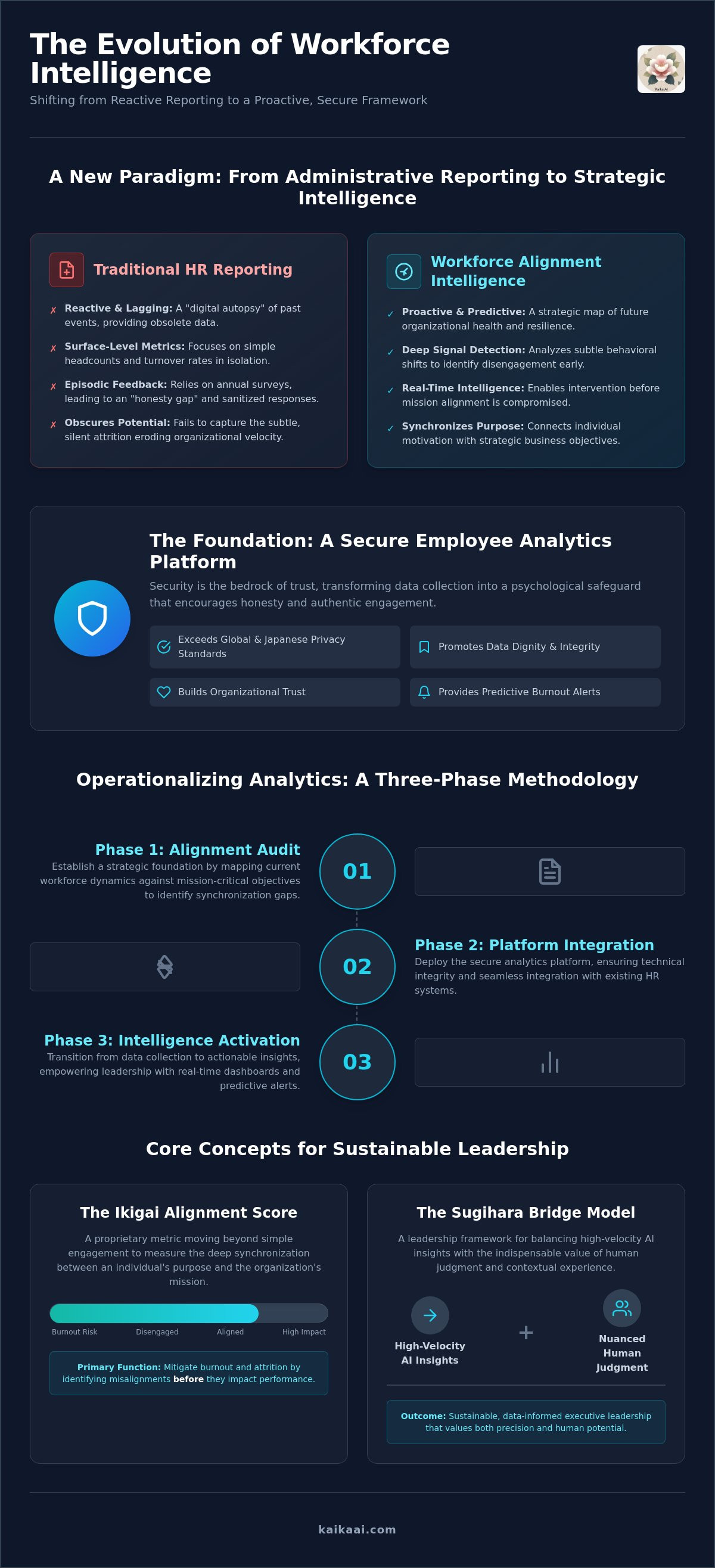
The evolution of human resources from a back-office administrative function to a strategic command center requires a departure from descriptive metrics. Traditional reporting often serves as a digital autopsy; it catalogs events that have already transpired without offering the foresight necessary for executive intervention. Modern leadership demands a shift toward predictive workforce intelligence. In this new paradigm, a secure employee analytics platform transforms raw data into a strategic map of future organizational health.
This transition centers on the maturation of People analytics as a core business discipline. Instead of measuring headcounts or turnover rates in isolation, sophisticated enterprises now prioritize the structural integrity of their human capital. They seek to understand the velocity of talent movement and the underlying drivers of resilience that sustain long-term growth. Precision requires more than data. It demands context.
To better understand how these systems operate in a modern environment, watch this overview of how AI-driven insights are reshaping the workplace:
The Limitations of Traditional People Operations
Annual engagement surveys represent a systemic failure in high-velocity environments. These tools provide lagging indicators that are frequently obsolete by the time leadership reviews the finalized reports. There's also a persistent honesty gap. Employees often provide sanitized responses due to a lack of psychological safety or a perceived lack of impact. True intelligence requires hearing the signal before the silence of a resignation letter. Real-time metrics allow managers to identify the subtle behavioral shifts that precede disengagement, enabling intervention while the mission alignment's still salvageable.
The Architecture of Workforce Alignment Intelligence
Establishing a new category of enterprise software, Workforce Alignment Intelligence serves as the connective tissue between individual purpose and organizational mission. These platforms don't merely track activity; they synchronize the unique motivations of a global workforce with the strategic objectives of the firm. In global enterprises, this synchronization's vital for cross-departmental synergy. By utilizing a secure employee analytics platform, leaders ensure that every division, from Tokyo to New York, operates with a shared sense of urgency and structural harmony. This architectural approach ensures that human potential isn't just managed but is strategically deployed for maximum resilience.
The Security Architecture of a Secure Employee Analytics Platform
Security architecture serves as the silent bedrock of organizational trust. While many enterprises view data protection as a technical checklist, a truly secure employee analytics platform functions as a psychological safeguard. It ensures that the transition from monitoring to intelligence-driven leadership doesn't compromise the mission-critical honesty of the workforce. When employees understand that their data's protected by clinical-grade standards, the honesty gap closes, allowing for a more authentic synchronization of purpose.
The complexity of global data sovereignty requires a sophisticated approach to encryption and localized compliance. Leaders often look to federal workforce data to benchmark macro-level trends, yet the micro-level security of internal systems determines operational resilience. Protecting sensitive human signals demands more than firewalls; it requires a systematic commitment to data dignity and structural integrity.
This commitment to localized compliance is equally critical in specialized sectors; for example, in the Australian real estate and legal industries, AML Partners provides the software and advisory services necessary to maintain institutional integrity against complex anti-money laundering requirements.
Similarly, for organizations managing a global or flexible talent pool in Europe, maintaining structural integrity involves navigating complex labor regulations; specialized resources like scaliify help businesses and freelancers proactively address the risks of false self-employment.
Technical Integrity and Data Privacy
Enterprise-grade HR data analytics must navigate a labyrinth of global regulations, including SOC2, GDPR, and specific Japanese privacy standards. These frameworks aren't merely obstacles; they're essential components of architectural integrity. Effective platforms utilize advanced anonymization protocols to ensure that individual privacy remains uncompromised while providing high-velocity insights. The Sugihara Bridge Model acts as a critical human-in-the-loop mechanism, ensuring that AI-driven data interpretation remains grounded in responsible, ethical judgment. For executives seeking this level of structural security, evaluating a Workforce Alignment Intelligence Platform is the first step toward resilient growth.
Clinical Ethics in Workforce Monitoring
The Employee Human Signal Index (EHSI) represents a shift toward clinical-grade burnout risk detection. Unlike standard algorithms, these indices are co-developed with clinical psychologists to mitigate AI bias and ensure psychological accuracy. This ethical oversight's why pilot programs utilizing this framework have achieved an 87% employee honesty rate. By prioritizing transparency, organizations foster a trust-first culture where data serves the employee as much as the enterprise. This alignment transforms monitoring into a tool for collective kaizen, ensuring that performance metrics never violate the human potential they're designed to support. Integration of a secure employee analytics platform requires this balance of technical precision and human-centric ethics to succeed at scale.
Strategic Metrics: Moving Beyond Productivity to Human Signal Detection
Standard productivity monitoring often rewards performative work. It prioritizes the quantity of digital activity over the quality of mission alignment; however, high-velocity enterprises require a more sophisticated lens to measure the true drivers of performance. By utilizing a secure employee analytics platform, leadership can shift focus from surface-level outputs to the underlying human signals that dictate long-term success. This evolution requires a transition from rudimentary activity tracking to the precise measurement of workforce velocity and internal synchronization.
Activity logs catalog the past, but signal detection predicts the future. When an organization focuses solely on time-on-task, it ignores the psychological friction that eventually leads to systemic stagnation. Strategic execution speed depends on more than just effort; it requires a workforce that's emotionally and intellectually aligned with the institutional mission. Intelligence-driven metrics provide the visibility needed to maintain this alignment across global divisions.
The Ikigai Intelligence Framework (IIF)
The Ikigai Intelligence Framework (IIF) serves as the architectural foundation for modern workforce alignment. It quantifies the intersection of individual passion, professional skill, and organizational need through the Ikigai Alignment Score (IAS). This metric provides a numerical value for the structural bond between an employee and the firm's mission. When this bond weakens, the IAS drops, signaling a misalignment that activity logs fail to capture. Leaders can then adjust roles or responsibilities to restore synchronization, ensuring that human potential remains focused on high-impact outcomes. Understanding these leading indicators of employee burnout is essential for maintaining a resilient talent architecture.
Predictive Attrition Intelligence
Traditional attrition metrics are lagging indicators. They measure the loss after the talent has already departed. Predictive intelligence utilizes the Human Signal Index (HSI) to detect subtle behavioral shifts months before a resignation occurs. These signals might include changes in communication frequency, a drop in collaborative velocity, or a gradual decoupling from mission-critical objectives. Detecting these patterns through a secure employee analytics platform allows for proactive alignment adjustments rather than reactive retention attempts. Organizations maintaining high alignment scores often report a Net Promoter Score (NPS) of 72 or higher, reflecting a sustainable, high-performance culture. This systematic approach ensures that workforce velocity remains high, accelerating the speed of strategic execution across the entire enterprise.
Operationalizing Analytics: The Three-Phase Integration Methodology
Implementing a workforce intelligence framework isn't a singular event. It's a phased evolution. To achieve a synchronized workforce, enterprises must move beyond simple software installation toward a methodical integration that aligns technical capabilities with leadership philosophy. This process ensures the secure employee analytics platform becomes a strategic asset rather than a siloed repository. By following a structured roadmap, organizations can bridge the gap between abstract data and measurable structural impact.
This integration methodology prioritizes the reconciliation of organizational structure with human motivation. It's a journey from diagnostic clarity to operational resilience. High-stakes decisions require a foundation of technical precision and executive readiness. Without this balance, even the most sophisticated analytics will fail to drive the necessary behavioral shifts across the enterprise.
The Strategic Alignment Audit
The process begins with a rigorous identification of mission alignment gaps across specialized divisions. This phase exposes where local priorities have diverged from the central institutional mission, often revealing the root causes of silent attrition. By establishing baseline measurements for both productivity and engagement, leaders gain a clear view of the starting point for their transformation. The Alignment Audit serves as a diagnostic tool for organizational health, identifying the structural fractures that impede mission-critical synchronization.
Architectural Consultation and Mindset Development
Phase two focuses on architectural consultation and the critical development of a leadership mindset. It's here that the secure employee analytics platform is configured to meet the specific data sovereignty needs of the firm. Leadership teams must learn to interpret human signals not as disciplinary triggers, but as strategic indicators for organizational adjustment. This phase bridges the gap between raw data and executive action, ensuring that managers are equipped to act on insights with both speed and sophistication.
Collective Kaizen and Continuous Improvement
The final phase centers on continuous improvement through data-driven Kaizen. Integrating analytics into existing HCM and payroll systems creates a unified data view, allowing for a comprehensive understanding of workforce dynamics. Real-time dashboards provide the visibility necessary for quantifying team synergy across diverse global teams. Collective Kaizen Workshops then translate these digital signals into operational shifts, rewarding transparency and mission-alignment. To begin identifying your organization's current synchronization gaps, you can request a Strategic Alignment Audit to establish your baseline for resilient growth.
The Kaika AI Advantage: Synchronizing Purpose through Intelligence
Most enterprise tools prioritize the "what" of employee activity while ignoring the "why" of human motivation. Kaika AI bridges this gap by transforming cold data into human truth, providing a secure employee analytics platform that honors the complexity of the modern professional. By rooting its architecture in the Ikigai philosophy, the platform moves beyond surveillance to achieve true synchronization. This approach ensures that every individual's sense of purpose remains harmonized with the firm's strategic velocity.
The roadmap toward 2032 demands a new standard of category leadership. It requires a system that doesn't just monitor output but actively builds organizational resilience. Kaika AI serves as a visionary partner for firms ready to evolve their talent architecture into a disciplined, mission-aligned engine for global growth.
The Sugihara Bridge Model
The Sugihara Bridge Model represents the cornerstone of the Kaika AI philosophy. It utilizes a hybrid architecture that pairs high-velocity AI measurement with the nuanced judgment of trained human consultants. This "human-in-the-loop" approach recognizes that sensitive workforce signals require sophisticated interpretation that algorithms alone cannot provide. By involving clinical psychologists in the development of signal indices, the model mitigates the risks of "black box" AI bias. This commitment to ethical precision is why pilot programs have achieved an 87% employee honesty rate. When professionals trust the system, the data becomes an authentic reflection of the organization's structural health.
Building Future-Proof Organizations
Operational resilience training and executive consultation are not mere add-ons; they're essential components of a sustainable enterprise strategy. These services ensure that the insights generated by a secure employee analytics platform translate into measurable behavioral shifts. Through Collective Kaizen Workshops, leadership teams can align teams with company mission objectives in real-time. This structured methodology fosters a culture of transparency where data informs evolution rather than just observation.
For CHROs and executive leaders seeking to lead this transformation, the transition to intelligence-driven alignment is the ultimate competitive advantage. It's time to move past the limitations of legacy HRIS systems and embrace a framework designed for the complexities of global scale. We invite visionary leaders to request early access to the Workforce Alignment Intelligence Platform and begin the process of mission-critical synchronization today.
Architectural Harmony for the Resilient Enterprise
The transition from descriptive HR metrics to a predictive, intelligence-driven framework isn't just an upgrade; it's a structural evolution for the global enterprise. By moving beyond surface-level activity tracking toward the measurement of human signals and Ikigai alignment, leaders finally synchronize individual purpose with the institutional mission. This evolution requires a secure employee analytics platform that prioritizes data dignity and clinical ethics as much as it does strategic velocity. You've seen how a phased integration methodology can turn abstract data into operational resilience.
Our framework, supported by strategic partnerships with Waseda University and the Tokyo Innovation Base, demonstrates that precision and humanity aren't mutually exclusive. Pilot programs show an 87% employee honesty rate and an NPS of 72 among enterprise participants, confirming that transparency fosters deep organizational trust. The Sugihara Bridge Model ensures that your high-stakes decisions remain grounded in expert judgment rather than unverified algorithms. It's time to replace administrative friction with architectural harmony.
Request Early Access to the Kaika AI Workforce Alignment Platform and lead your organization toward mission-critical synchronization.
Frequently Asked Questions
How does enterprise-grade HR data analytics differ from standard employee monitoring?
Enterprise-grade analytics focuses on organizational health and mission alignment rather than individual surveillance. While standard monitoring often tracks keystrokes or screen time, a secure employee analytics platform measures structural integrity and workforce velocity to inform high-stakes executive decisions. This strategic approach prioritizes long-term resilience over short-term activity tracking.
Is it possible to predict employee burnout without violating individual privacy?
Yes, prediction is achieved through the analysis of anonymized behavioral signals rather than invasive personal surveillance. By identifying patterns of digital fatigue and decoupling at the divisional level, leadership can intervene before exhaustion manifests as resignation. This methodology maintains strict data dignity while providing the visibility necessary for proactive wellness management.
What is the Ikigai Intelligence Framework and how does it apply to corporate strategy?
The Ikigai Intelligence Framework is a strategic methodology that quantifies the intersection of individual passion, professional skill, and organizational mission. It applies to corporate strategy by providing the Ikigai Alignment Score, a measurable indicator of human capital synchronization. This allows firms to ensure their talent architecture is perfectly tuned to achieve institutional objectives.
How does Kaika AI ensure data security for large Japanese corporations?
We maintain rigorous compliance with Japanese privacy standards and global data protection regulations through a secure employee analytics platform featuring enterprise-grade encryption. This architecture ensures data sovereignty while respecting the cultural nuances of privacy inherent in Japanese corporate environments. Our technical safeguards are designed to meet the most stringent institutional reliability requirements.
What are the leading indicators of silent attrition that AI can detect?
AI identifies subtle shifts in collaboration velocity, communication frequency, and mission-critical engagement patterns that precede formal resignations. These indicators often surface months before an employee departs. Detecting these signals early allows leadership to perform a strategic adjustment in role alignment, preserving institutional knowledge and maintaining operational momentum.
How long does it take to see measurable results from a workforce alignment platform?
Initial baseline measurements are established during the first 30 days of the Alignment Audit phase. Significant structural insights and predictive alerts typically emerge within the first full quarter of operation. This timeline allows the system to identify recurring behavioral trends and begin synchronizing divisional goals with the central corporate mission.
Can this platform integrate with our existing Workday or Oracle HCM systems?
The platform is designed for seamless integration with major HCM and payroll systems including Workday and Oracle. This connectivity creates a unified data view, allowing executive leadership to see the direct correlation between workforce alignment and operational performance. Integration ensures that your existing technical investments are enhanced by deeper intelligence capabilities.
What is the role of a clinical psychologist in an AI-driven HR platform?
Clinical psychologists co-develop our burnout and signal indices to ensure psychological accuracy and mitigate potential AI bias. Within the Sugihara Bridge Model, they provide the essential human-in-the-loop oversight required to interpret sensitive workforce signals. This partnership ensures that data interpretation remains grounded in professional expertise and ethical sophistication.
Disclaimer
#Disclaimer
At Kaika AI, we believe the future belongs to organizations that combine human wisdom with artificial intelligence responsibly. The articles, research, insights, and thought leadership published on this website are intended to educate, inform, and encourage meaningful conversations about the future of work, organizational intelligence, AI, leadership, and innovation.
While our content is developed through rigorous research and may be generated, curated, or enhanced using artificial intelligence, every effort is made to ensure it reflects thoughtful analysis, practical relevance, and responsible AI practices. However, no representation or warranty is made regarding the completeness, accuracy, or suitability of the information for every individual or organizational circumstance.
The ideas, opinions, frameworks, and recommendations shared by Kaika AI are provided for educational and informational purposes only. They should not be interpreted as legal, financial, medical, psychological, human resources, cybersecurity, or other professional advice. Organizations and individuals should seek qualified professional guidance before making strategic, legal, or operational decisions.
Where articles reference third-party organizations, products, services, academic research, industry reports, or public data, such references are provided solely to support discussion and analysis. Unless explicitly stated, they do not imply endorsement, partnership, or affiliation.
Artificial intelligence is a powerful decision-support technology—not a replacement for human judgment. Kaika AI advocates for responsible, transparent, and human-centered AI adoption. We encourage readers to critically evaluate information, consider their unique context, and combine AI-generated insights with professional expertise and sound decision-making.
The content published on this website may be updated, revised, or removed as knowledge, technology, regulations, and best practices continue to evolve.
To the fullest extent permitted by applicable law, Kaika AI, its affiliates, contributors, and partners disclaim liability for any direct, indirect, incidental, consequential, or other losses arising from the use of, or reliance upon, the information provided on this website.
By accessing or using this website, you acknowledge that you have read, understood, and agree to this Disclaimer.
Kaika AI
'Building trusted organizational intelligence for the AI Era'


