
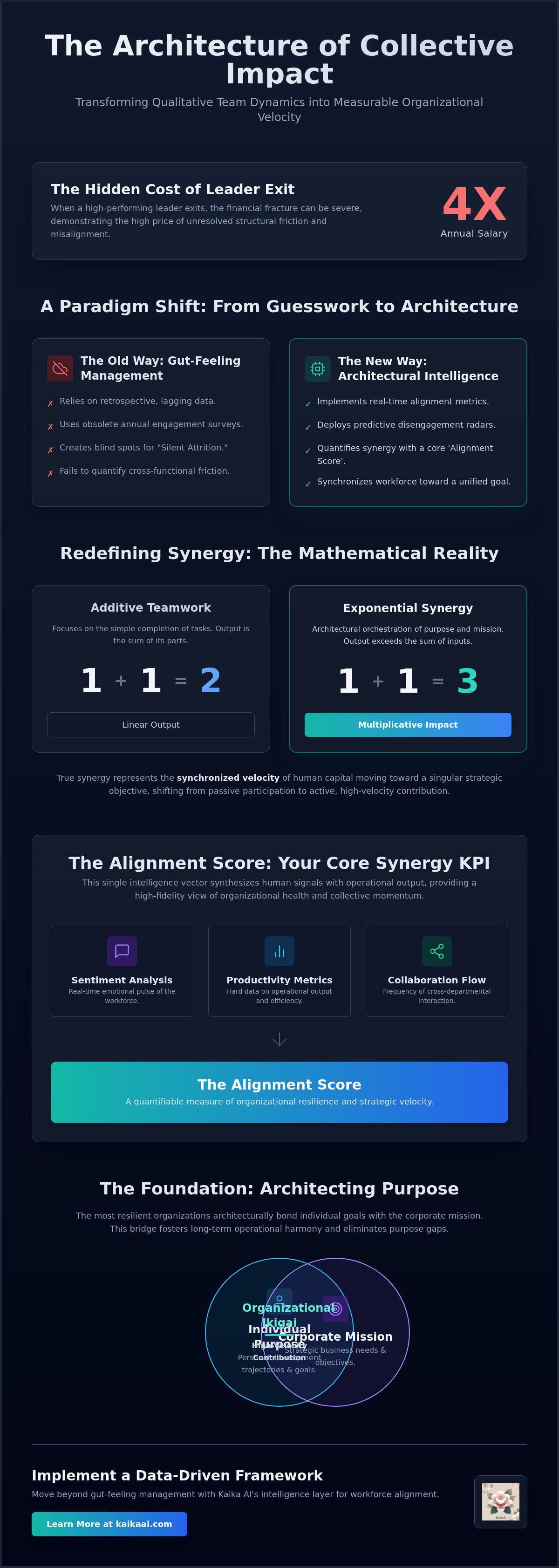
When a high-performing leader exits your organization, the financial impact isn't merely a line item; it's a structural fracture that can cost up to four times their annual salary. You recognize that while technical assets are tracked with surgical precision, the human element remains an opaque variable. Most executives struggle with the invisible friction of cross-functional silos, yet they lack the tools for quantifying team synergy in a way that correlates human purpose with bottom-line results.
It's time to move beyond gut-feeling management and embrace a disciplined, architectural approach to collective performance. This guide provides the framework required to transform qualitative team dynamics into measurable organizational velocity. We'll examine the implementation of real-time alignment metrics, the integration of Organizational Ikigai within your leadership structure, and the strategic deployment of predictive disengagement radars. By the end of this analysis, you'll possess a systematic roadmap to reduce burnout-related attrition and synchronize your entire workforce toward a unified strategic goal.
Key Takeaways
- Redefine synergy as the synchronized velocity of human capital moving toward a singular strategic objective rather than mere additive teamwork.
- Identify the 'Alignment Score' as a primary KPI for quantifying team synergy by integrating real-time sentiment analysis with hard productivity metrics.
- Distinguish between active collaboration and strategic alignment to eliminate social loafing and structural friction within cross-functional teams.
- Establish a measurable performance baseline through a comprehensive Alignment Audit before deploying AI-powered workforce intelligence frameworks.
- Bridge the gap between individual purpose and corporate mission to foster long-term operational resilience and organizational harmony.
The Architecture of Collective Impact: Defining Synergy in 2026
Synergy isn't a vague corporate ideal or a happy byproduct of talent density. It represents the synchronized velocity of human capital moving toward a singular strategic objective. While additive teamwork focuses on the simple completion of tasks, exponential synergy demands a structural orchestration of individual purpose and corporate mission. The Architecture of Collective Impact suggests that the total effect of a system is greater than the sum of its individual parts; however, achieving this requires more than simple cooperation. True workforce alignment acts as the primary driver, shifting the focus from passive participation to active, high-velocity contribution.
Traditional HR engagement models rely on retrospective data, often measuring sentiment long after the damage is done. Modern workforce intelligence prioritizes real-time visibility into the structural integrity of your teams. Quantifying team synergy allows leaders to identify where friction exists before it manifests as operational failure. It moves the needle from gut-feeling management to a precise, data-driven framework where every human signal is accounted for.
The Mathematical Reality of 1+1=3
In a high-functioning enterprise context, the conceptual formula for synergy is multiplicative. When individual roles are architecturally aligned with the broader mission, the output exceeds the input. Conversely, structural gaps in mission cascading lead to negative synergy, where 1+1 equals 1.5. This erosion of value occurs when departments operate in isolation or when strategic objectives aren't clearly translated into operational tasks. Synergy is a structural output of alignment intelligence.
Why Qualitative Metrics Fail Modern Leadership
Annual engagement surveys are increasingly obsolete for tracking real-time synergy. They capture a static snapshot of a dynamic environment, failing to account for the rapid shifts in organizational pulse. This lag creates a blind spot for Silent Attrition, where top performers become misaligned with their purpose and begin to disengage long before they resign. By the time a survey reflects a problem, the talent has already checked out. Quantifying team synergy serves as a critical lead indicator of operational resilience, providing the foresight needed to adjust strategy before momentum is lost.
The Variables of Synchronization: How to Quantify Internal Synergy
Quantifying team synergy requires a departure from traditional, anecdotal assessments of workplace harmony. To achieve true workforce alignment intelligence, executives must implement a rigorous measurement system that synthesizes qualitative human signals with quantitative operational output. The Alignment Score serves as the primary KPI for this endeavor, functioning as a single intelligence vector that reflects the health of your organizational architecture. By aggregating data across disparate silos, this metric provides a high-fidelity view of how effectively individual efforts are being converted into collective momentum.
This methodology moves beyond academic theory into a practical, data-driven Kaizen framework that evaluates how effectively teams convert collective effort into organizational outcomes. It involves the integration of real-time productivity metrics with sophisticated sentiment analysis to identify where structural friction is eroding value. A critical component of this calculation is the weighting of cross-departmental collaboration frequency. When departments operate in isolation, workforce velocity stagnates. By tracking the flow of information and resources between divisions, leaders can measure synergy as a dynamic force that accelerates over time rather than a static state of being.
Purpose Alignment: The Foundation Variable
The most resilient organizations ensure that individual employee goals are architecturally bonded to the corporate mission. When this correlation is weak, even the most talented teams experience a loss of velocity. AI-powered platforms now allow executives to identify purpose gaps across global divisions by analyzing the alignment between personal development trajectories and strategic business needs. This level of precision is essential for long-term retention. Establishing this baseline requires more than a simple checklist; it necessitates a comprehensive Alignment Audit to identify the precise structural vulnerabilities within your leadership hierarchy.
Real-Time Productivity and Burnout Correlation
High velocity is unsustainable if it's fueled by employee depletion. Burnout risk acts as a significant detractor from collective synergy, creating a drag on the entire system that eventually leads to talent attrition. Synchronized teams maintain high performance by balancing intense output with structural support, ensuring that workforce sustainability remains a core priority. Advanced intelligence systems detect subtle shifts in communication frequency and task completion rates to identify burnout patterns before they manifest as turnover. By monitoring these correlations in real time, leadership can intervene with precision, preserving the integrity of the team's synchronization while maintaining a competitive pace.
Synergy vs. Teamwork: Identifying the Structural Differentiators
Executives often conflate teamwork with synergy, yet the two represent fundamentally different levels of organizational maturity. Teamwork is an operational activity characterized by active collaboration, where individuals coordinate efforts to complete discrete tasks. Synergy, conversely, is the structural result of strategic alignment. It's the state where the collective output isn't just coordinated but exponentially amplified by a shared trajectory. Without the precision of quantifying team synergy, leadership risks mistaking high activity for high impact. This distinction is critical because teams can be highly collaborative while remaining profoundly misaligned with the enterprise’s core mission.
When synergy metrics are absent, organizations frequently encounter the phenomenon of social loafing. In these environments, individual accountability dissolves into the collective, leading to a hidden erosion of workforce velocity. Busy-work becomes a masquerade for progress. Many leaders attempt to solve this through increased meeting frequency, operating under the misconception that more face-time equals more synchronization. In reality, an over-reliance on meetings often signals a failure in the underlying architecture. High-alignment organizations require fewer synchronous touchpoints because the strategic intent is already embedded in the operational workflow. Utilizing an Alignment Audit allows leadership to strip away the noise of superficial teamwork and reveal the true state of collective synchronization.
The Trap of Siloed Collaboration
High-performing departments can paradoxically create organizational friction if their internal success isn't calibrated against the broader ecosystem. A sales team with record-breaking velocity might overwhelm a supply chain that isn't synchronized to the same rhythm. Breaking down these silos requires cross-departmental alignment tools that track Sync-Efficiency. This metric is especially vital for remote and hybrid teams, where spontaneous alignment is rare. Measuring how effectively information flows across departmental boundaries ensures that localized excellence contributes to, rather than detracts from, the total organizational velocity.
Mindset Development for Executive Leadership
Transitioning from a command and control model to one of alignment and autonomy requires a profound shift in leadership mindset. It demands a commitment to data-driven Kaizen, where continuous improvement is fueled by objective workforce intelligence rather than executive intuition. This evolution isn't always intuitive. Professional Executive Consultation serves as a bridge, helping leaders translate high-level strategy into a measurable framework that empowers autonomous teams. To further develop these leadership capabilities, visit Intact Academy for specialized training in the art and science of executive coaching and team coaching. By architecting a system where individual purpose is synchronized with corporate goals, leaders can step back from micromanagement and focus on sustaining long-term operational resilience.
Implementing a Data-Driven Kaizen Framework for Team Velocity
Establishing a systematic approach to collective output requires moving beyond static goal-setting. It demands a framework that treats organizational alignment as a living system. To achieve this, leadership must implement a methodical, phase-based strategy that replaces intuition with architectural precision. This process begins by establishing a baseline and evolves into a continuous loop of predictive optimization. By quantifying team synergy through this lens, you ensure that every unit of human effort is architecturally bonded to your strategic intent.
- Step 1: Conduct a comprehensive Alignment Audit. Before deploying technology, you must establish a performance baseline. This audit identifies the current structural fractures and silos that impede cross-functional velocity.
- Step 2: Deploy AI-powered workforce intelligence. Real-time synchronization tracking allows for the immediate identification of friction points. It moves the organization from retrospective analysis to active, live-streamed visibility.
- Step 3: Identify and remediate mission-critical alignment gaps. Precision is non-negotiable. Once gaps are visible, leadership must act with surgical speed to realign individual purpose with departmental goals.
- Step 4: Institutionalize Collective Kaizen Workshops. Continuous improvement isn't a solo endeavor. These workshops foster a culture where every team member is invested in the collective synchronization of the unit.
- Step 5: Scale the framework globally. Effective mission cascading requires that specialized divisions, regardless of geography, operate on the same intelligence layer to maintain global velocity.
The Three-Phase Strategic Integration
Successful implementation follows a logical, architectural progression. Phase 1 centers on architectural consultation to define the core organizational pillars that will guide all future efforts. Phase 2 involves the deployment of the Workforce Alignment Intelligence Platform for real-time data processing across all divisions. Finally, Phase 3 focuses on ongoing optimization through workforce analytics, ensuring the system remains resilient as market conditions shift.
Operational Resilience through Continuous Feedback
Predictive capabilities are the hallmark of a mature alignment strategy. Most traditional models fail because they lack the foresight to anticipate decay. By utilizing Early Warning Systems, executives can detect subtle shifts in team synergy before they result in project delays or attrition. This proactive stance is supported by psychological stamina training, which prepares teams to maintain high velocity during periods of intense strategic pressure. Linking these workforce sustainability metrics to long-term enterprise growth ensures that your organization's velocity is both explosive and enduring. It's about building a system that doesn't just perform, but evolves.
Kaika AI: The Intelligence Layer for Workforce Alignment
Kaika AI serves as the definitive engine for quantifying team synergy. It bridges the gap between abstract human potential and concrete enterprise performance. While previous methodologies relied on static observations, this platform provides a live intelligence layer that translates human signals into actionable strategy. Built specifically for the complexities of the Japanese enterprise market, the platform utilizes a bilingual architecture grounded in the cultural philosophy of Ikigai. This ensures that the synchronization of your workforce isn't just a technical achievement but a fundamental alignment of purpose and mission.
Security and institutional reliability form the foundation of the platform's architecture. Kaika AI is SOC2 compliant and adheres to the most rigorous Japanese data protection standards, ensuring that sensitive workforce sentiment data remains secure. This enterprise-grade confidence allows leadership to deploy the Workforce Alignment Intelligence Platform across global divisions without compromising privacy. By monitoring the real-time "alignment score" of every employee, the system identifies the subtle precursors to disengagement. This predictive capability is vital for mitigating the financial impact of talent loss, as the cost for an organization when a valued employee leaves is estimated to be three to four times that employee's annual salary.
Beyond Analytics: Executing Data-Driven Kaizen
The platform moves beyond passive reporting to facilitate active, data-driven Kaizen. Through a sophisticated executive dashboard, leadership gains immediate visibility into the structural health of the organization. This isn't a collection of vanity metrics; it's a high-fidelity map of organizational velocity. The dashboard highlights specific purpose gaps and burnout risks, allowing for surgical remediation before performance degrades. In complex enterprises where cross-departmental friction is common, these insights enable leaders to dismantle silos and foster a culture of continuous, synchronized improvement. It transforms the way decisions are made, replacing intuition with a persistent stream of workforce intelligence.
Request Early Access to the Future of Work
Forward-thinking leaders recognize that the era of gut-feeling management has ended. The integration of AI as a strategic partner allows for a level of precision that was previously impossible. By joining the Kaika AI ecosystem, you position your organization at the forefront of the 2026 HR market, which reached a value of $2.6 billion in Japan alone by 2025. Early implementation of this workforce alignment framework provides a significant competitive advantage, ensuring your teams remain resilient, synchronized, and focused on excellence. Request early access to Kaika AI and begin quantifying your team synergy today.
Architecting the Future of High-Velocity Performance
The evolution of enterprise leadership requires a fundamental shift from managing tasks to architecting alignment. You've seen how the distinction between simple collaboration and true strategic synchronization determines the ultimate velocity of your global divisions. By quantifying team synergy, you replace the ambiguity of cultural intuition with the structural integrity of real-time intelligence. This transition ensures that individual purpose remains bonded to your corporate mission, effectively preventing the silent attrition that erodes organizational value.
Implementing this level of precision demands a disciplined, systematic approach. Our three-phase strategic integration methodology provides the necessary roadmap, while AI-powered burnout prediction offers the foresight required to sustain high performance without sacrificing human potential. With full compliance with Japanese privacy standards, you can deploy these capabilities with absolute institutional confidence. The opportunity to synchronize your workforce into a singular, high-velocity unit is ready for your leadership.
Request early access to the Kaika AI workforce alignment platform and begin your journey toward organizational harmony today. Your strategic vision deserves a framework that matches its ambition.
Frequently Asked Questions
Is it truly possible to quantify team synergy using AI?
Yes, AI achieves this by synthesizing disparate human signals and operational data into a unified intelligence vector. By analyzing communication patterns and task velocity, the platform creates a real-time Alignment Score that replaces subjective intuition with structural precision. This methodology transforms qualitative team dynamics into a measurable asset that leadership can track with the same rigor as financial capital.
How does internal synergy tracking differ from traditional HR analytics?
Traditional HR analytics focus on retrospective metrics like past turnover and static engagement scores. Synergy tracking utilizes real-time workforce alignment intelligence to identify current friction points and predict future performance shifts before they impact the bottom line. It moves the organization from reactive damage control to a proactive stance of continuous, data-driven optimization.
Can quantifying synergy help in predicting employee burnout?
Quantifying team synergy provides a lead indicator for burnout by detecting subtle decays in synchronization and communication frequency. Advanced intelligence systems identify these purpose gaps early, allowing leadership to intervene before the structural integrity of the team is compromised. This predictive capability is essential for maintaining high velocity without sacrificing the long-term sustainability of your workforce.
What are the key metrics for measuring workforce alignment?
The primary metrics include the Alignment Score, which aggregates sentiment and output; Sync-Efficiency, which measures the fluidity of cross-departmental collaboration; and Workforce Velocity, which tracks the speed of collective movement toward strategic goals. These metrics provide a high-fidelity view of organizational health, allowing executives to identify exactly where mission-critical alignment gaps exist.
How does Kaika AI ensure data privacy while tracking synergy?
Kaika AI utilizes enterprise-grade data protection aligned with Japanese privacy standards and maintains SOC2 compliance. The architecture ensures that human signal intelligence is processed securely, protecting sensitive organizational data while providing the transparency necessary for executive decision-making. This commitment to institutional reliability allows for organization-wide deployments without compromising individual privacy.
What is the ROI of improving cross-departmental alignment?
The ROI is realized through a significant reduction in attrition costs, which can reach four times an employee's annual salary, and the elimination of invisible silos that prevent cross-functional velocity. Improved alignment accelerates organizational movement, ensuring that strategic initiatives are executed with maximum efficiency and minimal resource waste. It's a direct investment in the structural resilience of the enterprise.
How long does it take to see results from a synergy quantification framework?
An initial Alignment Audit provides an immediate performance baseline that highlights existing structural fractures. While the full three-phase strategic integration methodology unfolds systematically, leaders typically observe enhanced visibility and reduced friction within the first 90 days of platform deployment. The progression is cumulative, with synchronization deepening as the framework is institutionalized across divisions.
Can this framework be applied to remote and global teams?
The framework is specifically architected for global mission cascading across remote and hybrid environments. It utilizes a bilingual architecture to synchronize disparate divisions, ensuring that every team member remains aligned with the central strategic objective regardless of geographical location. This ensures that the collective intelligence of the organization remains unified even as the physical workforce remains distributed.
Disclaimer
#Disclaimer
At Kaika AI, we believe the future belongs to organizations that combine human wisdom with artificial intelligence responsibly. The articles, research, insights, and thought leadership published on this website are intended to educate, inform, and encourage meaningful conversations about the future of work, organizational intelligence, AI, leadership, and innovation.
While our content is developed through rigorous research and may be generated, curated, or enhanced using artificial intelligence, every effort is made to ensure it reflects thoughtful analysis, practical relevance, and responsible AI practices. However, no representation or warranty is made regarding the completeness, accuracy, or suitability of the information for every individual or organizational circumstance.
The ideas, opinions, frameworks, and recommendations shared by Kaika AI are provided for educational and informational purposes only. They should not be interpreted as legal, financial, medical, psychological, human resources, cybersecurity, or other professional advice. Organizations and individuals should seek qualified professional guidance before making strategic, legal, or operational decisions.
Where articles reference third-party organizations, products, services, academic research, industry reports, or public data, such references are provided solely to support discussion and analysis. Unless explicitly stated, they do not imply endorsement, partnership, or affiliation.
Artificial intelligence is a powerful decision-support technology—not a replacement for human judgment. Kaika AI advocates for responsible, transparent, and human-centered AI adoption. We encourage readers to critically evaluate information, consider their unique context, and combine AI-generated insights with professional expertise and sound decision-making.
The content published on this website may be updated, revised, or removed as knowledge, technology, regulations, and best practices continue to evolve.
To the fullest extent permitted by applicable law, Kaika AI, its affiliates, contributors, and partners disclaim liability for any direct, indirect, incidental, consequential, or other losses arising from the use of, or reliance upon, the information provided on this website.
By accessing or using this website, you acknowledge that you have read, understood, and agree to this Disclaimer.
Kaika AI
'Building trusted organizational intelligence for the AI Era'


