
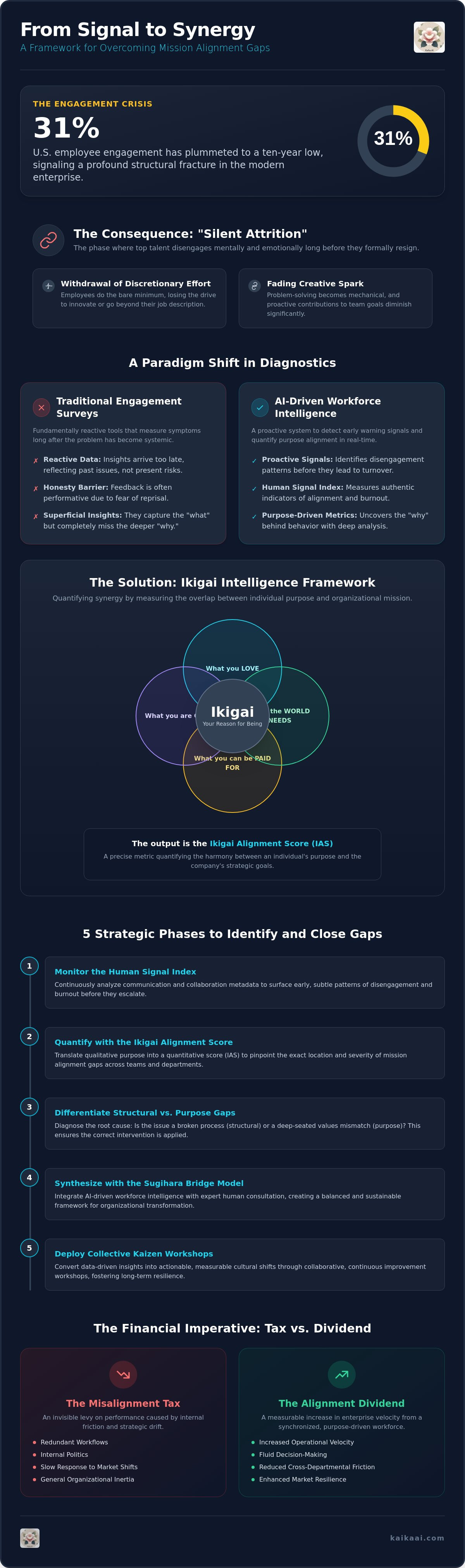
In 2025, U.S. employee engagement plummeted to a ten-year low of just 31%. This data point represents more than a cultural shift; it is a profound structural fracture in the architecture of the modern enterprise. You likely feel the mounting pressure of silent attrition and the friction of disconnected departmental silos. These are the symptoms of a deeper systemic failure. Identifying mission alignment gaps has become the primary challenge for leaders who recognize that traditional engagement surveys offer nothing more than a lagging indicator of a crisis already in motion.
We provide a more precise path forward through the integration of AI-driven workforce intelligence and the philosophy of Ikigai. You will learn how to transform abstract human potential into a measurable alignment score, providing the clarity needed to bridge the disconnect between organizational intent and individual purpose. This guide previews a framework for detecting early warning signals of disengagement, ensuring your leadership remains proactive, strategic, and uncompromisingly focused on collective excellence.
Key Takeaways
- Recognize the subtle indicators of "Silent Attrition" by monitoring the Human Signal Index to surface disengagement patterns before they manifest as turnover.
- Implement a data-driven methodology for identifying mission alignment gaps using the Ikigai Alignment Score to quantify the synergy between enterprise goals and employee purpose.
- Differentiate between structural process failures and deep-seated purpose gaps to ensure leadership applies the correct strategic interventions rather than superficial fixes.
- Utilize the Sugihara Bridge Model to synthesize AI workforce intelligence with human consultation, creating a balanced framework for sustainable organizational transformation.
- Deploy Collective Kaizen Workshops to convert intelligence insights into measurable cultural shifts, fostering long-term operational resilience and workforce harmony.
The High Stakes of Misalignment: Hearing the Signal Before the Silence
Mission alignment gaps represent a profound structural disconnect between the high-level trajectory of corporate strategy and the internal resonance of individual employee purpose. When these two vectors diverge, the organization loses its cohesive force. Achieving true strategic alignment requires more than just clear communication; it demands a deep synchronization of values and operational rhythms. Without this, leadership operates in a vacuum, unaware that the foundation of their enterprise is steadily eroding.
This erosion often manifests as "Silent Attrition." This phenomenon describes the period where top talent disengages mentally and emotionally long before they submit a formal resignation. It's a phase characterized by a quiet withdrawal of discretionary effort and a fading of the creative spark. Identifying mission alignment gaps early allows executives to hear the signal before the silence, preventing the irreversible loss of institutional knowledge and cultural momentum.
To visualize the complexities of detecting critical disconnects in complex organizational environments, watch this expert analysis:
The financial implications are stark. Organizations enjoy an "Alignment Dividend," a measurable increase in enterprise velocity where decision-making is fluid and cross-departmental friction is minimal. Conversely, those suffering from misalignment pay a "Misalignment Tax." This invisible levy manifests as redundant workflows, internal politics, and a general inertia that slows response times to market shifts. In 2026, real-time detection isn't a luxury; it's the only safeguard against strategic drift.
Why Traditional Engagement Surveys Fail to Identify Gaps
Annual engagement surveys are fundamentally reactive. Their inherent lag time means that by the time data is analyzed, the mission-critical issues of the previous quarter have already evolved into systemic failures. Additionally, these tools often hit an "honesty barrier." Employees frequently provide performative feedback, fearing that radical candor might jeopardize their standing. Standard HR tools measure the "what" but fail to probe the "why," leaving the deeper psychological drivers of disengagement untouched. This makes them ineffective for identifying mission alignment gaps before they lead to turnover.
The ROI of Systemic Workforce Alignment
Investing in a systematic approach to alignment yields multi-dimensional returns. Surfacing the early signals of burnout and purpose-voids allows enterprises to reduce the high costs associated with talent replacement. Beyond immediate cost savings, synchronized workforce alignment increases operational velocity. When every individual understands how their specific Ikigai contributes to the corporate mission, the organization gains a level of resilience that allows it to navigate market volatility with precision and composure. This structural integrity is the ultimate competitive advantage.
The Ikigai Intelligence Framework: Quantifying Organizational Synergy
Strategic success depends on the precision with which an enterprise synchronizes its high-level objectives with the intrinsic motivations of its workforce. Traditional top-down cascading models often fail because they treat employees as passive recipients of strategy rather than active contributors to a shared vision. The Ikigai Intelligence Framework (IIF) shifts this paradigm by positioning individual purpose as the primary engine of organizational velocity. By identifying mission alignment gaps through the lens of Ikigai, leaders can move beyond superficial engagement metrics toward a deeper, more resilient form of structural harmony.
This framework utilizes the Ikigai Alignment Score (IAS) to measure the overlap between what an individual loves, what they are skilled at, what the world needs, and what they are compensated for, relative to the corporate mission. It provides a definitive metric for mission synchronization, allowing executive leadership to visualize the health of their human capital with the same rigor applied to financial statements. Organizations that prioritize this level of visibility often find that purpose-driven alignment is the ultimate safeguard against market volatility.
Measuring the Ikigai Alignment Score (IAS)
The IAS quantifies the complex intersection of personal fulfillment and corporate productivity. Utilizing advanced AI to process anonymized sentiment data, the system surfaces the degree to which daily tasks resonate with an employee's core identity. This process maintains enterprise-grade privacy standards while delivering actionable intelligence. Benchmarking the IAS against specific industry standards allows leaders to identify underperforming sectors of the workforce and intervene with surgical precision. To establish a foundation for this measurement, executives often begin with an Alignment Audit to baseline their current cultural integrity.
Human Signal Index: Detecting Behavioral Drift
The Human Signal Index (HSI) serves as a proactive intelligence layer, surfacing micro-signals of disengagement before they manifest as systemic failure. While the IAS measures current state, the HSI detects behavioral drift by analyzing patterns in operational data that suggest a withdrawal of focus or a loss of purpose. This index incorporates the Employee Human Signal Index (EHSI), which draws on clinical psychology principles to identify early indicators of psychological strain and burnout. This approach provides a AI for organizational health framework that prioritizes human well-being as a prerequisite for performance. By identifying mission alignment gaps through these behavioral signals, leaders can foster a culture of transparency and operational resilience.
Diagnosing Structural vs. Purpose Gaps: A Comparative Framework
Effective enterprise leadership hinges on the ability to distinguish between operational friction and existential erosion. Identifying mission alignment gaps requires a binary diagnostic approach that separates mechanical failures from deep-seated purpose voids. Structural gaps emerge from inadequate processes, fragmented toolsets, or siloed communication channels. They are essentially technical hurdles. Purpose gaps, however, represent a psychological divergence where the workforce no longer resonates with the organizational "why."
Executives frequently default to structural solutions for purpose-driven problems. Deploying a new project management platform won't fix a culture that feels disconnected from its core mission. This misdiagnosis often leads to a "Velocity Gap," where departments operate at conflicting speeds because their underlying priorities are no longer synchronized. While one team may prioritize rapid market acquisition, another might focus on long-term stability. Without a shared mission-anchor, these teams pull the enterprise in opposing directions, creating an internal drag that stifles growth and innovation.
Strategic leaders must utilize a decision matrix to categorize these misalignments. They must ask: is the friction caused by the tool or the intent? If the workforce understands the goal but lacks the means, the gap is structural. If they have the means but lack the motivation, the gap is purpose-driven. This distinction is critical for identifying mission alignment gaps that truly impact long-term enterprise health.
Identifying Structural Misalignment
Structural misalignment often surfaces through siloed data and redundant workflows. When information doesn't flow horizontally across the organization, the enterprise loses its ability to respond to market shifts with precision. Utilizing diagnosing departmental silos with data allows leaders to pinpoint exactly where communication breaks down. Outdated KPIs often exacerbate these issues; they reward individual department success at the expense of cross-functional synergy and overall mission velocity. These mechanical barriers prevent even the most motivated teams from achieving their full potential.
Uncovering the Purpose Disconnect
The most dangerous disconnect exists between executive vision and frontline execution. This "Purpose Attrition" occurs when high-performing individuals lose sight of how their daily labor contributes to a larger societal or corporate goal. Analyzing this gap requires an architectural approach to human intelligence rather than simple sentiment tracking. Organizations that implement a comprehensive workforce alignment framework can bridge this divide. This ensures every layer of the hierarchy operates with a shared sense of urgency and intent. By identifying mission alignment gaps at the purpose level, leaders can restore the "why" that drives discretionary effort and institutional loyalty.
How to Identify Mission Alignment Gaps in 5 Strategic Phases
Identifying mission alignment gaps requires a methodical, architectural approach that moves beyond the superficiality of traditional HR practices. This process is not a one-time event but a continuous cycle of intelligence gathering and structural refinement. By following a structured five-phase methodology, enterprise leaders can transform invisible cultural friction into measurable operational data. This systematic progression ensures that every strategic intervention is grounded in the reality of the workforce experience.
- Phase 1: The Alignment Audit – Establishing a comprehensive baseline of current workforce sentiment to uncover the "Human Truth" of the organization.
- Phase 2: Data Aggregation – Integrating HRIS, productivity metrics, and purpose-driven data into a singular, cohesive intelligence layer.
- Phase 3: AI Signal Analysis – Utilizing the Human Signal Index (HSI) to detect subtle patterns of burnout and disengagement before they manifest as attrition.
- Phase 4: Executive Architectural Consultation – Interpreting complex intelligence through the Sugihara Bridge Model, which pairs AI precision with expert human judgment.
- Phase 5: Iterative Kaizen – Implementing continuous, data-driven improvements to bridge identified gaps and synchronize individual Ikigai with corporate goals.
Executing the Mission-Critical Alignment Audit
The first phase centers on establishing a baseline of radical candor. Most organizations suffer from a feedback loop compromised by performative responses. In contrast, pilot programs utilizing sophisticated organizational alignment assessment tools have demonstrated an 87% employee honesty rate, providing a foundation of "Human Truth" that traditional surveys cannot reach. This audit serves as the diagnostic starting point for identifying mission alignment gaps, allowing leadership to see the organization as it truly is, rather than how it appears on a slide deck.
The Role of AI in Real-Time Gap Detection
Transitioning from reactive surveys to predictive intelligence is the hallmark of modern enterprise resilience. AI enables the detection of "micro-signals" in daily operational data, flagging behavioral drift long before it impacts the bottom line. This approach prioritizes ethical data use and transparency, ensuring that workforce monitoring serves as a tool for support rather than surveillance. Workforce Alignment Intelligence is the integration of purpose metrics and productivity data. By leveraging these real-time signals, executives can maintain a state of constant synchronization, ensuring the corporate mission remains a living reality for every employee. To begin this transformation, leadership should initiate a professional Alignment Audit to surface hidden risks and opportunities.
Closing the Gap: The Sugihara Bridge Model and Data-Driven Kaizen
The successful resolution of misaligned vectors requires more than just algorithmic intervention; it demands a synthesis of technical precision and human empathy. The Sugihara Bridge Model serves as the definitive framework for this transition, pairing the high-velocity data of our platform with the nuanced judgment of executive consultants. While AI is unparalleled at identifying mission alignment gaps, the actual bridge between current disengagement and future synergy is built through strategic human dialogue. This dual-layered approach ensures that data never becomes a substitute for leadership, but rather its most powerful fuel.
Transformation occurs through Collective Kaizen Workshops, where intelligence insights are translated into actionable cultural shifts. These sessions move beyond the "what" of the data to address the "how" of organizational evolution. By involving the workforce in the realignment process, leaders transform passive observers into active architects of the corporate mission. This collaborative effort moves the enterprise from a state of "Silent Attrition" toward "Systemic Synergy," where individual Ikigai and corporate objectives operate in a state of perpetual synchronization.
Implementing Data-Driven Kaizen
Sustainable change is rarely the result of a single, massive upheaval. Instead, it's the product of small-scale, iterative improvements informed by IAS and HSI signals. Data-driven Kaizen focuses on refining specific friction points identified during the audit phase. By measuring the success of these interventions over time, leadership can observe the gradual elevation of the Ikigai Alignment Score across departments. This methodical approach ensures that improvements are not just temporary spikes in sentiment but permanent structural enhancements. Involving employees in these feedback loops reinforces their sense of agency, directly countering the burnout caused by a perceived lack of purpose.
The Future of Organizational Architecture
The long-term goal of any enterprise should be the cultivation of Operational Resilience. This state is achieved through continuous mission synchronization, where the organization possesses the structural integrity to withstand market volatility without losing its core identity. As we pursue category leadership in workforce intelligence and work toward our long-term vision of dual listing, our focus remains on providing the tools necessary for this evolution. Leaders who prioritize these frameworks aren't just managing a workforce; they're designing a high-performance ecosystem capable of global scale. To begin architecting your organization's future, request early access to the Kaika AI Workforce Alignment Intelligence Platform.
Architecting the Future of Enterprise Synergy
Leadership in 2026 demands a transition from reactive observation to architectural precision. The ability to distinguish between structural friction and purpose-driven erosion is the definitive hallmark of a resilient enterprise. By prioritizing the synchronization of individual Ikigai with corporate objectives, you move beyond the limitations of legacy management models. Identifying mission alignment gaps early allows you to address the root causes of silent attrition, ensuring that your workforce remains a cohesive, high-velocity engine of strategic innovation.
Our intelligence framework achieves an 87% employee honesty rate, surfacing the human truth that traditional surveys fail to reach. This proactive layer reduces attrition by detecting burnout signals in real-time, maintaining strict compliance with Japanese privacy standards throughout the process. It's time to replace operational guesswork with the clarity of systemic synergy. Request early access to the Kaika AI Workforce Alignment Intelligence Platform today. We're ready to help you secure the structural integrity and long-term vitality of your organization.
Frequently Asked Questions
What is a mission alignment gap in a corporate setting?
A mission alignment gap is the structural and psychological disconnect between an organization's high-level strategic objectives and the individual purpose of its employees. It manifests when daily operational tasks no longer resonate with the stated corporate mission. This friction creates internal drag, leading to strategic drift and a measurable reduction in enterprise velocity as departments move in conflicting directions.
How can AI identify employee disengagement before it becomes attrition?
AI identifies disengagement by monitoring behavioral micro-signals and subtle patterns in daily operational data. It detects the phase known as "silent attrition" by surfacing shifts in communication frequency, productivity rhythms, and sentiment. This proactive intelligence layer allows executive leadership to intervene during the "signal before the silence" phase, well before a formal resignation is submitted.
What is the difference between an engagement survey and an alignment audit?
Engagement surveys are reactive, lagging indicators that measure general workforce satisfaction at a single point in time. In contrast, an alignment audit is a comprehensive diagnostic tool focused on the structural integrity of the mission. It establishes a "Human Truth" baseline by measuring the deep synchronization of purpose and strategy across all layers of the organizational hierarchy.
How does the Ikigai philosophy apply to modern workforce management?
The Ikigai philosophy provides a rigorous framework for integrating individual fulfillment with corporate productivity. It maps the intersection of what employees love, what they are skilled at, and what the organization requires. Modern management utilizes this framework to quantify organizational synergy, ensuring that individual personal growth directly fuels the collective excellence and resilience of the enterprise.
Is real-time workforce monitoring compliant with privacy standards like GDPR or Japanese PIPA?
Yes, responsible intelligence platforms prioritize ethical data use and transparency to maintain trust. Compliance with Japanese privacy standards and global regulations like GDPR is achieved through sophisticated data anonymization and enterprise-grade security protocols. This ensures that workforce intelligence gathering serves as a strategic tool for support and harmony rather than a mechanism for invasive surveillance.
What are the first signs that an organization is losing its mission alignment?
The earliest indicators include the emergence of "Silent Attrition," where top talent becomes mentally withdrawn, and the hardening of departmental silos. You may also observe a "Velocity Gap," where cross-functional projects stall because teams have conflicting internal priorities. These signals suggest an urgent need for identifying mission alignment gaps before they compromise your long-term market resilience.
How do mission alignment gaps contribute to employee burnout?
Burnout often originates from a profound "purpose gap" rather than simple workload volume. When employees cannot see the direct connection between their daily labor and a meaningful corporate mission, they experience significant psychological strain. This lack of resonance erodes their discretionary effort and leads to the chronic emotional exhaustion that characterizes burnout in high-stakes enterprise environments.
Can mission alignment be measured quantitatively?
Yes, mission alignment can be quantified through advanced metrics like the Ikigai Alignment Score and the Human Signal Index. These tools transform abstract cultural sentiments into precise, actionable data points. By identifying mission alignment gaps through these proprietary indices, executive leaders can track the success of their cultural interventions and structural refinements with the same mathematical rigor applied to financial performance.
Disclaimer
#Disclaimer
At Kaika AI, we believe the future belongs to organizations that combine human wisdom with artificial intelligence responsibly. The articles, research, insights, and thought leadership published on this website are intended to educate, inform, and encourage meaningful conversations about the future of work, organizational intelligence, AI, leadership, and innovation.
While our content is developed through rigorous research and may be generated, curated, or enhanced using artificial intelligence, every effort is made to ensure it reflects thoughtful analysis, practical relevance, and responsible AI practices. However, no representation or warranty is made regarding the completeness, accuracy, or suitability of the information for every individual or organizational circumstance.
The ideas, opinions, frameworks, and recommendations shared by Kaika AI are provided for educational and informational purposes only. They should not be interpreted as legal, financial, medical, psychological, human resources, cybersecurity, or other professional advice. Organizations and individuals should seek qualified professional guidance before making strategic, legal, or operational decisions.
Where articles reference third-party organizations, products, services, academic research, industry reports, or public data, such references are provided solely to support discussion and analysis. Unless explicitly stated, they do not imply endorsement, partnership, or affiliation.
Artificial intelligence is a powerful decision-support technology—not a replacement for human judgment. Kaika AI advocates for responsible, transparent, and human-centered AI adoption. We encourage readers to critically evaluate information, consider their unique context, and combine AI-generated insights with professional expertise and sound decision-making.
The content published on this website may be updated, revised, or removed as knowledge, technology, regulations, and best practices continue to evolve.
To the fullest extent permitted by applicable law, Kaika AI, its affiliates, contributors, and partners disclaim liability for any direct, indirect, incidental, consequential, or other losses arising from the use of, or reliance upon, the information provided on this website.
By accessing or using this website, you acknowledge that you have read, understood, and agree to this Disclaimer.
Kaika AI
'Building trusted organizational intelligence for the AI Era'


