
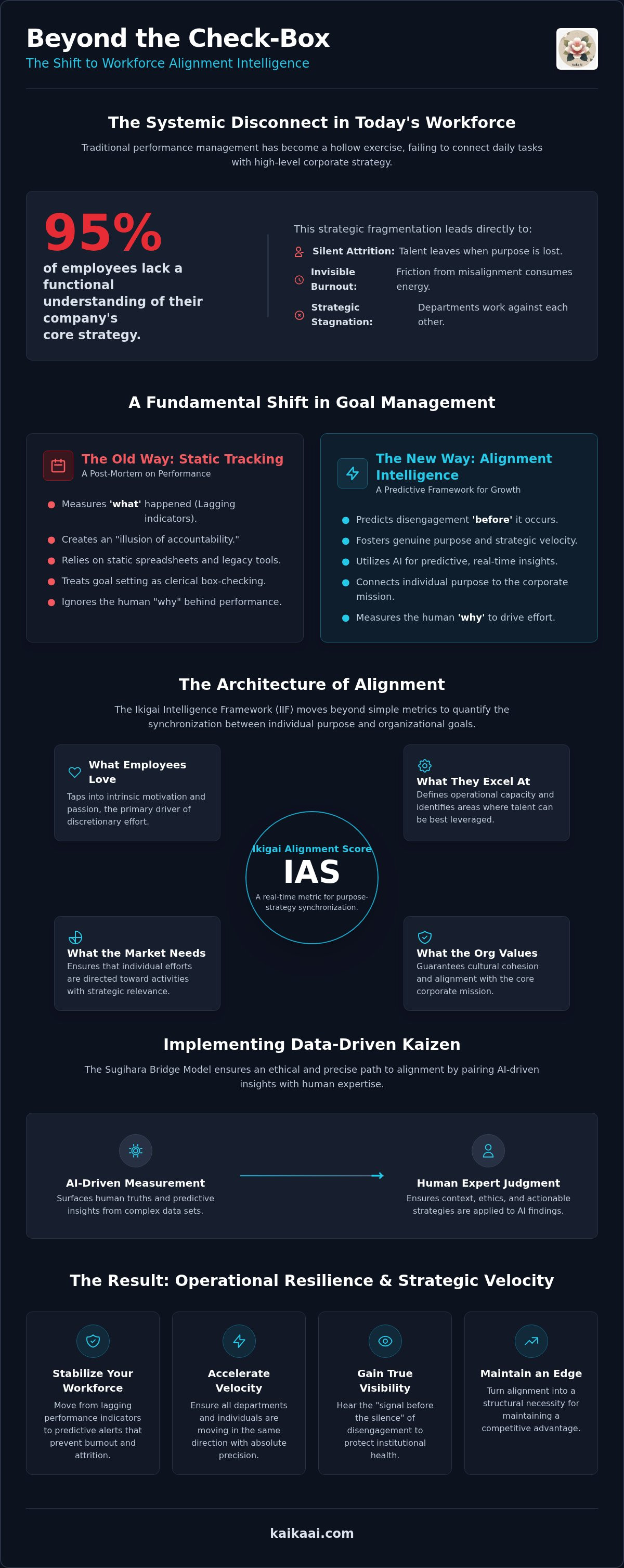
Ninety-five percent of employees currently navigate their daily tasks without a functional understanding of their organization's core strategy. This systemic fragmentation turns traditional performance management into a hollow exercise in box-checking rather than a driver of genuine growth. For leadership, the search for the right OKR software for enterprise alignment is often a quest for structural integrity in an era of silent attrition and invisible burnout. You recognize that when departmental goals drift from the corporate mission, the resulting friction creates a heat that eventually consumes your most valuable talent.
Static spreadsheets and legacy tracking tools lack the predictive intelligence required to maintain operational resilience. You need to hear the signal before the silence. This guide allows you to discover how to move beyond static goal management toward a workforce alignment intelligence framework that predicts burnout and accelerates strategic velocity. We'll examine the Sugihara Bridge Model's role in ethical AI implementation, leveraging frameworks co-developed with Waseda University to create a measurable link between individual purpose and organizational growth.
Key Takeaways
- Move beyond the "check-box trap" of traditional tracking by adopting a predictive framework that identifies disengagement before it results in silent attrition.
- Utilize the Ikigai Alignment Score (IAS) to quantify the synchronization between individual employee purpose and high-level corporate strategy.
- Distinguish between basic clerical tools and sophisticated OKR software for enterprise alignment that scales purpose across complex global divisions.
- Apply the Sugihara Bridge Model to pair AI-driven measurement with human expert judgment, ensuring an ethical and precise path toward operational resilience.
- Shift from lagging performance indicators to predictive alerts that stabilize your workforce and accelerate strategic velocity.
Beyond Static Metrics: Why Traditional Workforce Goal Tracking Software Fails
Most executive boards view high goal completion rates as a definitive proxy for organizational health. This is a strategic error. A department can achieve every numerical target while drifting entirely away from the corporate mission. This check-box trap creates a false sense of security that masks deep-seated structural rot. When your OKR software for enterprise alignment only tracks binary outputs, it ignores the human energy and psychological synchronization required to sustain those results. True velocity is not just about moving fast; it's about moving in the same direction with absolute precision.
The Illusion of Accountability
Top-down goal cascading often feels like an architectural imposition rather than a collective pursuit of excellence. Traditional platforms treat the goal-setting framework as a static repository for historical data. They fail to capture the psychological friction that occurs when an individual's sense of purpose is ignored. This lack of human truth turns accountability into a performance of compliance. Modern enterprises require a shift from clerical tracking to workforce intelligence that identifies the "signal before the silence" of disengagement.
Traditional tracking measures what happened. It is a post-mortem of performance that offers no protection against future volatility. Leading indicators, conversely, provide the predictive capacity to stabilize a global workforce. When purpose drifts, the first casualty is not the metric; it's the employee's commitment. This silent attrition is the most expensive tax on an organization. High-tier talent rarely leaves because of a missed target. They leave because the target no longer resonates with their personal mission.
The Economic Impact of Misalignment
The financial cost of purpose-drift is staggering. Misalignment creates localized silos where departmental goals impede overall organizational velocity. One division might optimize its own performance at the direct expense of another's operational capacity. This friction results in burnout that remains invisible until the moment of resignation. Leaders must adopt workforce resilience metrics to protect institutional health. Without these predictive insights, an enterprise remains vulnerable to sudden talent voids and strategic stagnation. Real-time visibility into workforce alignment is no longer a luxury; it is a structural necessity for maintaining a competitive edge in 2026.
The Architecture of Alignment: Intelligence Over Simple Management
Most enterprise tools focus exclusively on the "what" of performance. They track metrics and monitor deadlines but ignore the fundamental "why" that drives human effort. To truly maintain strategic alignment, leadership needs a framework that connects individual purpose with the corporate mission. This is the essence of Workforce Alignment Intelligence. It's a shift from clerical oversight to a systemic understanding of human potential. By 2026, the complexity of global operations requires a "Signal Before Silence" approach to prevent strategic stalling and ensure every unit moves with synchronized intent.
The Ikigai Intelligence Framework (IIF)
The IIF synthesizes the four pillars of Ikigai into a corporate architecture. It maps what employees love, what they excel at, what the market needs, and what the organization values. What employees love translates to intrinsic motivation. What they excel at defines operational capacity. What the market needs represents strategic relevance. What the organization values ensures cultural cohesion. When these elements intersect, the result is the Ikigai Alignment Score (IAS).
This metric quantifies qualitative synchronization. It provides a numerical value for how deeply an individual's personal mission resonates with the company's trajectory. This methodology surfaces human truths without violating enterprise privacy standards. It ensures that the OKR software for enterprise alignment acts as a catalyst for harmony rather than a tool for surveillance. By measuring these intersections, leaders can identify where talent is underutilized or where purpose has begun to drift from the strategic core.
Surfacing the Human Truth
Traditional sentiment surveys are notoriously unreliable. They often reflect what employees think leadership wants to hear rather than their actual state of engagement. Kaika pilots have demonstrated an 87% employee honesty rate, a significant deviation from industry norms. This is achieved through the Human Signal Index (HSI). Instead of sporadic, biased surveys, the HSI utilizes continuous behavioral signal detection to identify patterns of disengagement. It detects the subtle shifts in velocity and contribution that precede burnout.
Workforce Alignment Intelligence is the intersection of behavioral science and enterprise data. It allows executives to visualize the structural integrity of their workforce in real time. If you suspect your current tracking tools are only scratching the surface, consider a comprehensive Alignment Audit to uncover the hidden signals within your teams. By identifying these patterns early, organizations can implement corrective measures before disengagement manifests as attrition. This strategic foresight is what separates market leaders from those merely managing the status quo.
Evaluating Enterprise Platforms: From OKRs to Workforce Intelligence
Selecting the right OKR software for enterprise alignment requires a departure from superficial feature comparisons. Most procurement processes focus on user interface or integration counts while ignoring the underlying philosophical architecture. Evaluating Enterprise Platforms through a lens of workforce intelligence means looking for systems that don't just record history but predict future outcomes. Global organizations need a framework capable of synchronizing specialized units without diluting the corporate mission. It's about moving from a fragmented collection of dashboards to a unified systemic architecture that supports collective resilience.
Clerical Tracking vs. Strategic Intelligence
Traditional tools excel at documenting completion. They tell you that a task is finished but offer no insight into the human velocity behind it. A robust workforce alignment software framework moves beyond these clerical functions. It prioritizes the measurement of strategic momentum and provides predictive attrition intelligence. This allows leadership to intervene before disengagement destabilizes a critical project. Modern governance demands this level of foresight to maintain a competitive advantage in volatile markets. It transforms goal tracking from a passive record into an active engine for growth that detects the signal before the silence of resignation.
Security and Institutional Trust
Workforce analytics involve sensitive human data. This necessitates enterprise-grade security that adheres to stringent Japanese and global privacy standards. Trust is the foundation of any alignment initiative. Our academic partnership with Waseda University ensures that our AI models are grounded in academic rigor and ethical principles. Successful integration isn't a plug-and-play event. It requires deep Executive Consultation to ensure the software architecture mirrors the organization's unique structural needs. This systematic approach ensures that data collection remains a tool for empowerment rather than an instrument of surveillance. By prioritizing institutional trust, leaders can foster a culture where data drives collective Kaizen rather than individual anxiety.
Systemic organizational architecture is the ultimate goal. Standalone dashboards create data silos that impede strategic velocity. True alignment intelligence integrates directly into the daily workflow of global divisions. This synchronization ensures that a developer in Tokyo and a sales lead in Sydney are driven by the same core purpose. When purpose is synchronized across specialized units, the organization achieves a level of operational resilience that traditional tracking tools simply cannot provide.
Implementing Data-Driven Kaizen: The Sugihara Bridge Model
Deployment of OKR software for enterprise alignment often fails when it lacks a structured human-centric methodology. The Sugihara Bridge Model solves this by establishing a hybrid architecture that pairs AI measurement with human consultant judgment. This model ensures that data doesn't just sit in a dashboard but drives meaningful organizational evolution. It acknowledges that while technology identifies patterns, the interpretation of those patterns requires a sophisticated understanding of human behavior and corporate culture. This systematic approach moves through three distinct phases to ensure long-term strategic synchronization.
The first phase is the Alignment Audit. This diagnostic process identifies mission-critical gaps in organizational synergy where departmental objectives have drifted from the strategic core. Once these gaps are mapped, the organization enters Phase 2: Structural Framework Implementation. Here, the Ikigai Intelligence Framework (IIF) is deployed across global divisions to create a unified language of purpose. The final stage, Phase 3: Mindset Development, utilizes workshops to train leadership in acting on AI-driven signals. This ensures that the intelligence gathered by the platform results in decisive, empathetic leadership action.
The Clinical Edge in Burnout Prevention
Standard tracking tools often miss the psychological strain that precedes a drop in performance. To address this, we utilize the Employee Human Signal Index (EHSI), a metric co-developed with clinical psychologists to detect subtle shifts in workforce health. The EHSI flags psychological strain before it impacts the bottom line, allowing for proactive intervention rather than reactive damage control. Leaders can refer to our detailed guide on the leading indicators of employee burnout to understand how to interpret these predictive signals. This clinical depth provides a layer of protection that clerical tools simply cannot replicate.
Continuous Improvement Reimagined
Collective Kaizen is a data-driven approach to cross-departmental synergy that replaces sporadic reviews with continuous momentum. In our pilot programs, organizations achieved 74% weekly completion rates, a testament to the power of consistent, purpose-aligned action. This is not about relentless pressure; it's about the systematic removal of friction. The Sugihara Bridge Model ensures that even the most sensitive signals are handled with empathy and strategic care. If you are ready to move beyond static metrics, explore our Workforce Alignment Intelligence Platform to begin your journey toward operational resilience. By integrating these intelligence capabilities, you transform your organization into a synchronized entity capable of navigating global complexity with absolute precision.
Achieving Operational Resilience: The Kaika AI Strategic Advantage
Operational resilience is the byproduct of structural integrity. It requires a fundamental shift from monitoring activities to synchronizing intent across every layer of the enterprise. Kaika AI is not merely a software vendor. We are a strategic partner committed to defining the future of workforce intelligence. Our roadmap includes a targeted dual listing on the Tokyo Stock Exchange (TSE) and the Australian Securities Exchange (ASX) by 2032. This vision underscores our commitment to institutional reliability and long-term category leadership. By implementing our framework, organizations don't just track goals; they build a resilient architecture capable of sustaining peak performance through global volatility.
The measurable outcomes of this approach are definitive. Enterprises utilizing our platform see a significant reduction in silent attrition and a measurable boost in strategic velocity. When individual purpose is structurally aligned with the corporate mission, performance becomes a natural outcome of organizational harmony. This synchronization ensures that high-level strategy isn't lost in translation as it moves through specialized divisions. The search for the right OKR software for enterprise alignment ends where predictive intelligence begins. It's about securing the future of your talent by hearing the signal before the silence of disengagement.
The Future of People Operations
People operations must evolve into a function of strategic engineering. The link between human potential and organizational harmony is the primary driver of long-term ROI in the modern economy. Workforce sustainability metrics provide a clear view of institutional health, allowing leadership to protect their most valuable assets before burnout occurs. Kaika AI stands as the definitive category leader in this space, providing the tools necessary for this evolution. Leaders who wish to stay ahead of this curve should explore our insights on continuous performance management software to understand how data-driven Kaizen transforms daily operations.
Next Steps for Global Leadership
The executive mandate for 2026 is clear. CHROs and CEOs must lead the transition from traditional monitoring to active listening through the Ikigai Intelligence Framework (IIF). This shift requires a disciplined commitment to human-centric data and ethical AI implementation. Requesting an Executive Consultation is the first step toward integrating these capabilities into your unique organizational structure. This is a high-stakes endeavor. The cost of misalignment is not just missed targets; it's the erosion of your institutional culture and the loss of top-tier talent. Secure your strategic advantage by choosing a partner that understands the complexities of global scale. Begin your journey toward absolute alignment by scheduling an Alignment Audit today. The future of your organization depends on the synchronization you achieve now.
Transcending Management for Strategic Synchronization
Strategic velocity requires more than a digital ledger of completed tasks. It demands a sophisticated synchronization of individual purpose with institutional mission. By adopting the Ikigai Intelligence Framework, global leaders move beyond the check-box trap of legacy systems toward a predictive model of organizational health. This evolution from clerical tracking to workforce alignment intelligence is validated by our academic partnership with Waseda University and an NPS of 72 among participants in our 340-person Tokyo pilot. The development of our human signal index, led by clinical psychologists, ensures that your leadership hears the signal before the silence of disengagement.
Selecting a robust OKR software for enterprise alignment is an architectural decision that defines your organization's resilience. It's time to replace fragmented dashboards with a unified framework that respects human potential while driving data-driven Kaizen. We invite you to Request Early Access to the Kaika AI Alignment Platform and begin the transition toward a truly synchronized workforce. Your commitment to structural harmony today will secure your strategic excellence for the decade to come.
Strategic Alignment: Frequently Asked Questions
What is the difference between goal tracking and workforce alignment?
Goal tracking is a clerical function that records historical outputs, while workforce alignment is a systemic process of synchronizing individual purpose with the corporate mission. Traditional OKR software for enterprise alignment often fails because it focuses on binary completion rather than strategic velocity. Alignment intelligence ensures that every departmental objective serves the broader organizational trajectory.
How does Kaika AI predict burnout before it happens?
Our platform utilizes the Employee Human Signal Index (EHSI) to identify subtle patterns of disengagement. It detects shifts in contribution and velocity that precede the silence of resignation. This predictive capacity allows leadership to intervene with precision, protecting institutional health before psychological strain manifests as attrition.
Is workforce alignment software compliant with Japanese privacy laws?
The platform maintains enterprise-grade security that adheres to both Japanese privacy standards and global data protection regulations. We prioritize institutional trust by ensuring that data collection remains a tool for collective empowerment. Our academic partnership with Waseda University further validates the ethical architecture of our AI models.
What is the Sugihara Bridge Model and why is it necessary?
The Sugihara Bridge Model is a hybrid architecture that pairs AI measurement with human expert judgment. It's necessary because sensitive human signals require the nuanced interpretation of a strategic consultant. This model ensures that data-driven insights are handled with empathy and translated into meaningful leadership action.
Can this software integrate with my existing HRIS or performance management tools?
Our intelligence framework is designed to integrate directly with your current HRIS and performance ecosystems. We believe that workforce intelligence must be a core component of your systemic organizational architecture rather than a standalone silo. This connectivity ensures that strategic synchronization is maintained across all global divisions and specialized units.
How do you measure something as abstract as individual purpose or Ikigai?
We quantify purpose through the Ikigai Intelligence Framework (IIF), which maps four pillars: love, skill, need, and value. The resulting Ikigai Alignment Score (IAS) provides a numerical metric for qualitative synchronization. This allows executives to visualize how deeply an individual's personal mission resonates with the company's long-term goals.
What kind of results did the Tokyo-based pilot programs show?
Pilot programs involving 340 Tokyo-based participants demonstrated an 87% employee honesty rate and an NPS of 72. These organizations also achieved 74% weekly completion rates on mission-critical objectives. These metrics prove that aligning purpose with performance drives consistent organizational momentum and operational resilience.
How does the Employee Human Signal Index (EHSI) differ from traditional pulse surveys?
Traditional pulse surveys are sporadic and often biased by what employees think leadership wants to hear. The EHSI, co-developed with clinical psychologists, utilizes continuous behavioral signal detection to surface human truths. It identifies the "signal before the silence," offering a predictive advantage that traditional sentiment tracking cannot replicate.
Disclaimer
#Disclaimer
At Kaika AI, we believe the future belongs to organizations that combine human wisdom with artificial intelligence responsibly. The articles, research, insights, and thought leadership published on this website are intended to educate, inform, and encourage meaningful conversations about the future of work, organizational intelligence, AI, leadership, and innovation.
While our content is developed through rigorous research and may be generated, curated, or enhanced using artificial intelligence, every effort is made to ensure it reflects thoughtful analysis, practical relevance, and responsible AI practices. However, no representation or warranty is made regarding the completeness, accuracy, or suitability of the information for every individual or organizational circumstance.
The ideas, opinions, frameworks, and recommendations shared by Kaika AI are provided for educational and informational purposes only. They should not be interpreted as legal, financial, medical, psychological, human resources, cybersecurity, or other professional advice. Organizations and individuals should seek qualified professional guidance before making strategic, legal, or operational decisions.
Where articles reference third-party organizations, products, services, academic research, industry reports, or public data, such references are provided solely to support discussion and analysis. Unless explicitly stated, they do not imply endorsement, partnership, or affiliation.
Artificial intelligence is a powerful decision-support technology—not a replacement for human judgment. Kaika AI advocates for responsible, transparent, and human-centered AI adoption. We encourage readers to critically evaluate information, consider their unique context, and combine AI-generated insights with professional expertise and sound decision-making.
The content published on this website may be updated, revised, or removed as knowledge, technology, regulations, and best practices continue to evolve.
To the fullest extent permitted by applicable law, Kaika AI, its affiliates, contributors, and partners disclaim liability for any direct, indirect, incidental, consequential, or other losses arising from the use of, or reliance upon, the information provided on this website.
By accessing or using this website, you acknowledge that you have read, understood, and agree to this Disclaimer.
Kaika AI
'Building trusted organizational intelligence for the AI Era'


