
What if the $10 trillion lost to global disengagement in 2025 isn't a failure of individual effort, but an architectural flaw in the design of human contribution? Most executives recognize the silent attrition of top talent and the creeping burnout that follows a lack of perceived meaning, yet they remain tethered to ineffective annual goal cycles. This systemic friction persists because the impact of employee purpose on productivity is frequently relegated to the realm of soft culture rather than being treated as a rigorous, measurable engine of organizational velocity.
We understand that a workforce disconnected from its core "reason for being" eventually results in operational stasis and fragmented synergy. This article provides a strategic roadmap to transform abstract purpose into a precise tool for performance through the Ikigai Intelligence Framework. You'll learn how the Sugihara Bridge Model utilizes human-centric data to detect attrition signals early and align cross-departmental efforts. We'll move beyond corporate buzzwords to establish a systematic architecture where individual fulfillment and enterprise resilience become one and the same.
Key Takeaways
- Identify and mitigate "silent attrition" by measuring the direct impact of employee purpose on productivity before disengagement leads to turnover.
- Transform abstract human values into actionable corporate metrics using the four pillars of the Ikigai Intelligence Framework.
- Detect critical alignment gaps between executive strategy and workforce reality through the Ikigai Alignment Score (IAS).
- Deploy the Sugihara Bridge Model to unify technical AI insights with nuanced human judgment for superior strategic synchronization.
- Establish a foundation for operational resilience by architecting a system where individual meaning drives collective organizational velocity.
The Crisis of Silent Attrition: Why Misalignment Destroys Organizational Velocity
Silent attrition represents the psychological latency period between an employee’s loss of internal meaning and their eventual formal resignation. It isn't a sudden event but a gradual erosion of commitment where top talent remains on the payroll while mentally exiting the mission. This invisible disengagement creates a systemic drag on workforce velocity. When individual values clash with corporate objectives, the resulting purpose-goal friction stalls strategic execution. The impact of employee purpose on productivity is most visible during this phase; output may remain steady in the short term, but the creative energy and discretionary effort required for innovation vanish.
Leadership often treats exit interviews as a primary source of truth, yet these are lagging indicators that arrive long after the damage is done. Relying on historical data to manage a future-facing workforce is a governance failure. Modern leadership requires a "Signal before the Silence" philosophy. This proactive stance involves identifying the subtle flickers of disengagement before they become systemic failures. By surfacing these human truths in real time, executives can transition from reactive damage control to a model of intentional organizational harmony.
The Limitations of Traditional Engagement Surveys
Annual engagement surveys operate as architectural relics in a high-velocity market. These static snapshots fail to capture the dynamic, shifting nature of employee purpose. They often produce an "honesty gap" where staff provide performative, low-risk feedback rather than voicing deep-seated misalignments. Standard HR tools lack the sophisticated diagnostic depth to uncover why a high-performer has suddenly lost their drive. Predictive workforce alignment intelligence replaces these reactive reports, offering a continuous view of the human ecosystem. This precision allows for the detection of "flickers" in engagement, ensuring that leaders address friction before it necessitates a costly recruitment cycle.
Measuring the Impact of Purpose on Performance
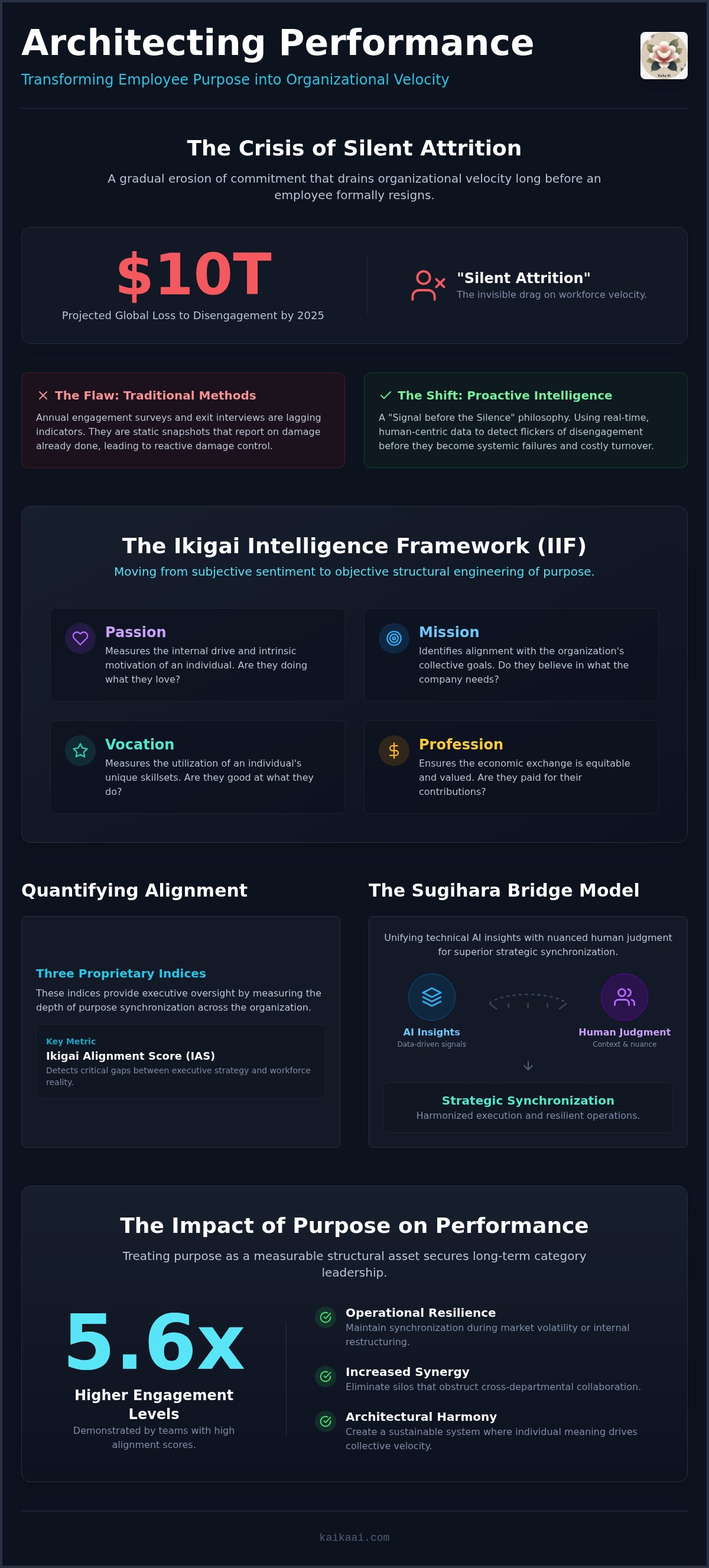
The impact of employee purpose on productivity is quantifiable through the lens of operational resilience. High alignment scores correlate directly with a team's ability to maintain synchronization during market volatility or internal restructuring. When employees understand how their specific contributions feed into the broader corporate vision, they demonstrate 5.6 times higher engagement levels. Conversely, mission-critical gaps in alignment create silos that obstruct cross-departmental synergy. CHROs must now view the Ikigai Intelligence Framework as a leading performance indicator. Treating purpose as a measurable structural asset rather than a vague cultural perk is the only way to secure long-term category leadership.
Decoding the Ikigai Intelligence Framework: The Science of Purpose Alignment
The Ikigai Intelligence Framework (IIF) represents a fundamental shift from subjective sentiment analysis to objective structural engineering. Developed in Tokyo through a strategic partnership with Waseda University, this Japan-first methodology moves beyond western engagement models by grounding workforce data in a deep philosophical heritage. While generic models focus on surface-level satisfaction, the IIF isolates the specific architectural intersections where individual contribution meets organizational need. This precision is vital because the impact of employee purpose on productivity is not a linear outcome of happiness; it's a byproduct of strategic synchronization.
The framework operates on four foundational pillars: Passion, Mission, Vocation, and Profession. In a corporate context, these aren't abstract ideals but measurable metrics. Passion tracks internal drive; Mission identifies alignment with collective goals; Vocation measures the utilization of unique skillsets; Profession ensures that the economic exchange remains equitable. When these pillars are in balance, an organization achieves a state of high-velocity output that is both sustainable and resilient. This structural harmony prevents the friction that typically leads to talent erosion and strategic stagnation.
The Three Proprietary Indices of Workforce Alignment
We quantify this balance through three distinct intelligence indices designed for executive oversight. The Ikigai Alignment Score (IAS) measures the depth of purpose synchronization, revealing how deeply an employee’s personal "why" integrates with the corporate strategy. The Human Signal Index (HSI) acts as a predictive sensor, surfacing early behavioral patterns that precede disengagement or attrition. Finally, the Employee Human Signal Index (EHSI) utilizes burnout indices developed by clinical psychologists to identify psychological strain. These tools provide leaders with the clarity needed to protect the purpose in the workplace that drives long-term retention and loyalty.
From Abstract Values to Concrete KPIs
Transforming qualitative purpose into quantitative performance data requires a sophisticated mapping of individual Ikigai to strategic mission outcomes. By using AI to identify where employee skillsets intersect with societal needs and corporate value, leaders can place talent with surgical precision. The IAS transforms the elusive concept of purpose into a hard KPI that dictates resource allocation and leadership priorities. This ensures that every hire and every internal move serves the dual purpose of human fulfillment and enterprise velocity. Organizations seeking to validate their current standing can begin with an Alignment Audit to identify hidden friction points within their structure.
Identifying Mission Alignment Gaps: A Strategic Diagnostic
Alignment gaps emerge at the precise intersection where executive strategy diverges from the employee's daily reality. These fissures are rarely visible on a balance sheet until they manifest as declining output or increased turnover. When a workforce no longer sees their personal "why" reflected in the corporate "how," the impact of employee purpose on productivity undergoes a sharp, measurable decline. This divergence acts as a silent tax on every strategic initiative, slowing the velocity of even the most well-funded projects.
Detecting these gaps requires a move beyond traditional observation. The Human Signal Index (HSI) serves as a high-precision sensor, identifying "flickers" of disengagement long before they evolve into systemic failures. These signals are often subtle behavioral shifts that indicate a loss of synchronization with the organizational mission. Identifying these patterns early allows leadership to intervene with surgical precision, preserving the integrity of the workforce before silent attrition takes hold. It's about seeing the signal before the silence.
Organizations often attempt to bridge these gaps through quantitative incentives. This approach is fundamentally flawed. Financial-only goals frequently backfire by crowding out intrinsic motivation, creating a transactional culture that lacks resilience. While compensation is a necessary baseline, it cannot serve as a substitute for genuine mission alignment. For a deeper analysis of these attrition risks, consult our resource on Leading Indicators of Employee Burnout: The Executive Guide to Predictive Attrition Intelligence.
Clinical Insights into Burnout and Purpose
High-performers who are deeply invested in their purpose are paradoxically the most susceptible to psychological strain. The Employee Human Signal Index (EHSI) utilizes clinical psychologist-led indices to detect the onset of burnout in these mission-critical individuals. This intelligence allows for proactive support rather than reactive crisis management. Our methodology prioritizes responsible AI use, ensuring that predictive analytics remain transparent and strictly adhere to Japanese privacy standards. This balance protects the individual while securing the collective performance of the enterprise.
The Alignment Audit: A Structural Framework
Resolving mission friction requires a methodical approach to structural refinement. An Alignment Audit provides the necessary diagnostic clarity through a three-phase process. Phase 1 involves assessing the current architectural state of workforce alignment across all global divisions. Phase 2 identifies cross-departmental silos that prevent mission synchronization, surfacing hidden friction points. Phase 3 focuses on developing a roadmap for data-driven Kaizen, ensuring continuous improvement and long-term operational resilience. This systematic evolution ensures that the impact of employee purpose on productivity remains a primary driver of organizational velocity.
The Sugihara Bridge Model: Bridging AI Intelligence with Human Judgment
The Sugihara Bridge Model serves as the necessary hybrid architecture for modern workforce alignment. While human-only interventions often struggle to scale across global divisions, this model leverages technical intelligence to provide a structural foundation for human judgment. It operates on the principle that data provides the "what," but human perception provides the "why." By synthesizing these two forces, organizations can ensure that the impact of employee purpose on productivity is managed with both mathematical precision and psychological depth. This framework moves beyond the limitations of manager-led surveys, creating a resilient bridge between individual aspirations and enterprise velocity.
Implementing this model requires a methodical, four-step progression designed to synchronize every level of the organization:
- Step 1: Deploy AI-driven measurement of the Ikigai Alignment Score (IAS) and Human Signal Index (HSI) across the entire enterprise to establish a baseline of structural health.
- Step 2: Utilize trained human consultants to interpret sensitive workforce signals, identifying the nuances that raw data might overlook.
- Step 3: Conduct executive-level architectural consultations to realign corporate structures, ensuring that strategic objectives don't conflict with workforce purpose.
- Step 4: Operationalize these insights by implementing continuous performance management software principles to maintain long-term synchronization.
The Role of AI in Human Truth Detection
AI surfaces patterns of "Human Truth" that remain invisible to traditional management layers. By analyzing the intersection of passion and professional output, these systems detect early indicators of friction before they manifest as attrition. Our pilots have demonstrated an 87% employee honesty rate, a result of anonymous and psychologically safe measurement protocols. This transition from surveillance to supportive intelligence allows leaders to protect their most valuable assets without compromising individual privacy. It turns workforce data into a proactive tool for organizational harmony rather than a reactive report on past failures.
Leadership Mindset and Strategic Integration
Success within the Sugihara Bridge Model depends on the executive capability to act on real-time alignment signals. Leaders must develop the discipline to respond to HSI "flickers" with strategic adjustments rather than generic motivational tactics. This integration is often achieved through Collective Kaizen Workshops, where teams align their specific missions with the broader company vision through structured dialogue. For a comprehensive look at the tools required for this evolution, see The Definitive Guide to Workforce Alignment Software. Organizations ready to bridge the gap between data and action should consider an Executive Consultation to refine their leadership architecture.
Architectural Synergy: Positioning Your Organization for Long-Term Resilience
Operational resilience is no longer a function of financial reserves alone; it's a byproduct of systemic workforce synchronization. In an era defined by market volatility and talent scarcity, the impact of employee purpose on productivity serves as the primary differentiator between category leaders and stagnant incumbents. Organizations that fail to architect a bridge between individual Ikigai and corporate strategy find themselves vulnerable to the corrosive effects of silent attrition. Conversely, those that treat alignment as a core structural discipline build an enterprise capable of weathering external shocks through collective, mission-driven velocity.
The roadmap to 2032 requires a shift toward global enterprise standards in workforce intelligence. This evolution moves beyond episodic check-ins to a continuous state of alignment monitoring. By surfacing real-time human truths, leaders can maintain synchronization across disparate global divisions, ensuring that every operational unit moves with the same strategic intent. This long-term vision positions the organization not just to survive disruption, but to lead the market through the unwavering synchronization of purpose and performance.
Building a High-Performance Culture of Alignment
Alignment is a continuous process of evolution rather than a finite project. Modern enterprise success exists at the intersection of lean management principles and organizational psychology. When employees experience a workplace where their contributions are visibly tied to a meaningful mission, the results are statistically significant. Our data indicates that organizations utilizing the Ikigai Intelligence Framework achieve 74% weekly completion rates on strategic objectives. This high-performance output is sustained through value-aligned employee experiences that prioritize human potential as much as technical efficiency.
Actionable Next Steps for CHROs
The transition to a resilient, purpose-driven architecture begins with an initial Alignment Audit. This diagnostic phase establishes the baseline purpose metrics required to identify hidden friction points within the current structure. Once these gaps are surfaced, the next imperative is integrating the IIF into existing enterprise HR data infrastructures. This ensures that workforce alignment becomes a permanent fixture of corporate governance. To deepen your understanding of these systems, explore our AI for organizational health framework for a detailed look at systemic synchronization.
Architecting the Future of Workforce Synchronization
The transition from traditional engagement surveys to predictive workforce intelligence is a necessity for the modern enterprise. By identifying mission alignment gaps through the Ikigai Intelligence Framework, leaders can mitigate silent attrition before it erodes operational velocity. We've established that the impact of employee purpose on productivity is a measurable, structural asset that dictates long-term resilience and cross-departmental synergy.
Our methodology, validated through a strategic partnership with Waseda University and achieving an NPS of 72 in enterprise pilots, bridges technical intelligence with human judgment. Through the Sugihara Bridge Model and clinically-informed EHSI, we provide a responsible, data-driven approach to detecting burnout and fostering organizational harmony. This isn't just about culture; it's about securing the structural integrity of your workforce for a high-stakes future.
The path to synchronization is clear, and the tools for evolution are ready. Request early access to the Kaika AI Workforce Alignment Intelligence Platform today to begin your journey toward architectural excellence. Your organization's potential is waiting to be unlocked.
Frequently Asked Questions
How do you measure something as subjective as employee purpose?
We measure purpose by utilizing the Ikigai Intelligence Framework to convert qualitative human sentiment into quantitative structural data. This methodology isolates the intersections of individual passion and organizational mission, providing a rigorous metric for contribution. By analyzing these specific alignment pillars, we can accurately assess the impact of employee purpose on productivity across diverse teams and global divisions.
What is the difference between a traditional engagement survey and the Ikigai Alignment Score?
Traditional surveys provide lagging indicators based on subjective, often performative feedback that fails to capture real-time friction. The Ikigai Alignment Score (IAS) offers a predictive view of structural synchronization by identifying where personal values and corporate goals diverge. This allows for proactive adjustments before misalignment leads to silent attrition or strategic stagnation.
How does AI predict burnout without compromising employee privacy?
Our platform utilizes the Employee Human Signal Index (EHSI) to detect burnout flickers through anonymized behavioral patterns and psychologically safe measurement protocols. We prioritize individual privacy by aggregating data, which has resulted in an 87% honesty rate in enterprise pilots. This intelligence allows leadership to address systemic strain without resorting to invasive surveillance.
Can this framework be applied to global divisions with different cultural values?
The framework is designed for global scalability by focusing on the universal human need for meaning and contribution. While cultural expressions of work vary, the core pillars of the Ikigai Intelligence Framework remain consistent across international borders. This allows global enterprises to maintain a unified strategic direction while respecting the local nuances of their workforce.
What is the Sugihara Bridge Model and why is it necessary for large enterprises?
The Sugihara Bridge Model is a hybrid architecture that integrates AI-driven analytics with human interpretative judgment. Large enterprises require this model to scale alignment efforts that raw data alone cannot sustain. It ensures that sensitive workforce signals are interpreted with the necessary psychological and strategic depth to drive meaningful organizational change.
How long does it take to see measurable results from a workforce alignment platform?
Baseline insights are available immediately following an Alignment Audit, surfacing hidden friction points within days. Measurable improvements in workforce velocity and retention typically emerge within the first full strategic cycle as alignment becomes operationalized. Continuous monitoring ensures these gains are sustained as the organization evolves and market conditions shift.
Is the Ikigai Intelligence Framework compliant with global data privacy standards?
The framework strictly adheres to Japanese privacy standards and global ethical AI guidelines for responsible data use. We ensure transparency in our measurement protocols and maintain rigorous security to protect workforce intelligence. This commitment to ethics is essential for building the trust required to surface the human truths beneath organizational data.
How does purpose alignment impact the bottom line and overall profitability?
Purpose alignment acts as a multiplier for organizational velocity and resilience. Verified data from 2025 shows that organizations with the highest levels of engagement are 23% more profitable than their misaligned counterparts. By reducing the costs of silent attrition and improving cross-departmental synergy, the impact of employee purpose on productivity becomes a primary driver of enterprise value.
Disclaimer
#Disclaimer
At Kaika AI, we believe the future belongs to organizations that combine human wisdom with artificial intelligence responsibly. The articles, research, insights, and thought leadership published on this website are intended to educate, inform, and encourage meaningful conversations about the future of work, organizational intelligence, AI, leadership, and innovation.
While our content is developed through rigorous research and may be generated, curated, or enhanced using artificial intelligence, every effort is made to ensure it reflects thoughtful analysis, practical relevance, and responsible AI practices. However, no representation or warranty is made regarding the completeness, accuracy, or suitability of the information for every individual or organizational circumstance.
The ideas, opinions, frameworks, and recommendations shared by Kaika AI are provided for educational and informational purposes only. They should not be interpreted as legal, financial, medical, psychological, human resources, cybersecurity, or other professional advice. Organizations and individuals should seek qualified professional guidance before making strategic, legal, or operational decisions.
Where articles reference third-party organizations, products, services, academic research, industry reports, or public data, such references are provided solely to support discussion and analysis. Unless explicitly stated, they do not imply endorsement, partnership, or affiliation.
Artificial intelligence is a powerful decision-support technology—not a replacement for human judgment. Kaika AI advocates for responsible, transparent, and human-centered AI adoption. We encourage readers to critically evaluate information, consider their unique context, and combine AI-generated insights with professional expertise and sound decision-making.
The content published on this website may be updated, revised, or removed as knowledge, technology, regulations, and best practices continue to evolve.
To the fullest extent permitted by applicable law, Kaika AI, its affiliates, contributors, and partners disclaim liability for any direct, indirect, incidental, consequential, or other losses arising from the use of, or reliance upon, the information provided on this website.
By accessing or using this website, you acknowledge that you have read, understood, and agree to this Disclaimer.
Kaika AI
'Building trusted organizational intelligence for the AI Era'


