
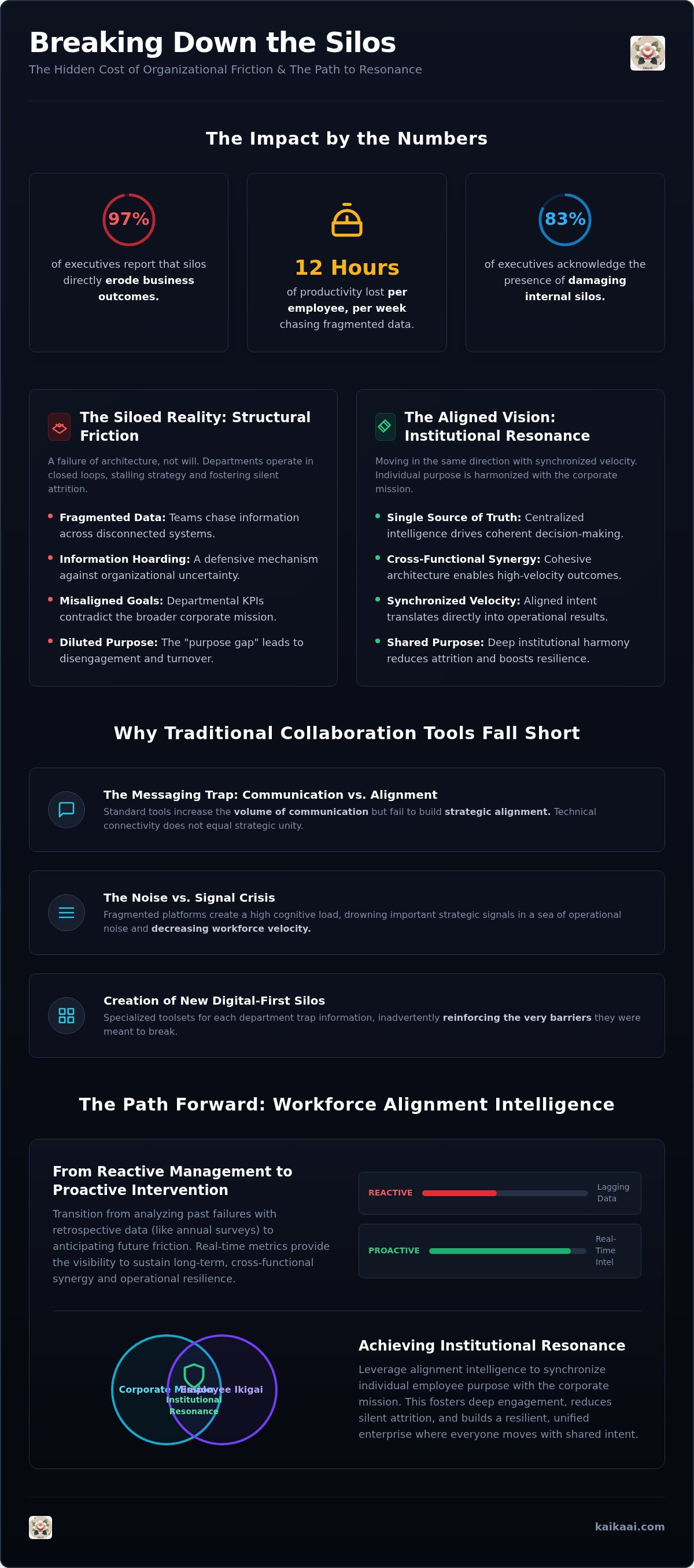
While 83% of executives acknowledge the presence of internal silos, a staggering 97% report that these structural barriers directly erode business outcomes. You likely feel the weight of this friction every day. It manifests as 12 hours of lost productivity every week while teams chase fragmented data or struggle with information hoarding that stalls momentum. This persistent lack of synergy isn't just an operational nuisance. It's a structural failure that leads to silent attrition and a diluted sense of institutional purpose.
This guide explores how to transform organizational friction into institutional resonance. We'll demonstrate how the next generation of tools for breaking down departmental silos can establish a single source of truth and synchronize individual employee Ikigai with your corporate mission. By leveraging the Sugihara Bridge Model and the Ikigai Intelligence Framework, leadership can move beyond superficial communication fixes. We'll examine the strategic shift from manual Kaizen to digital workforce intelligence platforms that provide the visibility needed to build a resilient, unified enterprise.
Key Takeaways
- Distinguish between behavioral silo mentality and structural organizational design to identify where strategic friction and data hoarding truly originate.
- Evaluate the limitations of traditional collaboration software and identify specialized tools for breaking down departmental silos that prioritize strategic alignment over mere communication.
- Master a phased Kaizen methodology that utilizes alignment audits and predictive analytics to integrate specialized divisions into a cohesive, high-velocity architecture.
- Leverage workforce alignment intelligence to synchronize individual employee purpose with the corporate mission, fostering deep institutional resonance and reducing silent attrition.
- Transition from reactive management to proactive intervention by using real-time metrics to sustain long-term cross-functional synergy and operational resilience.
Decoding the Architecture of Departmental Silos in 2026
Organizational friction is rarely a failure of employee will. It's a failure of architecture. Most leaders misdiagnose "silo mentality" as a behavioral resistance to cooperation, but behavior almost always follows structure. An Information silo isn't merely a data storage problem; it's a systemic barrier to institutional resonance. When departments operate within these closed loops, they create fragmented environments where corporate strategy stalls and "silent attrition" begins to hollow out the workforce from the inside.
The quantifiable economic impact of this structural isolation is staggering. Mid-market companies lose an average of 12 hours of productivity per employee every week simply because teams are chasing information across disconnected systems. This leak drains the 60-70% of operating expenses tied to workforce performance. While leadership often implements standard communication software, these are not the specialized tools for breaking down departmental silos necessary for deep structural alignment. Traditional hierarchies often reinforce this isolation by rewarding localized KPIs that directly contradict the broader mission.
The Symptoms of Structural Isolation
Information hoarding often emerges as a defensive mechanism against organizational uncertainty. When individuals lack a clear connection to the corporate mission, they protect their data to maintain perceived value. This creates a "purpose gap" where departmental goals become misaligned with the enterprise vision. Recognizing the human signal of this friction before it manifests as operational failure requires a shift toward workforce intelligence. Without this visibility, leaders remain blind to the growing gap between departmental output and institutional harmony.
Why Silos Persist in the Hybrid Era
Digital proximity didn't bridge the gap. Increased Zoom calls and Slack notifications often added cognitive load without improving strategic alignment. In the hybrid era, remote work inadvertently strengthened departmental bubbles. Teams became more cohesive internally but grew increasingly isolated from the rest of the organization. Legacy HR tech contributes to this fragmentation by treating employee data as static records. Modern tools for breaking down departmental silos must move beyond these legacy limitations to provide real-time, cross-functional visibility that respects the nuances of global, distributed teams.
Why Traditional Collaboration Tools Fail to Bridge Structural Gaps
Most organizations attempt to solve fragmentation by deploying more communication software. While these platforms increase the volume of digital exchanges, they rarely address the underlying structural misalignment. Research into strategies to break organizational silos suggests that technical connectivity does not equate to strategic unity. In fact, standard tools for breaking down departmental silos often exacerbate the problem by creating a "Noise vs. Signal" crisis. When every department has its own Slack channel or specialized project management suite, the result isn't transparency. It's the creation of new, digital-first silos where information remains trapped within specialized toolsets.
The transition from mere communication to true institutional resonance requires a shift in focus. Communication is the act of talking; resonance is the act of moving in the same direction with synchronized velocity. Traditional employee engagement surveys fail here because they provide retrospective data. By the time an annual review identifies friction, the damage to cross-functional synergy is already done. Leaders need visibility into the real-time flow of intent across the enterprise to prevent strategy from stalling.
The Messaging Trap
Fragmented messaging apps make a "Single Source of Truth" impossible to maintain. These platforms prioritize the immediate over the important, leading to a high cognitive load that drains executive focus. There is a significant psychological toll to "always-on" communication when it lacks clear purpose alignment. Workforce Velocity is the speed at which aligned intent translates into operational outcome. Without this alignment, high-speed communication actually decreases velocity by creating circular discussions that never reach a definitive resolution.
Traditional Analytics vs. Predictive Intelligence
Retrospective data cannot prevent the formation of silos because it lacks predictive power. To maintain organizational health, leadership must monitor leading indicators of employee burnout and early signals of departmental drift. Workforce Alignment Software differs fundamentally from standard HRIS or ERP modules. While an ERP manages resources, alignment intelligence manages the synchronization of human potential. It identifies where individual effort is being wasted on misaligned goals before that waste manifests as financial loss. To understand your current standing, consider conducting a professional alignment audit to surface hidden structural gaps.
- Fragmented Data: Specialized tools isolate information within specific teams.
- Cognitive Overload: Excessive messaging without strategic context creates friction.
- Lagging Indicators: Annual surveys identify problems too late for proactive intervention.
The Rise of Workforce Alignment Intelligence: A New Category of Tools
Workforce Alignment Intelligence represents a fundamental shift in how leadership views the enterprise. It isn't just another software suite. It's the synthesis of artificial intelligence, systems engineering, and organizational psychology. While traditional platforms focus on task management or basic communication, these new tools for breaking down departmental silos target the root cause of friction: the disconnect between human intent and organizational structure. By surfacing the human truth buried beneath layers of workforce data, this category of intelligence allows executives to see the organization as a living system rather than a static hierarchy.
This approach prioritizes ethical data use and adheres to rigorous Japanese privacy standards. In an era of surveillance concerns, Kaika AI maintains an 87% employee honesty rate in pilot programs because the framework focuses on harmony rather than control. Real-time metrics on productivity and engagement don't just track output. They identify burnout risks and departmental drift before these signals manifest as attrition. This creates a foundation of trust, evidenced by an NPS of 72 among enterprise participants who value the transparency of the intelligence gathered.
Core Indices of Alignment Intelligence
The Ikigai Intelligence Framework (IIF) utilizes proprietary metrics to provide a granular view of organizational health. These indices move beyond surface-level engagement scores to measure the structural integrity of the workforce. They provide a common language for leadership to discuss human performance with the same precision used for financial reporting.
- The Ikigai Alignment Score (IAS): This metric quantifies the intersection of individual purpose and the corporate mission. High IAS scores correlate with increased resilience and performance.
- The Human Signal Index (HSI): It detects the subtle behavioral shifts that often precede open departmental conflict or information hoarding.
- The Employee Human Signal Index (EHSI): A clinically-informed index that monitors psychological strain, providing an early warning system for leadership.
The Sugihara Bridge Model: Hybrid AI-Human Architecture
Technology alone cannot resolve deep-seated human silos. The Sugihara Bridge Model recognizes this limitation by integrating advanced AI with trained human consultants. This hybrid architecture ensures that sensitive workforce signals aren't just processed as cold data points. Instead, they're interpreted with the cultural nuance and strategic depth required for executive decision-making. It respects the complexity of global scale while maintaining the intimacy of human-led transformation.
This model creates a robust operational resilience for leadership framework. It empowers executives to act as strategic sages, using predictive intelligence to bridge gaps between specialized divisions. By combining technical precision with human-centric outcomes, organizations can achieve a state of institutional resonance that traditional tools for breaking down departmental silos simply cannot facilitate. This methodology, supported by an academic partnership with Waseda University, ensures that the evolution of your workforce is both scientifically grounded and philosophically aligned.
Implementing a Data-Driven Kaizen Framework for Cross-Departmental Synergy
Evolution requires a methodical blueprint. While many organizations rely on general best practices, true structural integration demands a phased, architectural approach. By deploying specialized tools for breaking down departmental silos, leadership can move from reactive troubleshooting to proactive synchronization. This framework utilizes data-driven Kaizen to ensure that every structural adjustment serves the overarching mission. It is a transition from static management to a dynamic state of institutional resonance.
The implementation process follows a rigorous three-phase methodology designed to minimize disruption while maximizing strategic impact. In Phase 1, the organization undergoes an Alignment Audit to surface mission-critical gaps using predictive analytics. Phase 2 focuses on Strategic Integration, where the alignment architecture is customized for specialized divisions to ensure that unique workflows still feed into the enterprise mission. Finally, Phase 3 establishes Collective Kaizen cycles. These continuous, data-driven improvement loops allow the organization to adapt in real-time as market conditions or internal dynamics shift.
Measuring the success of this framework requires a focus on measurable outcomes rather than activity metrics. Leadership must track improvements in workforce velocity, the speed at which aligned intent translates into operational results. Additionally, a reduction in silent attrition serves as a primary indicator of increased structural health. When individual purpose is synchronized with corporate goals, retention rates naturally stabilize as employees find deeper meaning in their contributions. To begin this transformation, your leadership team can engage with our Workforce Alignment Intelligence Platform to establish a baseline for your current organizational health.
The Alignment Audit Process
A mission critical alignment audit allows executives to identify structural friction without disrupting daily operations. This process begins by mapping the flow of information across divisional boundaries to find where data hoarding or bottlenecks occur. By identifying "High-Resonance" teams, leadership can establish internal benchmarks for synergy. These teams serve as models for how cross-functional cooperation should function, providing a localized proof of concept for the broader organization.
Leadership Mindset and Kaizen Workshops
Institutional change starts at the executive level. Training leaders to "hear the signal before the silence" involves using advanced data visualization to detect early signs of departmental drift. Utilizing continuous performance management software facilitates Collective Kaizen Workshops that bring leaders from different divisions together. These workshops use ethical AI insights to foster a culture of transparency, ensuring that every division understands its role in the collective success of the enterprise. This disciplined focus on excellence ensures that the organization remains resilient and unified.
Achieving Institutional Resonance with Kaika AI’s Ikigai Intelligence
The resolution of departmental friction requires more than technical connectivity; it demands the synchronization of human intent. While traditional tools for breaking down departmental silos focus on surface-level communication, Kaika AI addresses the root cause of isolation by aligning individual purpose with organizational mission. This alignment transforms a collection of disconnected divisions into a unified, high-velocity enterprise. By utilizing the Ikigai Intelligence Framework, leadership can move beyond the "Noise vs. Signal" crisis and establish a state of institutional resonance where every employee’s contribution is strategically meaningful.
Real-time metrics provide the foundation for this transformation. Proactive intervention is now possible through the detection of early signals that precede attrition and performance decay. Pilot results from our Tokyo-based programs demonstrate the efficacy of this evidence-based approach. We've achieved an NPS of 72 among enterprise participants and maintained an 87% employee honesty rate. These figures aren't just statistics; they represent a fundamental shift in how employees engage with their work and their colleagues when they feel a genuine sense of purpose alignment. Organizations that embrace this intelligence gain the ability to stabilize their workforce while simultaneously boosting operational resilience.
The Future of Organizational Architecture
The enterprise of the future will not be defined by rigid, top-down hierarchies. Instead, we're moving toward fluid, purpose-aligned networks that can adapt with precision to global market shifts. Kaika AI is central to the global 2032 vision for workforce intelligence, where structural silos are replaced by synchronized ecosystems. This evolution allows for the seamless integration of specialized talent across divisional boundaries, ensuring that collective wisdom is never trapped in a single department. Hearing the signal before the silence is the ultimate competitive advantage.
Next Steps for Global CHROs
Initiating a transformation of this scale requires a disciplined, research-backed methodology. Global CHROs can now initiate pilot programs through our Tokyo headquarters, leveraging our academic partnership with Waseda University to ensure every alignment strategy is grounded in rigorous organizational psychology. This process begins with an Alignment Audit to identify your current structural vulnerabilities. By moving toward a hybrid AI-human architecture, your leadership team can ensure that cultural nuances are respected while technical precision is maintained. The path to institutional resonance is a strategic choice that begins with the right intelligence framework.
- Phase 1: Conduct a comprehensive Alignment Audit to surface hidden structural gaps.
- Phase 2: Implement the Ikigai Intelligence Framework to synchronize individual and corporate missions.
- Phase 3: Establish Collective Kaizen cycles for continuous, data-driven improvement.
Don't let fragmented data and silent attrition erode your strategic momentum. Request early access to the Kaika AI Workforce Alignment Intelligence Platform and begin the journey toward a truly unified organization.
Mastering the Architecture of Institutional Resonance
Eliminating departmental friction isn't a matter of increasing communication volume. It's a matter of structural synchronization. The path to a unified enterprise requires a departure from traditional messaging and a shift toward predictive workforce intelligence. By prioritizing resonance over noise, leadership can transform fragmented divisions into a cohesive ecosystem that moves with singular velocity.
Effective tools for breaking down departmental silos must bridge the gap between human purpose and organizational strategy. Through our academic partnership with Waseda University and the implementation of the clinically-informed EHSI index, we've enabled executives to identify burnout and misalignment with unprecedented precision. Our Tokyo pilot programs already reflect this success, sustaining an NPS of 72 among enterprise participants who've achieved a single source of truth.
The transition from structural isolation to institutional harmony is the ultimate leadership imperative for 2026. Request early access to the Kaika AI Workforce Alignment Intelligence Platform to begin your organizational evolution. It's time to build a resilient future where individual potential and corporate mission exist in perfect alignment.
Frequently Asked Questions
What are the most effective tools for breaking down departmental silos in large enterprises?
Workforce alignment intelligence platforms represent the most effective tools for breaking down departmental silos because they target structural intent rather than mere communication. Unlike standard messaging apps, these systems utilize predictive analytics to identify information hoarding and mission drift across specialized divisions. Large enterprises require these architectural solutions to synchronize human potential with global corporate goals and eliminate systemic friction.
How does workforce alignment intelligence differ from standard project management software?
Workforce alignment intelligence focuses on the synchronization of human intent and purpose, whereas project management software merely tracks task completion. While project tools often inadvertently create new silos within specialized teams, alignment intelligence provides a cross-functional view of institutional resonance. It identifies the root cause of friction by measuring how individual efforts contribute to the overarching mission rather than just monitoring project timelines.
Can AI really predict employee burnout and departmental friction before they happen?
Advanced AI systems use clinically-informed indices like the EHSI to detect behavioral signals that precede burnout and cross-functional conflict. By analyzing real-time workforce data, these tools identify psychological strain and mission misalignment before they manifest as silent attrition. This proactive intervention allows leadership to sustain operational resilience and maintain a high-velocity workforce through early signal detection and strategic support.
What is the Ikigai Alignment Score (IAS) and how is it measured?
The Ikigai Alignment Score is a proprietary metric that quantifies the intersection of an employee's professional purpose and the organization's mission. It is measured through the Ikigai Intelligence Framework, which synthesizes engagement data and behavioral signals into a single, actionable index. This score provides a granular view of organizational health, allowing executives to identify where structural adjustments are necessary to restore harmony and performance.
How do tools for breaking down silos ensure employee data privacy and ethical AI use?
Leading tools for breaking down departmental silos adhere to rigorous Japanese privacy standards and prioritize transparent, non-punitive data collection. Kaika AI, for instance, maintains an 87% honesty rate in pilot programs because employees trust the framework's focus on collective harmony. Ethical AI use involves interpreting data with cultural nuance and ensuring that insights serve to empower the workforce rather than facilitate intrusive monitoring.
How long does it typically take to see results from a workforce alignment platform?
Organizations typically begin surfacing mission-critical gaps during the initial Alignment Audit, which occurs within the first phase of implementation. Measurable improvements in workforce velocity and retention usually manifest within three to six months as Collective Kaizen cycles stabilize. Long-term institutional resonance is achieved through continuous, data-driven improvement cycles that adapt to evolving enterprise needs and market conditions.
Is the Sugihara Bridge Model applicable to global companies outside of Japan?
The Sugihara Bridge Model is designed for global scale, providing a hybrid architecture that respects cultural nuances while maintaining technical precision. Its focus on the intersection of AI and human consultation makes it highly effective for distributed teams across diverse geographic regions. The model's emphasis on structural integrity and human potential transcends regional boundaries to support any mission-oriented organization seeking excellence.
What role do human consultants play in an AI-driven alignment framework?
Human consultants provide the strategic depth and cultural nuance that AI alone cannot achieve. In the Sugihara Bridge Model, these experts interpret complex workforce signals to provide actionable recommendations for executive leadership. This hybrid approach ensures that data-driven insights are translated into meaningful structural changes that foster long-term organizational harmony, ensuring that the technology serves the human potential of the enterprise.
Disclaimer
#Disclaimer
At Kaika AI, we believe the future belongs to organizations that combine human wisdom with artificial intelligence responsibly. The articles, research, insights, and thought leadership published on this website are intended to educate, inform, and encourage meaningful conversations about the future of work, organizational intelligence, AI, leadership, and innovation.
While our content is developed through rigorous research and may be generated, curated, or enhanced using artificial intelligence, every effort is made to ensure it reflects thoughtful analysis, practical relevance, and responsible AI practices. However, no representation or warranty is made regarding the completeness, accuracy, or suitability of the information for every individual or organizational circumstance.
The ideas, opinions, frameworks, and recommendations shared by Kaika AI are provided for educational and informational purposes only. They should not be interpreted as legal, financial, medical, psychological, human resources, cybersecurity, or other professional advice. Organizations and individuals should seek qualified professional guidance before making strategic, legal, or operational decisions.
Where articles reference third-party organizations, products, services, academic research, industry reports, or public data, such references are provided solely to support discussion and analysis. Unless explicitly stated, they do not imply endorsement, partnership, or affiliation.
Artificial intelligence is a powerful decision-support technology—not a replacement for human judgment. Kaika AI advocates for responsible, transparent, and human-centered AI adoption. We encourage readers to critically evaluate information, consider their unique context, and combine AI-generated insights with professional expertise and sound decision-making.
The content published on this website may be updated, revised, or removed as knowledge, technology, regulations, and best practices continue to evolve.
To the fullest extent permitted by applicable law, Kaika AI, its affiliates, contributors, and partners disclaim liability for any direct, indirect, incidental, consequential, or other losses arising from the use of, or reliance upon, the information provided on this website.
By accessing or using this website, you acknowledge that you have read, understood, and agree to this Disclaimer.
Kaika AI
'Building trusted organizational intelligence for the AI Era'


