
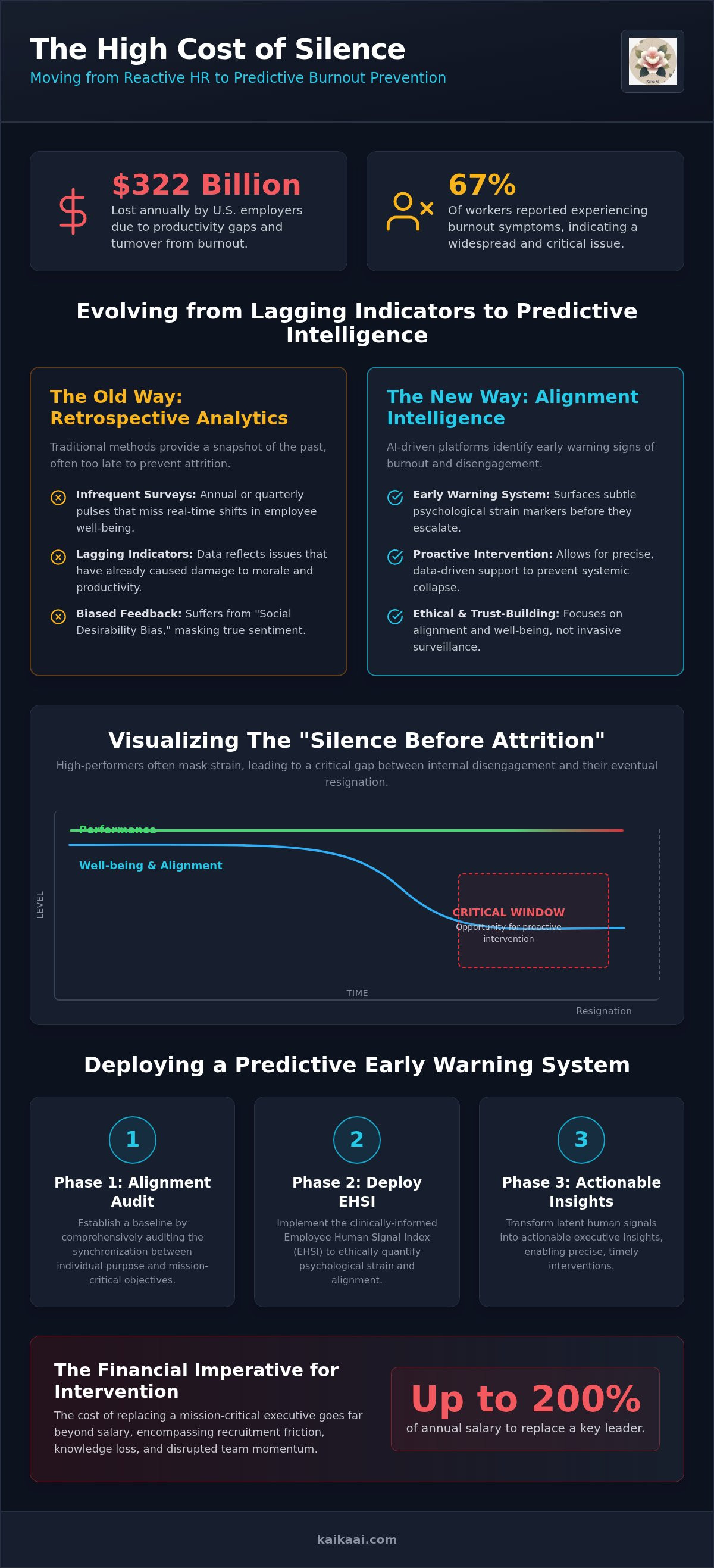
While U.S. employers lose $322 billion annually to productivity gaps and turnover, the true cost of burnout is measured in the quiet departure of your most vital architects. With 67% of workers reporting burnout symptoms in 2026, the reliance on infrequent, retrospective engagement surveys has become a strategic liability. You recognize that the traditional pulse check is insufficient for the velocity of modern enterprise. You need a way to utilize AI for burnout prevention that identifies psychological strain without resorting to the invasive, trust-eroding surveillance of "Big Brother" monitoring.
You deserve a system that balances data-driven confidence with a deep respect for human potential. This guide details how to deploy a clinically-grounded predictive attrition framework to identify latent burnout signals and realign workforce purpose before your top talent resigns. We'll explore the transition from reactive crisis response to a proactive early warning system. By integrating workforce alignment intelligence, your organization can foster a culture of high-performance resilience and enduring mission synchronization.
Key Takeaways
- Identify the "Silence before Attrition" by transitioning from retrospective surveys to an intelligence layer that surfaces early psychological strain markers.
- Deploy the clinically-informed Employee Human Signal Index (EHSI) to bring scientific precision and ethical integrity to your predictive workforce analytics.
- Navigate the strategic divide between invasive surveillance and sophisticated AI for burnout prevention to protect employee trust while securing operational resilience.
- Execute a structured three-phase deployment, beginning with a comprehensive Alignment Audit to synchronize individual purpose with organizational mission-critical objectives.
- Leverage the Ikigai Intelligence Framework to transform latent human signals into actionable executive insights, validated by premier academic research partnerships.
Beyond Static Surveys: Why Enterprises Require a Burnout Prediction Platform
A burnout prediction platform functions as a sophisticated intelligence layer designed to surface subtle psychological strain markers before they manifest as operational failure. This technology moves beyond simple activity tracking to analyze the underlying alignment between a contributor's effort and the organization's strategic trajectory. By identifying patterns of cognitive overload and emotional exhaustion early, leadership can preserve the integrity of their most valuable human assets. Understanding the clinical nuances of occupational burnout is no longer an HR elective; it's a core requirement for maintaining enterprise velocity in a volatile market.
Relying on output metrics alone ignores the structural decay of human potential that often precedes a resignation. This phenomenon, known as the "Silence before Attrition," represents a critical window where performance remains high even as internal alignment has completely collapsed. High-performers often mask their strain by maintaining rigorous standards until they reach a breaking point. The financial imperative for intervention is undeniable. Replacing a mission-critical executive can cost an organization up to 200% of their annual salary when accounting for recruitment friction, knowledge loss, and the disruption of collective momentum. Utilizing AI for burnout prevention allows the C-suite to see through this silence.
The Limitations of Retrospective HR Analytics
Annual engagement scores serve as lagging indicators of organizational health. They provide a static snapshot of a dynamic system that has already shifted by the time the data reaches the executive suite. These surveys frequently suffer from Social Desirability Bias, where employees provide sanitized feedback to avoid perceived professional repercussions or to maintain a specific corporate image. This creates a dangerous information vacuum characterized by:
- Inaccurate sentiment data that masks burgeoning resentment or fatigue.
- A failure to capture the real-time physiological and psychological shifts associated with chronic stress.
- The inability to identify "quiet quitting" behaviors before they impact the bottom line.
We define the "attrition gap" as the critical period between a specialist's mental disengagement and their eventual physical resignation. During this gap, the individual is present in body but the "human energy velocity" is decelerating, leading to a silent erosion of collective resilience and innovation. Traditional feedback loops are simply too slow to bridge this divide.
From Reactive Management to Predictive Intelligence
Modern leadership must pivot from monitoring "hours worked" to overseeing the synchronization of human effort and strategic intent. Predictive platforms facilitate a transition toward Data-Driven Kaizen within the people operations function, where small, continuous adjustments to workload and alignment prevent systemic collapse. This approach treats employee well-being as a measurable component of operational integrity rather than a peripheral benefit.
By deploying AI for burnout prevention, organizations gain the ability to intervene with surgical precision, offering support exactly when the data indicates a decline in alignment. This shift ensures that the workforce remains agile and mission-focused rather than merely occupied. For a deeper understanding of these structural dynamics, consult The Definitive Guide to Workforce Alignment Software to learn how to synchronize purpose and performance at scale.
The Science of EHSI: Integrating Clinical Intelligence into Workforce Analytics
The Employee Human Signal Index (EHSI) serves as a clinically-informed metric, translating abstract psychological strain into quantifiable executive data. Unlike standard performance trackers that focus on output volume, the EHSI focuses on the structural integrity of the human element within the enterprise. By partnering with clinical psychologists, we've developed algorithms that prioritize accuracy and ethical safety, ensuring that the data reflects true human states rather than surface-level activity. This sophisticated approach to AI for burnout prevention allows leadership to distinguish between temporary fatigue and the systemic decay of professional engagement.
Our framework identifies critical behavioral markers that traditional analytics often overlook. We analyze variance in sentiment, communication velocity, and subtle mission-alignment shifts to construct a comprehensive view of organizational health. While the EHSI focuses on the individual, the broader Human Signal Index (HSI) acts as a behavioral layer detecting friction across entire departments. Recent analysis in Forbes highlights how AI To Predict Employee Burnout can empower HR teams to act with foresight rather than hindsight. Organizations seeking to stabilize their talent architecture can utilize a Workforce Alignment Intelligence Platform to transform these signals into strategic interventions.
The Role of Clinical Psychology in AI Algorithms
Precision in AI for burnout prevention requires a deep understanding of the human psyche. The EHSI is designed to distinguish between "constructive stress," which can drive growth during high-stakes cycles, and "chronic burnout risk," which signals an impending collapse. This clinical foundation is an ethical necessity; it prevents algorithmic bias and ensures that data-driven insights support at-risk employees rather than penalizing them. By grounding our intelligence in psychological science, we move away from punitive monitoring toward a model of institutional care and operational resilience.
The Ikigai Alignment Score as a Buffer against Burnout
The Ikigai Alignment Score (IAS) measures the critical intersection of individual purpose and corporate mission. Our research indicates that purpose-aligned employees demonstrate 3x higher resilience during intense operational phases compared to those who feel disconnected from the organization's core "why." When an individual's personal trajectory synchronizes with the company's strategic goals, the resulting synergy creates a natural resistance to exhaustion. Deeply rooted organizational purpose acts as the primary defense against systemic burnout by providing a cognitive framework that sustains effort even under pressure. This alignment ensures that high performance is not just a temporary spike, but a sustainable, long-term velocity.
Strategic Evaluation: Surveillance Monitoring vs. Alignment Intelligence
High-stakes enterprise environments often mistake visibility for understanding. While traditional surveillance methods focus on "Activity Tracking," measuring keystrokes or idle time, these metrics are blunt instruments that fail to capture the nuance of human contribution. This invasive monitoring creates a culture of performance anxiety, where specialists engage in productivity theater to avoid being flagged by rigid systems. True AI for burnout prevention requires a shift toward Alignment Intelligence, a method that listens to purpose and synergy rather than just output volume. Recent academic research on AI and burnout suggests that when monitoring is perceived as punitive, it actually accelerates the very exhaustion it intends to prevent.
Alignment Intelligence prioritizes the structural harmony of the organization. It doesn't track when a person is at their desk; it measures how synchronized their efforts are with the mission-critical objectives of the firm. By focusing on these high-level strategic concepts, leadership can identify psychological strain markers without eroding the foundational trust of their top talent. This approach transforms data from a tool of control into a framework for collective evolution and sustained excellence.
The Trust Architecture of Non-Invasive Listening
High-performance cultures thrive on transparency and agency. Our internal data confirms that non-invasive, alignment-focused platforms achieve an 87% employee honesty rate, a significant leap from the sanitized responses typical of traditional surveys. This honesty is only possible when contributors know their privacy is protected by Japanese and global enterprise-grade standards. We advocate for a "Signal before the Silence" philosophy, where the platform acts as an early warning system that respects individual boundaries. This preserves employee agency, which is a key driver of long-term organizational stamina and resilience.
Sugihara Bridge Model: Why AI Requires Human Interpretation
Pure technical intelligence is insufficient for managing the complexities of human behavior. The Sugihara Bridge Model emphasizes the necessity of pairing AI data with trained human judgment to ensure strategic accuracy. Without this human layer, an algorithm might misinterpret a high-stress sprint as a permanent burnout risk, failing to recognize the resilience and commitment driving a specific project. We utilize Strategic Sage consultants to interpret these signals, ensuring that every intervention is both precise and grounded in established management principles. For a deeper look at these dynamics, explore our resource on Leading Indicators of Employee Burnout.
Deploying a Predictive Early Warning System: A Three-Phase Implementation
Deploying a structural framework for AI for burnout prevention requires more than technical installation; it demands a methodical architectural integration into the organizational fabric. We approach this transition through three distinct phases that move from diagnostic realization to operational mastery. This progression ensures that the intelligence layer doesn't just exist as a passive monitor but functions as a dynamic catalyst for institutional health. By following this methodical sequence, leadership can transform fragmented data into a unified system of high-performance resilience.
The first phase centers on the Alignment Audit. Before any software deployment, leadership must establish mission-critical baselines by identifying departments exhibiting the highest risk for silent attrition. In the second phase, Real-Time Metric Integration, the EHSI and HSI signals are synchronized with existing executive dashboards. This provides CHROs with a continuous, high-fidelity view of psychological strain. Finally, the third phase focuses on Operational Resilience Training. Technology alone is insufficient; executive leadership must be equipped to act on the signals they receive. We utilize Collective Kaizen Workshops to facilitate team realignment, ensuring that once a risk is identified, the response is both systematic and human-centric.
Phase 1: The Alignment Audit
The Alignment Audit serves as the diagnostic foundation for the entire framework. During this phase, we pinpoint where the "attrition gap" is widening by identifying departments with the highest potential for silent attrition. We measure Organizational Synergy to ensure the corporate mission is cascaded correctly through every layer of the hierarchy. By setting precise KPIs for workforce velocity and long-term sustainability, we create a benchmark for future growth that accounts for both output and human energy velocity.
Building Institutional Resilience
Building institutional resilience requires integrating "Psychological Stamina" into the core corporate governance framework. Leadership must be trained to handle sensitive burnout data with a balance of empathy and strategic precision. This ensures that interventions are viewed as supportive rather than punitive, maintaining the trust architecture we've established. You can explore these methodologies further in our guide on Operational Resilience for Leadership. To begin stabilizing your talent architecture today, schedule an Alignment Audit with our strategic consultants.
The Kaika AI Advantage: Surfacing Human Truth Before Silent Attrition
Kaika AI stands as the definitive category leader in Workforce Alignment Intelligence, offering a sophisticated alternative to the blunt instruments of traditional employee monitoring. We've moved beyond the "cold" algorithmic risks of pure surveillance to create a system dedicated to human capital evolution. Our academic research partnership with Waseda University serves as a rigorous trust signal, ensuring that our data validity meets the highest institutional standards. By focusing on structural harmony rather than mere activity, we provide the strategic foresight necessary for effective AI for burnout prevention.
The efficacy of our framework is reflected in our exceptional engagement metrics. We maintain a 72 NPS and a 74% weekly completion rate, figures that demonstrate genuine employee buy-in and perceived platform value. This level of participation is critical; it ensures the intelligence gathered is a reflection of honest human truth rather than the sanitized data produced by "productivity theater." When contributors feel the platform supports their personal mission, the "Signal before the Silence" becomes a reliable guide for executive intervention.
The Ikigai Intelligence Framework (IIF)
The Ikigai Intelligence Framework (IIF) functions as a unified executive command center, synthesizing the IAS, HSI, and EHSI indices into a singular strategic view. This comprehensive architecture allows leadership to monitor the synchronization of individual purpose and organizational velocity across global divisions. We adhere to Japanese-level privacy standards and enterprise-grade sophistication, ensuring that sensitive data remains secure and ethically handled. Our 2032 vision is to set the global standard for workforce alignment, positioning our platform as a prerequisite for institutional excellence and future public listing.
Securing Early Access to Kaika AI
CHROs ready to stabilize their talent architecture can initiate the process through an Alignment Audit and strategic consultation. During the initial architectural integration phase, our consultants work to map your organization's mission-critical objectives to our intelligence indices, ensuring a seamless transition from reactive management to predictive resilience. This methodical onboarding establishes the baselines required to detect the subtle shifts in human energy velocity that precede attrition. Visionary leaders must act now while there is still time to act to protect their most vital talent from the invisible erosion of systemic burnout.
Securing the Human Foundation of Enterprise Velocity
True organizational resilience depends on the structural alignment of individual purpose and corporate mission. We've explored how transitioning from retrospective surveys to a predictive intelligence layer allows leadership to identify psychological strain markers with surgical precision. By deploying AI for burnout prevention, you move beyond the limitations of invasive monitoring to embrace a framework of ethical, non-invasive listening. This approach is anchored by a clinically-informed EHSI developed alongside clinical psychologists and validated through our academic research partnership with Waseda University.
The results are measurable. Our pilot studies demonstrate an 87% employee honesty rate, indicating that contributors value a system that prioritizes their long-term stamina over short-term activity tracking. You have the opportunity to transform your people operations from a reactive cost center into a proactive engine of high-performance stability. Now is the time to synchronize your workforce before the quiet departure of your most vital architects compromises your strategic trajectory. We invite you to lead this evolution and protect the human potential that drives your mission forward.
Request Early Access to the Kaika AI Workforce Alignment Platform and begin architecting a future of enduring organizational harmony today.
Frequently Asked Questions
How does a burnout prediction platform differ from standard HR analytics software?
Standard HR analytics are retrospective and reactive, while a burnout prediction platform provides real-time, clinically-informed foresight into human energy velocity. It functions as an intelligence layer that detects psychological strain before it impacts organizational output. Unlike basic tools, it measures the structural alignment between individual purpose and the organization's strategic trajectory.
Is the data from burnout prediction accurate enough to base executive decisions on?
Data validity is secured through a clinically-informed EHSI developed with clinical psychologists and an academic research partnership with Waseda University. These foundations ensure that executive decisions are based on structural human truths rather than superficial activity metrics. Pilot studies have confirmed an 87% employee honesty rate, providing high-fidelity signals for strategic intervention.
Will employees feel like their privacy is being invaded by an AI prediction platform?
Employees embrace these platforms when they're framed as tools for institutional care and long-term stamina rather than invasive surveillance. By adhering to Japanese-level privacy standards and focusing on non-invasive alignment signals, organizations protect contributor agency. This shift from monitoring behavior to measuring synergy ensures that AI for burnout prevention is viewed as a supportive resource.
What are the primary behavioral indicators of burnout that AI can detect in real-time?
The platform analyzes subtle shifts in communication velocity, sentiment variance, and mission-critical alignment markers to detect latent strain. These indicators surface the "Silence before Attrition," where a specialist's performance remains high but their internal synchronization with the firm is decaying. Identifying these patterns allows leadership to address structural friction before it leads to physical resignation.
How can a company use burnout data without creating a 'Big Brother' culture?
Organizations avoid a "Big Brother" culture by prioritizing Alignment Intelligence over intrusive Activity Tracking. This means listening to human purpose and synergy rather than monitoring keystrokes or idle time. Using AI for burnout prevention to foster collective resilience ensures that the technology serves the workforce's well-being, creating a culture of high-performance harmony rather than surveillance-driven anxiety.
Can burnout prediction platforms help manage remote or hybrid workforce alignment?
Burnout prediction platforms are essential for managing distributed teams where traditional social cues are absent. By analyzing digital interaction patterns and purpose-alignment scores, leadership can bridge the gap between remote specialists and the central mission. This ensures that hybrid employees remain synchronized with the organization's strategic trajectory, reducing the digital overload and isolation that often accelerate burnout.
What is the expected ROI of implementing a burnout prediction platform for a large enterprise?
The primary ROI is the drastic reduction in recruitment and knowledge-loss costs, as replacing a mission-critical executive can cost up to 200% of their annual salary. Beyond direct savings, implementation drives long-term value through sustained human energy velocity and reduced silent attrition. This architectural stability ensures that the firm maintains its competitive edge and operational resilience in volatile global markets.
Disclaimer
#Disclaimer
At Kaika AI, we believe the future belongs to organizations that combine human wisdom with artificial intelligence responsibly. The articles, research, insights, and thought leadership published on this website are intended to educate, inform, and encourage meaningful conversations about the future of work, organizational intelligence, AI, leadership, and innovation.
While our content is developed through rigorous research and may be generated, curated, or enhanced using artificial intelligence, every effort is made to ensure it reflects thoughtful analysis, practical relevance, and responsible AI practices. However, no representation or warranty is made regarding the completeness, accuracy, or suitability of the information for every individual or organizational circumstance.
The ideas, opinions, frameworks, and recommendations shared by Kaika AI are provided for educational and informational purposes only. They should not be interpreted as legal, financial, medical, psychological, human resources, cybersecurity, or other professional advice. Organizations and individuals should seek qualified professional guidance before making strategic, legal, or operational decisions.
Where articles reference third-party organizations, products, services, academic research, industry reports, or public data, such references are provided solely to support discussion and analysis. Unless explicitly stated, they do not imply endorsement, partnership, or affiliation.
Artificial intelligence is a powerful decision-support technology—not a replacement for human judgment. Kaika AI advocates for responsible, transparent, and human-centered AI adoption. We encourage readers to critically evaluate information, consider their unique context, and combine AI-generated insights with professional expertise and sound decision-making.
The content published on this website may be updated, revised, or removed as knowledge, technology, regulations, and best practices continue to evolve.
To the fullest extent permitted by applicable law, Kaika AI, its affiliates, contributors, and partners disclaim liability for any direct, indirect, incidental, consequential, or other losses arising from the use of, or reliance upon, the information provided on this website.
By accessing or using this website, you acknowledge that you have read, understood, and agree to this Disclaimer.
Kaika AI
'Building trusted organizational intelligence for the AI Era'


