
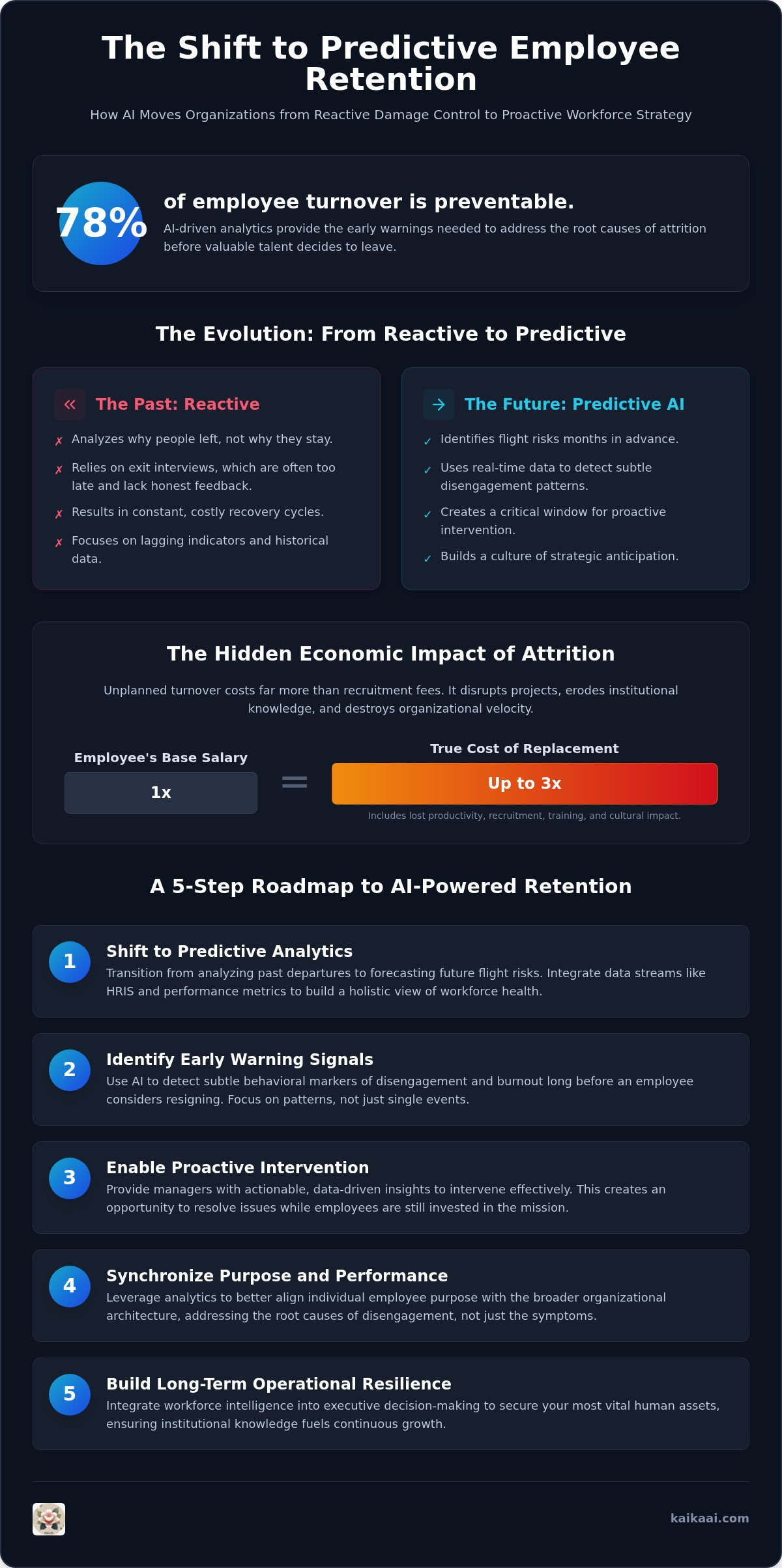
Recent data confirms that 78% of the reasons employees quit their jobs are entirely preventable. For executive leadership, this statistic represents more than a human resources challenge; it's a structural vulnerability that threatens institutional knowledge and systemic velocity. You recognize the high stakes of specialized turnover and the silent erosion caused by undetected burnout in remote environments. Implementing ai for employee retention allows you to move beyond reactive damage control and toward a model of precision workforce alignment.
This guide demonstrates how to shift your perspective from traditional attrition management to a predictive framework that identifies flight risks before they materialize. You'll learn to synchronize individual purpose with your broader organizational architecture using sophisticated early-warning systems. We will examine the transition from surface-level engagement metrics to a data-driven strategy that secures your most vital human assets. This methodology ensures your talent remains anchored in a framework of shared mission and improved operational resilience.
Key Takeaways
- Identify high-stakes flight risks early by shifting from lagging exit interviews to predictive turnover analytics.
- Synchronize individual purpose with organizational architecture using the Ikigai Intelligence Framework to resolve the root causes of disengagement.
- Deploy ai for employee retention through a structured five-step roadmap focused on data integrity and ethical transparency.
- Establish a proactive "signal before silence" culture that detects burnout and misalignment patterns months before they lead to attrition.
- Build long-term operational resilience by integrating academic-validated workforce intelligence into your executive decision-making process.
The Evolution of Retention: From Reactive Reporting to Predictive Turnover Analytics
Historically, human resources relied on post-mortem data to understand workforce stability. Exit interviews served as the autopsy of a failed engagement, providing insights only after the talent had departed. This reactive stance is no longer sufficient for enterprise leadership. By the time a resignation reaches your desk, the cultural and economic damage is already done. Utilizing ai for employee retention transforms this timeline. It allows executives to identify subtle shifts in behavioral signals before they manifest as a formal departure. This evolution moves the organization from a state of constant recovery to a posture of strategic anticipation.
Many traditional employee retention strategies focus on retrospective metrics that describe what happened, rather than predicting what will happen. This creates a structural vulnerability. Leaders find themselves solving for yesterday's problems while today's high-performers are already mentally disengaging. To better understand how technology is reshaping this field, watch this video on the trends transforming workforce stability:
Why Exit Interviews are Too Late
Exit interviews suffer from a fundamental lack of psychological safety. Departing employees often prioritize maintaining professional bridges over providing the raw, diagnostic feedback necessary for structural improvement. This creates a feedback gap where the true causes of regrettable attrition remain obscured. Regrettable attrition, the loss of high-performers with specialized skills and deep institutional knowledge, is the most expensive form of turnover. Once a resignation is submitted, the psychological distance is usually too vast to bridge. Predictive intelligence identifies these disengagement patterns months in advance, providing a critical window for intervention while the employee is still invested in the mission.
The Economic Impact of Unplanned Attrition
The cost of turnover extends far beyond recruitment fees and onboarding hours. Unplanned attrition destroys organizational velocity. When a key architect or specialized strategist leaves, the ripple effect disrupts cross-departmental synergy and stalls project momentum. These indirect costs often triple the base salary of the departing role. Leaders must view retention as a core pillar of operational resilience. Securing your workforce architecture through ai for employee retention ensures that institutional knowledge remains within the system. It fuels continuous growth rather than constant recovery. Research confirms that 78% of the reasons employees quit are preventable. Success requires hearing the signal before the silence of a formal resignation.
The Mechanics of Predictive Intelligence: How AI Identifies Flight Risk
Predictive turnover analytics represents a paradigm shift in organizational architecture. It moves beyond the administrative limits of traditional HR into the strategic domain of Workforce Intelligence. Using ai for employee retention allows leaders to identify disengagement patterns before they reach a point of no return. Unlike static quarterly surveys, real-time metrics provide a continuous pulse on organizational health. This approach is gaining traction across sectors, as seen in Predictive Analytics for Public Sector Retention, where data-driven algorithms generate risk scores to prevent talent loss. By integrating disparate data streams, including HRIS and sentiment analysis, you gain a 360-degree view of the workforce.
The Human Signal Index (HSI)
The Human Signal Index (HSI) provides the necessary resolution to see these patterns. It surfaces the specific behavioral markers of disengagement within large-scale enterprises. Unlike intrusive activity trackers, the HSI focuses on alignment and synchronicity. It identifies the "signal before the silence" by measuring how individual output interacts with the organizational architecture. When these signals diverge, the system flags a risk. This enables a targeted response that honors both the individual's purpose and the company's mission. Organizations utilizing these frameworks report an 87% honesty rate in employee feedback, far exceeding the sanitized data found in traditional surveys.
Clinical Precision in Burnout Detection
Burnout detection requires more than simple sentiment analysis. The Employee Human Signal Index (EHSI) introduces clinical rigor into the intelligence framework. Developed with clinical psychologists, this metric identifies the psychological strain that leads to systemic exhaustion. It moves beyond measuring workload to assessing the health of the human-system interface. By identifying burnout risk 3-6 months before attrition occurs, leaders can implement structural changes to restore harmony. This proactive intervention is essential for maintaining a high-performance culture without sacrificing human potential. You can explore how these metrics function in practice through an Alignment Audit of your current workforce data.
The Ikigai Intelligence Framework: Synchronizing Purpose and Performance
Engagement is a trailing indicator. While many organizations focus on surface-level happiness or activity logs, these metrics fail to address the core driver of longevity: purpose alignment. When an individual's personal mission diverges from the organizational architecture, disengagement is inevitable. The Ikigai Intelligence Framework (IIF) provides a sophisticated lens through which to view this relationship. By leveraging ai for employee retention, leaders can move beyond measuring how much an employee works and start understanding why they remain committed to the collective mission. This shift identifies the root causes of turnover rather than merely documenting the symptoms.
Measuring the Ikigai Alignment Score
The Ikigai Alignment Score (IAS) offers a precise, data-driven calculation of mission synchronicity. It evaluates the intersection of individual passion, professional competency, and organizational needs. Standard satisfaction scores often fluctuate based on temporary environmental factors; however, the IAS remains a stable predictor of long-term retention. It quantifies the degree of harmony between the employee's internal 'reason for being' and their functional role within the enterprise. For a deeper look at the tools facilitating this measurement, consult The Definitive Guide to Workforce Alignment Software. This level of resolution allows executives to see exactly where purpose and performance are in conflict, enabling targeted structural adjustments before top-tier talent begins to look elsewhere.
Bridging the Gap Between Individual and Corporate Goals
Executive leadership holds the responsibility for cascading mission-critical alignment across global divisions. Misalignment rarely happens in isolation; it often clusters in specific pockets within the organizational structure. Using advanced intelligence, you can pinpoint these areas of friction where individual goals have become decoupled from the corporate vision. This systemic view is vital for maintaining workforce velocity and preventing the silent erosion of institutional knowledge. Recognizing these patterns early is a cornerstone of proactive leadership. Our research into Leading Indicators of Employee Burnout highlights how purpose misalignment serves as a primary precursor to psychological strain. Organizations that master this synchronization through ai for employee retention achieve higher operational resilience. They don't just retain employees; they cultivate a workforce that is fundamentally aligned with the company's future trajectory.
Implementing a Predictive Framework: A 5-Step Executive Roadmap
Integrating ai for employee retention requires more than technical installation; it demands a structural reconfiguration of leadership mindset. This roadmap ensures your transition from reactive management to predictive workforce alignment is both systematic and ethical. By following a structured methodology, you transform disparate data points into a cohesive strategy for organizational harmony. This process allows for the synchronization of individual potential with high-scale enterprise goals.
- Establish a foundation of ethical data use and transparency to secure workforce trust.
- Integrate disparate data streams, including HRIS and real-time sentiment, for a unified intelligence view.
- Calibrate the AI model using clinical benchmarks and organizational performance history.
- Operationalize insights through the Sugihara Bridge Model to ensure human-centric intervention.
- Foster a culture of data-driven Collective Kaizen to drive continuous workforce evolution.
Ethical AI and Data Privacy Standards
Successful predictive systems rely on the integrity of the underlying data. Adhering to enterprise-grade security and stringent Japanese privacy standards is non-negotiable for maintaining organizational trust. When employees feel secure in the anonymity of their contributions, the quality of the behavioral signal improves significantly. This environment of high-trust data collection is what drives the 87% employee honesty rate observed in optimized intelligence systems. Without this ethical bedrock, predictive models risk becoming surveillance tools rather than instruments of alignment. Leadership must prioritize transparency to ensure the workforce remains an active participant in the alignment process.
Operationalizing Insights with Human Judgment
Data provides the diagnostic map, but human judgment provides the strategic navigation. Purely algorithmic approaches to workforce management often fail because they lack the nuance of organizational psychology. The Sugihara Bridge Model addresses this by pairing high-resolution AI measurement with trained human consultants. This synergy ensures that the signals detected by the ai for employee retention framework lead to strategic, empathetic interventions. It empowers CHROs to act with absolute confidence, transforming raw data into measurable structural impact. Leaders who utilize this balanced approach don't just solve for attrition; they build a resilient workforce architecture capable of global scale. You can begin this transformation by implementing a Workforce Alignment Intelligence Platform to secure your high-performer velocity.
Achieving Organizational Synergy with Kaika AI’s Workforce Intelligence
Kaika AI provides the architectural foundation for global enterprise transformation. Integrating ai for employee retention allows you to transcend simple risk mitigation and enter the domain of high-performance culture acceleration. This transition is governed by a three-phase strategic integration framework designed for enterprise SaaS environments. In the initial phase, we perform an Alignment Audit to establish a baseline of current human signals. The second phase involves the deployment of the Workforce Alignment Intelligence Platform to surface real-time insights. By leveraging our academic partnership with Waseda University, we provide a validated methodology that moves beyond corporate trends and into the realm of structural excellence. The focus isn't just on stopping departures; it's on building a resilient system where talent thrives in synchronicity with the mission.
Strategic Integration and Executive Consultation
Effective alignment requires a top-down architectural commitment. Our Executive Consultation services provide CHROs and global leadership with the precision necessary to navigate complex organizational shifts. Through Collective Kaizen Workshops, teams engage in structured synchronization, ensuring that individual purpose remains locked with corporate objectives. This process is documented in The Executive Guide to Data-Driven Kaizen Platforms, which explores how continuous performance is reimagined through data. These workshops aren't just meetings. They're the engine of systemic evolution that transforms insights into operational reality. We prioritize the development of internal capabilities, ensuring your leadership team can interpret predictive signals with clinical accuracy and strategic foresight.
Securing the Future of the Workforce
The ultimate goal of workforce intelligence is to hear the "signal before the silence." This proactive capability ensures that misalignment is corrected before it results in the loss of specialized talent. Our commitment to institutional stability is reflected in our roadmap for a dual TSE/ASX listing target in 2032. Platform efficacy is evidenced by an NPS of 72, demonstrating that the framework delivers measurable value to leadership and employees alike. By adopting ai for employee retention, your organization achieves a state of operational resilience that defines the global standard for excellence. You don't just manage a workforce; you lead an aligned collective toward a shared future. This strategic evolution secures your competitive advantage by protecting your most vital asset: human potential.
Advancing Toward Systemic Workforce Alignment
The transition from retrospective attrition reporting to predictive workforce intelligence represents a fundamental shift in organizational architecture. You've explored how identifying behavioral signals before they manifest as resignations allows for proactive leadership rather than reactive damage control. By prioritizing purpose synchronicity over surface-level engagement, you secure the institutional knowledge and systemic velocity required for global scale. Integrating ai for employee retention provides the high-resolution data necessary to maintain structural integrity and human harmony across your enterprise.
Our methodology, co-developed with clinical psychologists and Waseda University, delivers the precision required for high-stakes decision-making. Pilot deployments have achieved an 87% employee honesty rate and a 74% weekly completion rate, proving that trust and transparency drive actionable intelligence. These tools empower you to detect burnout and misalignment months before attrition occurs, ensuring your high-performers remain committed to the mission. It's time to evolve your retention strategy into a framework for continuous excellence.
Request early access to the Kaika AI Workforce Alignment Intelligence Platform to secure your organizational future.
Frequently Asked Questions
What is predictive employee turnover analytics and how does it work?
Predictive turnover analytics is a machine learning methodology that identifies behavioral patterns preceding workforce disengagement. It functions by synthesizing historical HRIS data with real-time sentiment streams to generate risk scores. This allows leadership to transition from lagging indicators to a proactive stance. Implementing ai for employee retention through this framework identifies potential departures while there's still a window for strategic intervention.
Can AI really predict when an employee is going to quit?
AI identifies disengagement signals approximately 3 to 6 months before a formal resignation occurs. These early behavioral markers, often called the signal before the silence, allow leadership to address the root causes of turnover. By analyzing shifts in synchronicity and mission alignment, the system flags flight risks with high resolution. This foresight is critical for maintaining organizational velocity and protecting specialized institutional knowledge.
How does the Ikigai Intelligence Framework differ from standard HR analytics?
The Ikigai Intelligence Framework (IIF) focuses on the root cause of retention: purpose alignment. Standard HR analytics often measure trailing symptoms like activity logs or superficial satisfaction scores. The IIF quantifies the synchronicity between individual mission and organizational architecture. This depth ensures that workforce intelligence remains focused on human potential and structural harmony rather than administrative metrics.
What data is used to calculate the Employee Human Signal Index (EHSI)?
The Employee Human Signal Index (EHSI) utilizes a blend of behavioral signals and sentiment analysis informed by clinical psychology. It measures indicators of psychological strain and systemic burnout risk to provide a diagnostic view of workforce health. This metric is co-developed with clinical psychologists to ensure accuracy and ethical integrity. It moves beyond simple stress tracking to assess the long-term resilience of the human-system interface.
Is predictive turnover analytics ethical and compliant with privacy laws?
Responsible ai for employee retention adheres to stringent global privacy standards, including the EU AI Act and Japanese data protection laws. Ethical frameworks prioritize employee anonymity and transparency to foster a culture of high trust. Ensuring data integrity through secure, non-intrusive collection methods is essential for maintaining workforce honesty. Our platform is designed to meet these rigorous compliance requirements while delivering actionable strategic insights.
What is the Sugihara Bridge Model in workforce intelligence?
The Sugihara Bridge Model is a strategic framework that pairs high-resolution AI measurement with trained human consultation. It ensures that sensitive workforce decisions are never left to algorithms alone. By combining technical intelligence with executive expertise, the model operationalizes data into meaningful structural changes. This synergy allows CHROs to lead with confidence, knowing their interventions are validated by both data and psychological nuance.
How does purpose alignment impact employee retention?
Purpose alignment serves as the primary driver of workforce longevity and operational resilience. When an employee's personal mission synchronizes with the organizational architecture, they're significantly less likely to disengage. Misalignment is often the root cause of regrettable attrition in specialized roles. Organizations that prioritize this synchronicity achieve higher velocity and a more durable competitive advantage in global markets.
What is a good honesty rate for employee sentiment surveys?
A high-performing intelligence system should target an honesty rate above 80% to ensure data reliability. Kaika AI achieves an 87% honesty rate by utilizing anonymous, high-trust frameworks that prioritize psychological safety. This level of transparency is rare in traditional surveys, which often suffer from sanitized or performative feedback. Achieving these benchmarks is critical for building a predictive system that leadership can trust for strategic planning.
Disclaimer
#Disclaimer
At Kaika AI, we believe the future belongs to organizations that combine human wisdom with artificial intelligence responsibly. The articles, research, insights, and thought leadership published on this website are intended to educate, inform, and encourage meaningful conversations about the future of work, organizational intelligence, AI, leadership, and innovation.
While our content is developed through rigorous research and may be generated, curated, or enhanced using artificial intelligence, every effort is made to ensure it reflects thoughtful analysis, practical relevance, and responsible AI practices. However, no representation or warranty is made regarding the completeness, accuracy, or suitability of the information for every individual or organizational circumstance.
The ideas, opinions, frameworks, and recommendations shared by Kaika AI are provided for educational and informational purposes only. They should not be interpreted as legal, financial, medical, psychological, human resources, cybersecurity, or other professional advice. Organizations and individuals should seek qualified professional guidance before making strategic, legal, or operational decisions.
Where articles reference third-party organizations, products, services, academic research, industry reports, or public data, such references are provided solely to support discussion and analysis. Unless explicitly stated, they do not imply endorsement, partnership, or affiliation.
Artificial intelligence is a powerful decision-support technology—not a replacement for human judgment. Kaika AI advocates for responsible, transparent, and human-centered AI adoption. We encourage readers to critically evaluate information, consider their unique context, and combine AI-generated insights with professional expertise and sound decision-making.
The content published on this website may be updated, revised, or removed as knowledge, technology, regulations, and best practices continue to evolve.
To the fullest extent permitted by applicable law, Kaika AI, its affiliates, contributors, and partners disclaim liability for any direct, indirect, incidental, consequential, or other losses arising from the use of, or reliance upon, the information provided on this website.
By accessing or using this website, you acknowledge that you have read, understood, and agree to this Disclaimer.
Kaika AI
'Building trusted organizational intelligence for the AI Era'


