
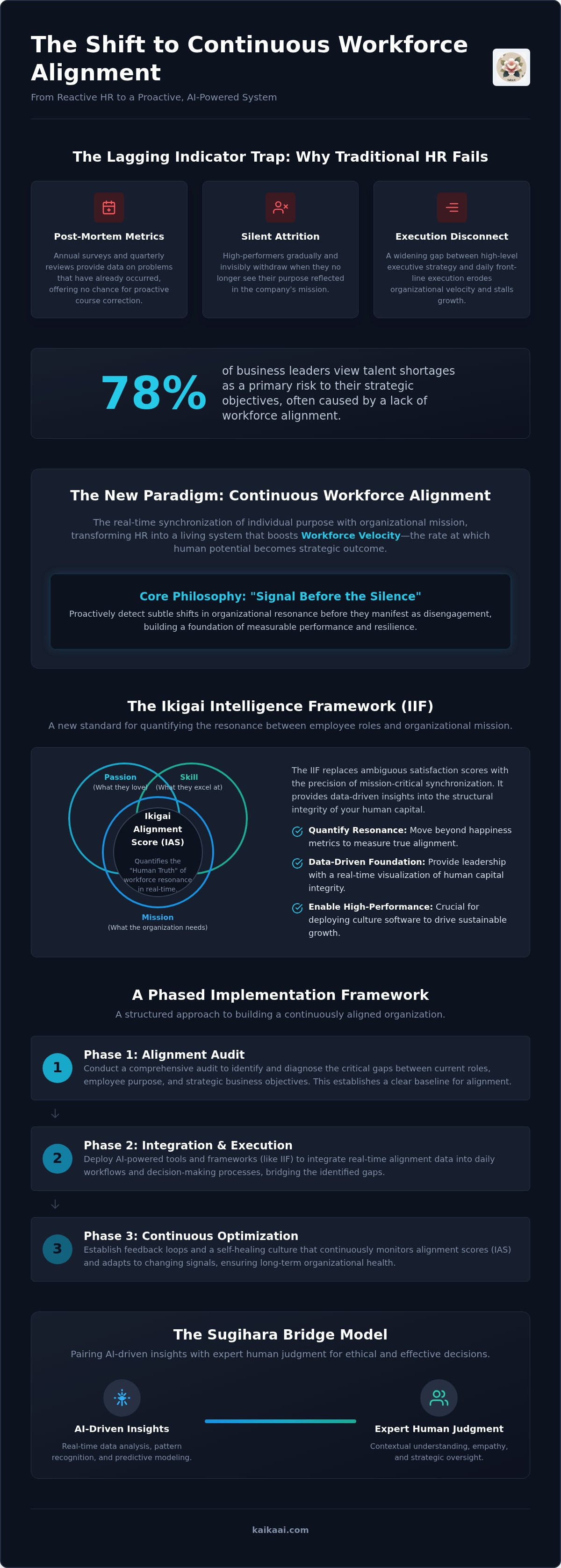
The traditional annual engagement survey isn't just a lagging indicator; it's a post-mortem on a culture that's already fractured. While your executive dashboard might show a stable headcount, 78% of business leaders now view talent shortages as a primary risk to their strategic objectives. This gap often stems from a lack of continuous workforce alignment, where the silent attrition of high-performers goes unnoticed until the damage is irreversible. You likely feel the growing disconnect between your high-level strategy and daily front-line execution, a friction that quietly erodes organizational velocity and stalls growth.
It's time to move beyond static planning. This guide reveals how to transform your HR architecture into a dynamic, AI-powered system that synchronizes individual purpose with enterprise strategy. You'll learn to replace guesswork with real-time human signals to eliminate the disconnects that lead to disengagement. We'll examine the structural shift toward early signal detection, the integration of the Sugihara Bridge Model, and the specific methodologies required to build a high-performance culture grounded in structural integrity and shared mission.
Key Takeaways
- Transition from static annual reviews to continuous workforce alignment to synchronize individual purpose with enterprise strategy in real-time.
- Implement the Ikigai Intelligence Framework (IIF) and the Ikigai Alignment Score (IAS) to quantify the resonance between employee roles and organizational mission.
- Leverage the Sugihara Bridge Model to balance AI-driven data insights with expert human judgment for ethical and nuanced workforce decisions.
- Execute a three-phase integration strategy, beginning with an Alignment Audit to identify and bridge critical gaps in your organizational structure.
- Establish a self-healing organizational culture that detects early signals of disengagement to eliminate silent attrition among high-performing talent.
The Paradigm Shift: Defining Continuous Workforce Alignment
Continuous workforce alignment represents the real-time synchronization of individual purpose with organizational mission. It's a structural evolution from static, periodic assessments to a living system of operational harmony. While traditional models often focus on "workforce readiness" as a measure of degree attainment or external hiring, true enterprise resilience depends on the internal resonance between a company's strategic intent and its employees' daily execution. This synchronization generates workforce velocity, the measurable rate at which an organization converts human potential into strategic outcomes.
To better understand the immediate steps required to achieve this state, watch this helpful video:
When this synchronization fails, organizations suffer from silent attrition. This phenomenon isn't merely turnover; it's the gradual, invisible withdrawal of high-performers who no longer see their personal reason for being reflected in the corporate path. The cost is a catastrophic loss of institutional knowledge and a deceleration of competitive momentum. Leaders who ignore these subtle fractures risk a complete breakdown of organizational synergy.
The Limitations of Static Strategic Planning
Traditional HR relies on the lagging indicator trap. Annual reviews and quarterly surveys provide data on events that have already occurred, offering no opportunity for proactive correction. This reliance on historical data represents a failure of modern Workforce Sciences, which advocates for the measurement of workforce impact in real-time. Without continuous workforce alignment feedback loops, the gap between executive strategy and front-line execution widens into a chasm. Departmental silos exacerbate this friction, creating isolated pockets of activity that lack a unified direction and drain resources through redundant effort.
From Engagement to Alignment Intelligence
Leadership must distinguish between simple employee happiness and deep mission alignment. A "happy" workforce can still be directionless, while an aligned workforce is driven by a shared sense of purpose and structural integrity. We advocate for the "Signal before the Silence" philosophy. This proactive stance allows executives to detect subtle shifts in organizational resonance before they manifest as disengagement or resignation. By prioritizing intelligence over surface-level sentiment, companies build a foundation of measurable performance. Workforce alignment is a structural necessity for operational resilience.
The Ikigai Intelligence Framework: A New Standard for Measurement
The Ikigai Intelligence Framework (IIF) establishes a rigorous, multidimensional architecture for quantifying human resonance within the enterprise. It replaces the inherent ambiguity of traditional employee satisfaction scores with the precision of mission-critical synchronization. By moving beyond surface-level sentiment, the IIF provides a data-driven foundation for continuous workforce alignment, allowing leadership to visualize the structural integrity of their human capital in real-time.
Measuring the Intersection of Love, Skill, and Mission
Ikigai, the Japanese philosophical concept regarding one's reason for being, serves as the conceptual anchor for this modern measurement system. In a sophisticated corporate environment, we translate this philosophy into the Ikigai Alignment Score (IAS). The IAS doesn't just track labor output; it quantifies the "Human Truth" by measuring the resonance between an individual's core purpose and the organization's strategic mission. This level of insight is critical for organizations deploying high-performance culture software to drive sustainable growth. Effective leadership relies on these Key Principles for Effective Strategic Workforce Planning to ensure every role serves a mission-critical function. Our framework has demonstrated an 87% employee honesty rate in pilot programs, proving that when employees feel their purpose is understood, they provide more accurate, actionable data.
The framework operates through three proprietary indices that function as a unified intelligence system. The IAS measures current purpose-mission fit. The Human Signal Index (HSI) detects early behavioral shifts that suggest a loss of synchronization. Finally, the Employee Human Signal Index (EHSI) provides a clinical window into the workforce's psychological health, identifying friction points before they escalate into systemic failures.
Clinical Precision in Burnout Detection
The EHSI distinguishes itself through its rigorous foundation in clinical psychology. Developed in collaboration with clinical psychologists and academic partners at Waseda University, this index identifies the leading indicators of employee burnout before they manifest as attrition. Real-time metrics track psychological strain, identifying high-performers at risk of "silent departure" long before they submit a resignation. This early detection allows for surgical executive intervention rather than reactive, broad-based policy changes that often fail to address the root cause of disengagement. By monitoring these clinical signals, organizations maintain continuous workforce alignment and protect their most valuable human assets from structural exhaustion. This predictive intelligence ensures that the human element of the enterprise remains resilient, even during periods of high-velocity change.
Consider how an Alignment Audit might reveal the hidden friction points within your current leadership structure and provide the clarity needed for your next strategic evolution.
The Sugihara Bridge Model: Pairing AI with Human Judgment
The Sugihara Bridge Model represents a hybrid architecture designed for the ethical deployment of artificial intelligence within human capital management. Raw data, while powerful, often lacks the contextual depth required to navigate the complexities of organizational behavior. By pairing advanced analytics with expert human judgment, this model ensures that continuous workforce alignment remains a nuanced, empathetic process rather than a cold mechanical exercise. This "Human-in-the-Loop" approach stands in direct opposition to automated platforms that treat employees as mere data points. It respects the subtle cultural nuances inherent in global operations, specifically those within Japanese enterprise environments where harmony and collective purpose are paramount.
A bridge is only as strong as its foundation. In this model, the AI functions as the sensor, detecting subtle shifts in resonance that the human eye might miss. However, the interpretation of these signals remains a human prerogative. This methodology prevents the "black box" effect, where algorithms make life-altering career decisions without oversight. Instead, it empowers leadership with actionable intelligence that is validated by organizational psychologists and strategic consultants.
Ethical Data Use and Employee Trust
Trust is the currency of alignment. Our pilot programs achieved an 87% employee honesty rate, a figure that far exceeds industry norms for internal surveys. This transparency is rooted in a "Privacy by Design" approach that complies with the most stringent international standards, ensuring that data is used to empower rather than monitor. Trained consultants play a vital role here. They translate abstract signals into specific executive actions, providing a layer of interpretation that AI alone cannot replicate. This human bridge ensures that sensitive HR contexts are handled with the necessary sophistication, fostering a culture of mutual respect and long-term commitment. When employees understand that their input leads to structural improvement rather than punitive monitoring, the quality of data improves exponentially.
Continuous Improvement through Data-Driven Kaizen
Operational excellence requires more than just identifying gaps; it demands a systematic approach to resolution. The data-driven kaizen platform serves as the engine for this evolution. Through Collective Kaizen Workshops, teams utilize real-time alignment data to identify and dismantle structural inefficiencies that stifle productivity. This methodology shifts the organizational stance from reactive problem-solving to proactive alignment. The ROI of this transition is measurable in both workforce velocity and reduced attrition. By embedding continuous improvement into the daily workflow, enterprises move beyond the limitations of annual planning and embrace a state of perpetual, mission-driven optimization. This creates a resilient structure where continuous workforce alignment is not a goal to be reached, but a standard to be maintained.
Implementing Continuous Alignment: A Three-Phase Framework
Large-scale enterprises require a methodical integration strategy to move from static planning to dynamic synchronization. Establishing continuous workforce alignment isn't a simple software installation; it's a structural transformation. This framework provides a disciplined roadmap for leadership to bridge the gap between visionary strategy and operational reality. By following a structured progression, organizations ensure that their human capital architecture remains resilient and responsive to market volatility.
The Alignment Audit: Surfacing the Human Truth
The first phase involves conducting a mission critical alignment audit. This diagnostic process establishes an empirical baseline for organizational synergy by examining the resonance between executive objectives and front-line activity. Leaders often face specific "blind spots," such as overestimating the clarity of strategic communication or underestimating the friction caused by legacy workflows. The audit surfaces these hidden fractures before they manifest as attrition or productivity loss.
Key metrics used to establish this baseline include:
- Role Resonance: The degree to which an employee's daily tasks reflect their primary mission and the organization's strategic needs.
- Strategic Clarity: The measurable consistency of goal interpretation across different departmental hierarchies.
- Friction Density: The identification of structural barriers and departmental silos that impede workforce velocity.
Architectural Consultation and Continuous Intelligence
Once the audit identifies mission-critical gaps, the process moves into Architectural Consultation. During this phase, we design a synchronization framework tailored to the specific nuances of the organization's leadership style. This isn't a generic template. It's a bespoke blueprint for operational harmony that ensures continuous workforce alignment is embedded into the corporate DNA. Leadership must move beyond periodic check-ins to a state of perpetual synchronization.
The final phase is the deployment of Continuous Intelligence through the Ikigai Intelligence Framework (IIF). This enables real-time monitoring and facilitates Collective Kaizen Workshops where teams use data to solve structural inefficiencies. By maintaining this constant feedback loop, the organization achieves a "self-healing" state where alignment is perpetually optimized through both technical intelligence and human wisdom.
Developing a Leadership Mindset for Resilience
Structural change fails without an evolution in leadership mindset. Executive-level workshops are essential to ensure that governance models reflect modern workforce resilience metrics. CHROs must transition from being administrators of policy to strategic architects of human potential. To evaluate your current progress, consider this maturity checklist:
- Does your data provide early signals of disengagement before attrition occurs?
- Are your strategic goals translated into actionable purpose at every organizational level?
- Do you have a mechanism for pairing AI insights with expert human interpretation?
If you're ready to identify the hidden fractures in your organization, schedule a professional Alignment Audit to begin your strategic transformation.
The Future of Organizational Health: Beyond Attrition Prevention
Continuous workforce alignment transforms the enterprise into a self-healing organism. In this state, the organization doesn't merely react to crises; it proactively maintains its own structural integrity through constant synchronization. By moving beyond the reactive limitations of annual planning, leadership establishes a system where individual purpose and corporate mission remain in a state of perpetual resonance. This evolution marks the transition from traditional management to a sophisticated era of workforce alignment intelligence. We position this framework not just as a tool for retention, but as the fundamental prerequisite for sustainable enterprise velocity.
Our long-term vision for category leadership is rooted in an uncompromising commitment to scientific rigor and human potential. The collaboration with clinical psychologists and our academic partnership with Waseda University ensure that the Ikigai Intelligence Framework (IIF) continues to evolve alongside the complexities of modern labor markets. Kaika AI stands as the definitive partner for enterprises undergoing workforce transformation, providing the architectural blueprint needed to bridge the gap between technical capability and human fulfillment. This partnership enables CHROs to lead with a level of precision that was previously unattainable, grounding high-stakes decisions in empirical truth rather than executive intuition.
Scaling Synergy Across Global Divisions
The IIF is designed to handle the intricate challenges of cross-departmental and international alignment. In large-scale global enterprises, departmental silos and cultural variances often create friction that stalls strategic momentum. Our framework synchronizes corporate missions across diverse cultural contexts, ensuring that a unified vision translates effectively from Tokyo to New York. This synchronization is particularly critical during global M&A integration, where the ability to track real-time synergy can determine the success or failure of a merger. By visualizing the alignment of disparate workforces, leadership can identify and resolve cultural or operational disconnects before they compromise the value of the deal.
Securing Early Access to Alignment Intelligence
The competitive advantage of the next decade belongs to those who can hear the signal before the silence. While competitors focus on surface-level agility, visionary leaders understand that continuous workforce alignment is the only path to true organizational resilience. Detecting the subtle shifts in human resonance allows you to intervene before disengagement manifests as attrition. This proactive stance protects your most valuable human assets and ensures your strategic objectives are met with uncompromising velocity. We invite you to move beyond the post-mortem data of the past and embrace a future of real-time organizational harmony.
Take the first step toward building a resilient, mission-driven enterprise. Request early access to the Kaika AI Workforce Alignment Platform and secure your position at the forefront of workforce evolution.
Mastering the Architecture of Organizational Resonance
The evolution toward continuous workforce alignment represents more than a technical upgrade; it's a commitment to the intersection of human potential and strategic precision. You've explored how replacing lagging surveys with real-time synchronization through the Ikigai Intelligence Framework can eliminate the friction of silent attrition. By leveraging the Sugihara Bridge Model, your organization maintains the crucial balance between AI-driven intelligence and expert human judgment.
This systematic approach is validated by an 87% employee honesty rate and a pilot NPS of 72, developed through a rigorous academic partnership with Waseda University. These metrics prove that when individual purpose is synchronized with enterprise strategy, workforce velocity increases and operational resilience becomes a permanent state. The path to category leadership belongs to those who act on signals before they become silence.
Secure your organization’s future-Request Early Access to Kaika AI
We invite you to lead this transformation and build an enduring culture of excellence.
Frequently Asked Questions
What is the primary difference between employee engagement and workforce alignment?
Engagement measures employee sentiment and satisfaction, while continuous workforce alignment focuses on the structural resonance between individual contribution and the strategic mission. Happiness is often a byproduct, but alignment is the functional engine of the enterprise. Organizations can have high engagement yet low velocity if their collective efforts aren't synchronized toward a singular, mission-critical objective.
How does the Ikigai Intelligence Framework measure individual purpose?
The Ikigai Intelligence Framework (IIF) utilizes the Ikigai Alignment Score (IAS) to quantify the intersection of personal fulfillment and corporate requirements. It maps an individual's "reason for being" against specific organizational milestones and strategic needs. This creates a data-driven visualization of how well a specific role serves both the person's potential and the enterprise's long-term growth strategy.
Can continuous workforce alignment software really predict employee burnout?
Our platform utilizes the Employee Human Signal Index (EHSI) to identify the psychological precursors to burnout before they manifest as attrition. It monitors shifts in human resonance that suggest structural exhaustion and psychological strain. This predictive capability allows executives to intervene surgically, protecting high-performers from the silent attrition that typically follows prolonged periods of mission misalignment.
Is the Sugihara Bridge Model compliant with international data privacy standards?
The Sugihara Bridge Model adheres to the most stringent international data privacy standards by employing a "Privacy by Design" architecture throughout the synchronization process. It ensures that sensitive human signals are interpreted by trained consultants rather than opaque, automated algorithms. This hybrid approach guarantees ethical data handling while maintaining the transparency necessary to foster institutional trust and employee honesty.
How long does it take to see measurable results from an alignment audit?
An Alignment Audit provides immediate baseline visibility into your organization's current state of synergy and identifies hidden friction points. While the initial diagnostic is rapid, the measurable impact on workforce velocity and productivity typically emerges within the first 90 days of active synchronization. This rapid realization of value allows leadership to pivot strategies with high-stakes precision and operational resilience.
What industries benefit most from continuous workforce alignment intelligence?
Knowledge-intensive sectors and high-velocity enterprises benefit most from continuous workforce alignment intelligence. Industries such as global finance, advanced manufacturing, and technology require deep synchronization between complex strategic goals and individual execution. Any organization where human capital is the primary driver of competitive advantage will see significant structural gains through real-time alignment tracking.
How does Kaika AI ensure the honesty of employee feedback in the IIF?
We achieve an 87% honesty rate by establishing a culture of transparency where data is used for collective Kaizen rather than individual performance assessment. When employees understand that their signals drive structural improvements to their daily workflow, the incentive for performative feedback disappears. This high honesty rate is a direct result of our mission-oriented approach to achieving organizational harmony.
What role do clinical psychologists play in the EHSI development?
Clinical psychologists are the architects of the EHSI's predictive logic and behavioral markers. They collaborate with our systems engineers to define the nuanced indicators of disengagement and psychological strain. Their expertise ensures that the framework remains grounded in established organizational psychology, providing a level of clinical depth that traditional HR analytics platforms cannot replicate.
Disclaimer
#Disclaimer
At Kaika AI, we believe the future belongs to organizations that combine human wisdom with artificial intelligence responsibly. The articles, research, insights, and thought leadership published on this website are intended to educate, inform, and encourage meaningful conversations about the future of work, organizational intelligence, AI, leadership, and innovation.
While our content is developed through rigorous research and may be generated, curated, or enhanced using artificial intelligence, every effort is made to ensure it reflects thoughtful analysis, practical relevance, and responsible AI practices. However, no representation or warranty is made regarding the completeness, accuracy, or suitability of the information for every individual or organizational circumstance.
The ideas, opinions, frameworks, and recommendations shared by Kaika AI are provided for educational and informational purposes only. They should not be interpreted as legal, financial, medical, psychological, human resources, cybersecurity, or other professional advice. Organizations and individuals should seek qualified professional guidance before making strategic, legal, or operational decisions.
Where articles reference third-party organizations, products, services, academic research, industry reports, or public data, such references are provided solely to support discussion and analysis. Unless explicitly stated, they do not imply endorsement, partnership, or affiliation.
Artificial intelligence is a powerful decision-support technology—not a replacement for human judgment. Kaika AI advocates for responsible, transparent, and human-centered AI adoption. We encourage readers to critically evaluate information, consider their unique context, and combine AI-generated insights with professional expertise and sound decision-making.
The content published on this website may be updated, revised, or removed as knowledge, technology, regulations, and best practices continue to evolve.
To the fullest extent permitted by applicable law, Kaika AI, its affiliates, contributors, and partners disclaim liability for any direct, indirect, incidental, consequential, or other losses arising from the use of, or reliance upon, the information provided on this website.
By accessing or using this website, you acknowledge that you have read, understood, and agree to this Disclaimer.
Kaika AI
'Building trusted organizational intelligence for the AI Era'


