
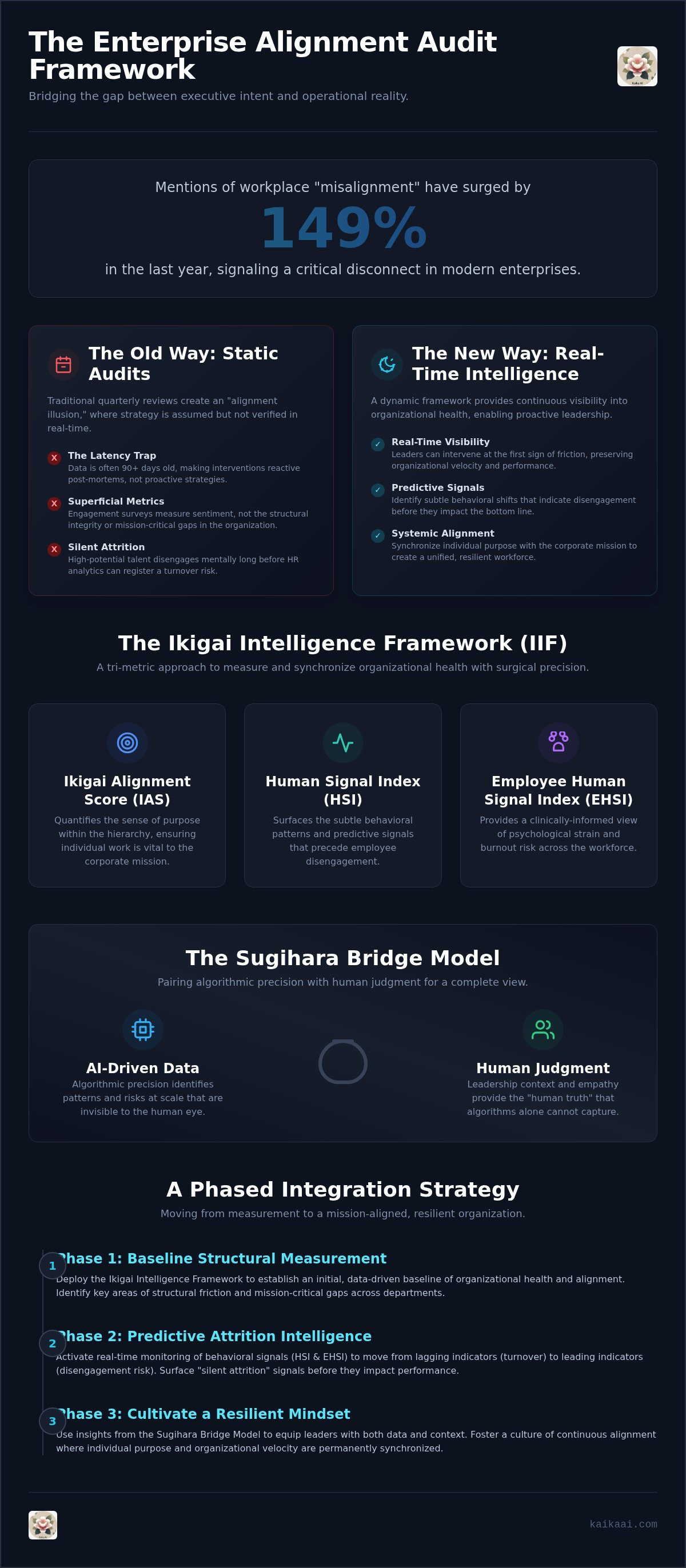
Did you know that mentions of "misalignment" in workplace interactions surged by 149% in the last year? Most executives sense this friction long before the data confirms it. You've likely encountered the "alignment illusion," a state where strategic goals are broadcast from the top but fail to take root in daily operations. To bridge this gap, leaders are turning to the enterprise alignment audit framework, a systematic approach to identifying the disconnects that lead to silent talent attrition and reduced organizational velocity.
We recognize that maintaining structural integrity in a volatile market requires more than periodic surveys; it demands a real-time intelligence infrastructure. This guide promises to help you master a sophisticated, AI-driven framework to identify mission-critical gaps and synchronize individual purpose with organizational velocity. We'll examine how to gain real-time visibility into organizational health, reduce burnout-related turnover, and transform fragmented departments into a unified engine of operational resilience.
Key Takeaways
- Identify why static, quarterly reviews create an "alignment illusion" and learn to close the latency gap between executive intent and operational reality.
- Implement a sophisticated enterprise alignment audit framework anchored by the Ikigai Intelligence Framework (IIF) to synchronize individual purpose with corporate velocity.
- Utilize the Sugihara Bridge Model to balance AI-driven data with human judgment, providing a comprehensive view of organizational health that algorithms alone cannot capture.
- Detect mission-critical gaps and silent attrition risks through predictive behavioral signals before they impact the bottom line or department performance.
- Execute a phased integration strategy that moves from baseline structural measurements to the development of a resilient, mission-aligned leadership mindset.
The Fallacy of Periodic Reviews: Why Static Audits Fail the Modern Enterprise
The "alignment illusion" describes a pervasive executive blind spot where leaders assume that stated objectives are synonymous with operational reality. While a CEO may broadcast a new strategic direction, the message often fragments as it descends through the organizational hierarchy. This fragmentation creates a profound disconnect between corporate mission and individual execution. Traditional methods of assessing strategic alignment rely on static, retrospective data that fails to capture the dynamic shifts of a high-velocity workforce. Without a robust enterprise alignment audit framework, organizations remain vulnerable to structural friction that erodes both profit and performance.
Conventional HR analytics frequently ignore the "human truth" buried beneath surface-level metrics. They measure symptoms like turnover or absenteeism rather than the underlying cause: a lack of synchronization between personal purpose and corporate velocity. When individual contributors don't see their work as vital to the mission, engagement becomes a performance in itself. To solve this, leadership must adopt a predictive, systemic framework for systemic workforce alignment that detects these mission-critical gaps before they solidify into cultural debt.
The Latency Trap in Enterprise Governance
Strategic drift occurs when small, uncorrected deviations in department goals accumulate over time. Quarterly reviews act as organizational post-mortems. They identify failures only after the damage is done. By the time a report reaches the CHRO, the data is often ninety days old. This latency gap masks the "silent attrition" of high-potential talent who disengage mentally long before they submit a resignation letter. Proactive workforce intelligence replaces retrospective reporting with real-time visibility. It allows leaders to intervene at the first sign of friction, preserving the velocity required for global scale.
Moving Beyond the "Engagement Survey" Status Quo
Annual employee satisfaction scores offer a superficial snapshot that rarely reflects the complex reality of a modern enterprise. These surveys often prioritize optics over structural integrity. They fail to address the high-stakes urgency of performance in a market defined by rapid technological shifts. Modern governance demands more than just sentiment tracking. It requires enterprise-grade security and strict compliance with evolving standards like the California Generative AI Transparency Act. Leaders must learn to hear the "signal before the silence." This involves identifying the subtle behavioral shifts that indicate a breakdown in organizational harmony. Moving beyond the status quo means building a resilient infrastructure where every individual action contributes to a unified strategic outcome.
The Ikigai Intelligence Framework: A Tri-Metric Approach to Structural Synchronization
The Ikigai Intelligence Framework (IIF) provides the architectural rigor necessary to transform abstract strategy into measurable performance. While traditional approaches often rely on the Strategic Alignment Model (SAM) to bridge business and IT, the IIF introduces a third, more vital dimension: the human element. An effective enterprise alignment audit framework must account for the intersection of individual purpose and organizational mission. Without this synchronization, strategic velocity is impossible. By adopting a comprehensive enterprise alignment audit framework, leadership can move from reactive troubleshooting to proactive optimization.
The IIF utilizes three core indices to map organizational health with surgical precision. The Ikigai Alignment Score (IAS) quantifies the sense of purpose within the hierarchy. The Human Signal Index (HSI) surfaces behavioral patterns that precede disengagement. Finally, the Employee Human Signal Index (EHSI) provides a clinically-informed view of psychological strain. Together, these metrics move beyond superficial data to reveal the structural integrity of the workforce, ensuring that the human infrastructure is as resilient as the technology it manages.
The Ikigai Alignment Score (IAS) Explained
Purpose is vital. It is a structural requirement for high-performance teams. The IAS quantifies the "sense of purpose" by analyzing how closely an individual's core skills and personal values align with the specific needs of the enterprise. When this alignment is high, velocity increases naturally. When it's low, friction occurs. The Ikigai Alignment Score serves as the primary metric for organizational harmony, calculating the precise degree to which individual talent is synchronized with the corporate mission.
Linking individual skillsets directly to organizational needs allows leaders to optimize talent distribution. This ensures that the right people are in the right roles for the right reasons. When individual goals mirror the corporate mission, the organization achieves a state of flow that traditional management styles cannot replicate. This alignment isn't just about satisfaction; it's about the measurable synergy required for global scale.
Clinically-Informed Metrics for Workforce Sustainability
The EHSI distinguishes itself by incorporating principles of clinical psychology to measure psychological safety and resilience. Co-developed with clinical psychologists, this index identifies the subtle shifts in behavior that suggest an employee is reaching a breaking point. It's about detecting the signal before the silence of attrition. To see these metrics in a strategic context, you can review our guide on leading indicators of employee burnout.
Integrating these indices into the audit process allows for preemptive intervention. Instead of reacting to a resignation, managers can address the root causes of disengagement. This systemic approach ensures that performance remains sustainable, even during high-stakes periods of growth. The EHSI doesn't just track sentiment; it monitors the structural health of the human infrastructure, providing a stable foundation for collective kaizen and long-term resilience.
Predictive Attrition Intelligence: Surfacing the Signal Before the Silence
Strategic failure rarely arrives as a sudden explosion. It begins as a quiet erosion of commitment. Within a modern enterprise alignment audit framework, predictive intelligence serves as the early warning system for this decay. By analyzing high-frequency behavioral signals, leaders can identify mission-critical gaps before they manifest as department-wide attrition. This capability transforms the audit from a static report into a dynamic intelligence signal that guides executive decision-making. It allows for the detection of structural friction that traditional oversight mechanisms often ignore.
Identifying these gaps requires a move away from generic engagement metrics toward structural synchronization. A mission-critical gap occurs when the strategic intent of the C-suite is not just misunderstood, but functionally impossible to execute at the ground level. This friction creates a "heat map" of organizational strain. By visualizing this strain, leaders can reallocate resources or refine communication before the friction leads to a total system failure. The audit doesn't just find problems; it maps the path to operational resilience.
Detecting Behavioral and Sentiment Anomalies
Descriptive analytics tell you who left; predictive analytics tell you who is leaving. AI-driven sentiment analysis filters environmental noise to isolate actionable signals. It identifies the specific "silence" that precedes the departure of high-value talent. When a top performer stops contributing to collective kaizen or retreats from cross-departmental collaboration, the system flags the anomaly. These behavioral signals are the leading indicators of strategic failure. They represent the "signal before the silence" that allows for surgical intervention rather than broad, ineffective policy changes.
The Science of Employee Honesty and Data Integrity
Traditional surveys often suffer from social desirability bias. Employees provide the answers they believe leadership wants to hear, which renders the data useless for strategic planning. Our pilot programs demonstrated an 87% employee honesty rate, a figure achieved through rigorous privacy-first design and ethical data use. We leverage academic partnerships with Waseda University to validate these methodologies, ensuring that the audit data reflects the genuine psychological state of the workforce. This integrity is why Kaika AI is the premier workforce alignment software for organizations that prioritize truth over optics. By removing the fear of surveillance, we unlock a level of transparency that traditional HR tools can't reach. High-integrity data is the foundation of any reliable enterprise alignment audit framework, providing the clarity required for genuine organizational evolution.
The Sugihara Bridge Model: Pairing Algorithmic Precision with Human Judgment
Data without context is merely noise. While AI excels at identifying patterns within an enterprise alignment audit framework, it lacks the capacity to interpret the delicate cultural nuances of a global organization. The Sugihara Bridge Model addresses this limitation by creating a hybrid architecture. It pairs algorithmic precision with the seasoned judgment of expert consultants. These "Strategic Sages" translate cold datasets into actionable executive strategies. This approach ensures that leadership decisions are grounded in both empirical evidence and human reality. By integrating human expertise, the framework moves beyond simple automation to provide a comprehensive blueprint for organizational harmony.
Central to this model is the concept of operational resilience for leadership. In high-stakes environments, the ability to maintain structural integrity during periods of rapid change is paramount. The Sugihara Bridge Model provides the oversight required to prevent strategic drift. It allows leaders to navigate complexity with a composed, data-driven confidence. You can achieve this balance by leveraging our executive consultation services to interpret the specific signals within your workforce.
The Hybrid Architecture of Workforce Intelligence
AI identifies the "what"—the specific mission-critical gaps and sentiment anomalies. Human consultants determine the "why." They explore the systemic origins of friction that an algorithm might overlook. This hybrid approach offers several advantages for institutional trust:
- Professional Empathy: Ensuring sensitive workforce signals are handled with human nuance rather than automated penalties.
- Institutional Trust: Building a transparent auditing process where employees feel heard and valued.
- Contextual Clarity: Distinguishing between temporary environmental stress and deep-seated structural misalignment.
When employees see that data leads to meaningful human dialogue, honesty rates remain high. This transparency is vital for maintaining the 87% honesty rate observed in our pilot programs. The Sugihara Bridge Model ensures that the audit remains a tool for evolution, not surveillance.
Translating Data into Data-Driven Kaizen
The ultimate goal of the audit is to fuel a continuous performance management cycle. This isn't about massive, disruptive overhauls. It's about data-driven kaizen—implementing small, systemic changes that yield measurable structural impact. By using real-time alignment scores, leaders can make iterative adjustments that keep the organization synchronized with its mission. In pilot programs, organizations utilizing this hybrid model achieved an NPS of 72. This high level of participant satisfaction proves that when purpose and performance are synchronized through both technology and human wisdom, the entire enterprise thrives. Small, cumulative improvements lead to the operational velocity required for global scale.
Implementing the Audit: A Phase-Based Framework for Strategic Realignment
Transitioning from an "alignment illusion" to a state of structural synchronization requires more than a software deployment. It demands a methodical, phase-based execution that respects both technical precision and human complexity. The enterprise alignment audit framework operates as a cumulative process, where each stage builds upon the integrity of the previous one. By following this architectural blueprint, organizations ensure that strategic intent is not just broadcast, but deeply internalized across every division. This progression moves the enterprise from reactive troubleshooting to a proactive state of operational resilience.
A synchronized workforce is the ultimate competitive advantage. When individual purpose is mapped to organizational velocity, the result is a resilient infrastructure capable of navigating global volatility. The long-term ROI of this framework manifests in reduced attrition costs, higher strategic hit rates, and an institutionalized culture of excellence. By treating alignment as a continuous intelligence signal rather than a one-time event, leadership secures the structural integrity required for 2026 and beyond.
Phase 1: Baselining the Human Truth
The first phase focuses on establishing the technical and psychological foundation of the audit. This involves integrating the Workforce Alignment Intelligence Platform into existing enterprise systems to begin continuous signal detection. During this stage, leadership conducts the initial Ikigai alignment assessment to map the baseline IAS, HSI, and EHSI scores across all divisions. This data provides the "human truth" necessary for accurate strategic planning. Establishing privacy-first trust protocols is vital here to maintain the 87% honesty rate observed in successful pilot programs.
- Infrastructure Deployment: Setting up AI nodes to monitor sentiment anomalies and behavioral shifts in real-time.
- Trust Protocols: Implementing privacy safeguards that ensure employee anonymity, which is the cornerstone of data integrity.
- Divisional Mapping: Identifying high-friction areas where individual purpose and corporate mission have diverged.
Phase 2 & 3: From Insight to Institutional Resilience
Once the baseline is established, the focus shifts to architectural consultation and leadership development. Strategic Sages analyze the enterprise alignment audit framework results to identify the systemic causes of misalignment. This phase moves beyond data collection to active intervention. Executive consultations bridge the gap between algorithmic insights and cultural reality, ensuring that leadership mindsets evolve alongside the technology. This is where the Sugihara Bridge Model becomes operational, translating complex signals into clear executive directives.
The final phase involves scaling these insights through Collective Kaizen Workshops. These sessions foster cross-departmental synergy by encouraging teams to solve alignment gaps collaboratively. As the framework scales to global divisions, real-time synergy tracking allows for continuous refinement. Organizations utilizing this phased approach have achieved an NPS of 72 among participants, proving that structural harmony is attainable at scale. By maintaining this cycle of audit and adjustment, the enterprise achieves a state of perpetual alignment, where human potential and corporate mission operate in perfect harmony.
Advancing Toward Synchronized Performance
The transition from strategic drift to organizational harmony requires a shift from retrospective reporting to real-time intelligence. By adopting a comprehensive enterprise alignment audit framework, your organization can replace the "alignment illusion" with measurable structural synchronization. This evolution relies on the integration of clinically-informed indices and the Sugihara Bridge Model. These tools ensure that data-driven precision is always balanced by human wisdom, allowing for a more nuanced understanding of workforce health.
Our pilot programs, validated through a strategic academic partnership with Waseda University, have demonstrated an 87% honesty rate and a 74% weekly completion rate. These metrics highlight the power of high-integrity data in reducing attrition risk and fostering institutional resilience. You now possess the architectural blueprint to identify mission-critical gaps before they impact your operational velocity. It's time to move beyond superficial metrics and build a foundation of sustainable excellence.
Request early access to the Kaika AI Workforce Alignment Intelligence Platform to begin your organizational transformation. We look forward to helping you synchronize purpose and performance for a resilient future.
Frequently Asked Questions
What is an enterprise alignment audit framework?
An enterprise alignment audit framework is a strategic blueprint designed to identify and bridge mission-critical gaps between executive intent and operational execution. Unlike static reviews, this framework utilizes real-time intelligence to synchronize individual purpose with organizational velocity. It provides a structured methodology for assessing structural integrity, ensuring that every division operates in total harmony with the corporate mission to prevent strategic drift and silent attrition.
How does the Ikigai Intelligence Framework differ from traditional HR audits?
The Ikigai Intelligence Framework (IIF) moves beyond the surface-level metrics of traditional HR audits by focusing on the intersection of personal meaning and corporate goals. While standard audits often prioritize retrospective compliance, the IIF employs clinically-informed indices like the EHSI to measure psychological resilience. This approach allows leadership to detect subtle behavioral shifts and disengagement patterns that conventional satisfaction surveys typically overlook during their quarterly cycles.
Is employee data privacy protected during an AI-driven alignment audit?
Employee data privacy is a foundational priority maintained through a privacy-first infrastructure and strict adherence to evolving regulatory standards. Our platform complies with requirements like the California Generative AI Transparency Act to ensure ethical data use and absolute anonymity. By removing the fear of surveillance, the audit fosters a secure environment where employees feel safe providing the honest feedback necessary for accurate organizational health assessments.
Can an alignment audit predict employee burnout before it happens?
An alignment audit can predict burnout by identifying the specific behavioral signals and sentiment anomalies that precede mental exhaustion. Using proprietary clinical indices co-developed with psychologists, the framework detects patterns of psychological strain long before they manifest as turnover. This "signal before the silence" allows management to implement proactive interventions and operational resilience training, preserving both human potential and organizational performance.
What is the Sugihara Bridge Model in workforce intelligence?
The Sugihara Bridge Model is a hybrid architecture that pairs the algorithmic precision of AI with the nuanced judgment of expert consultants. AI identifies the quantitative "what" of organizational friction, while Strategic Sages interpret the qualitative "why" behind cultural disconnects. This model ensures that executive actions are grounded in both data-driven evidence and professional empathy, providing a more reliable blueprint for systemic evolution.
How long does it take to see results from an enterprise alignment audit?
Organizations typically establish a baseline of their organizational health within the first phase of implementation, which often spans a few weeks. Immediate visibility into the Ikigai Alignment Score (IAS) provides instant clarity on divisional friction. However, achieving total mission synchronization and institutional resilience is an iterative process. Systemic results, such as reduced attrition and increased velocity, become measurable as the framework moves through architectural consultation and collective kaizen workshops.
What is the ROI of implementing a real-time alignment framework?
The ROI of a real-time enterprise alignment audit framework is measured through the significant reduction in burnout-related turnover and the preservation of institutional knowledge. Pilot programs have demonstrated an NPS of 72 among participants, indicating high levels of organizational harmony and engagement. By eliminating the "alignment illusion," enterprises reduce the high costs of strategic drift and accelerate their operational velocity toward global scale.
How does Kaika AI ensure high employee honesty rates in audits?
Kaika AI achieves an 87% employee honesty rate by prioritizing ethical data transparency and technical anonymity. Our methodologies are validated through an academic partnership with Waseda University to ensure they elicit genuine responses rather than performative feedback. When employees understand that their data is used for structural improvement rather than individual policing, they contribute more accurately to the collective intelligence of the enterprise.
Disclaimer
#Disclaimer
At Kaika AI, we believe the future belongs to organizations that combine human wisdom with artificial intelligence responsibly. The articles, research, insights, and thought leadership published on this website are intended to educate, inform, and encourage meaningful conversations about the future of work, organizational intelligence, AI, leadership, and innovation.
While our content is developed through rigorous research and may be generated, curated, or enhanced using artificial intelligence, every effort is made to ensure it reflects thoughtful analysis, practical relevance, and responsible AI practices. However, no representation or warranty is made regarding the completeness, accuracy, or suitability of the information for every individual or organizational circumstance.
The ideas, opinions, frameworks, and recommendations shared by Kaika AI are provided for educational and informational purposes only. They should not be interpreted as legal, financial, medical, psychological, human resources, cybersecurity, or other professional advice. Organizations and individuals should seek qualified professional guidance before making strategic, legal, or operational decisions.
Where articles reference third-party organizations, products, services, academic research, industry reports, or public data, such references are provided solely to support discussion and analysis. Unless explicitly stated, they do not imply endorsement, partnership, or affiliation.
Artificial intelligence is a powerful decision-support technology—not a replacement for human judgment. Kaika AI advocates for responsible, transparent, and human-centered AI adoption. We encourage readers to critically evaluate information, consider their unique context, and combine AI-generated insights with professional expertise and sound decision-making.
The content published on this website may be updated, revised, or removed as knowledge, technology, regulations, and best practices continue to evolve.
To the fullest extent permitted by applicable law, Kaika AI, its affiliates, contributors, and partners disclaim liability for any direct, indirect, incidental, consequential, or other losses arising from the use of, or reliance upon, the information provided on this website.
By accessing or using this website, you acknowledge that you have read, understood, and agree to this Disclaimer.
Kaika AI
'Building trusted organizational intelligence for the AI Era'


