
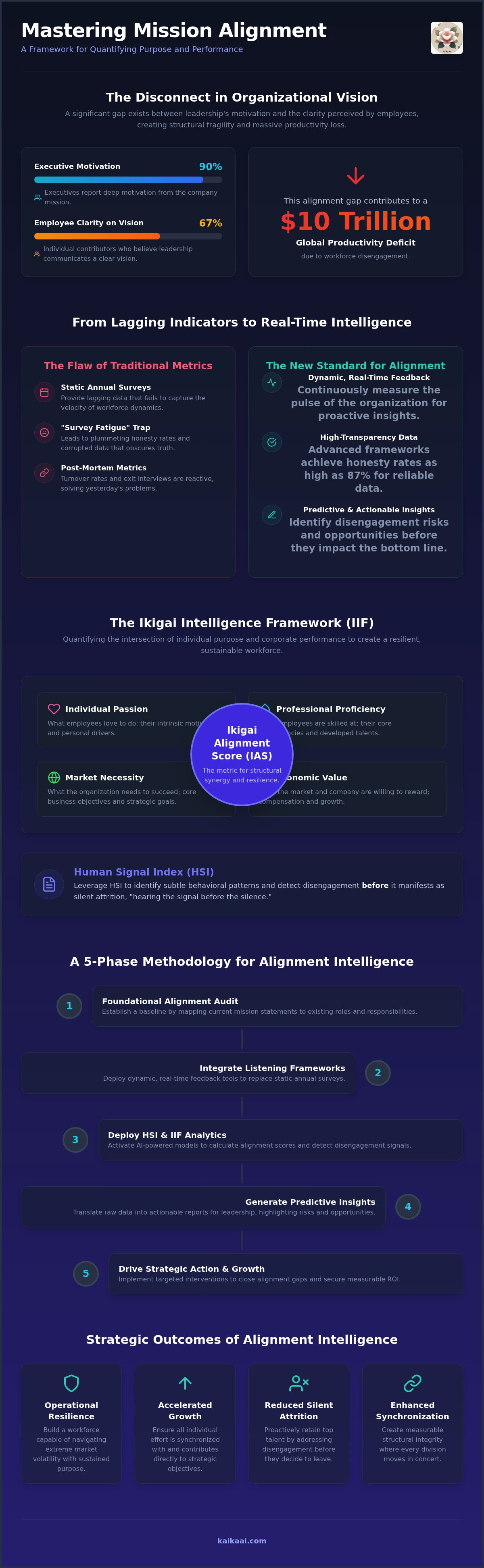
While 90% of executives report deep motivation regarding their organization's mission, Perceptyx research from June 2026 reveals that only 67% of individual contributors believe leadership communicates a clear vision. This disconnect creates a structural fragility that contributes to a $10 trillion global productivity deficit. You likely sense the friction of silent attrition and the execution gaps that emerge when individual purpose drifts from corporate intent. Mastering how to measure mission alignment is the only way to secure the structural integrity of your enterprise.
We agree that traditional annual surveys provide only static, lagging data that fails to capture the velocity of modern workforce dynamics. This article introduces a sophisticated, AI-powered framework designed to quantify the synchronization between individual purpose and corporate mission. You'll gain access to the Ikigai Intelligence Framework (IIF) and the Sugihara Bridge Model to generate predictive insights into burnout and disengagement. We'll move from abstract sentiment to a repeatable methodology for alignment intelligence; this ensures your leadership moves with the precision and confidence required for 2026 excellence.
Key Takeaways
- Transition from static annual surveys to dynamic, real-time feedback loops to overcome the "Survey Fatigue" trap and capture the true velocity of organizational health.
- Discover how to measure mission alignment through the Ikigai Alignment Score (IAS), a sophisticated metric for quantifying the structural synergy between individual purpose and corporate objectives.
- Leverage the Human Signal Index (HSI) to identify subtle behavioral patterns and detect disengagement before it manifests as silent attrition.
- Apply a rigorous 5-phase methodology to integrate alignment intelligence across global divisions, beginning with a foundational Alignment Audit.
- Secure measurable ROI on workforce synchronization by converting alignment signals into operational resilience and accelerated strategic growth.
Beyond the Annual Survey: Why Traditional Mission Alignment Metrics Fail
Mission alignment represents the structural synchronization of individual effort with organizational purpose. It is the architectural integrity of an enterprise. When this alignment fractures, the result is not merely a cultural shift but a measurable decline in operational velocity. Most executive leaders understand the necessity of this harmony, yet they struggle with how to measure mission alignment in a way that provides actionable, real-time intelligence. A disconnect exists between the boardroom's vision and the frontline's reality, often resulting in a strategic gap that traditional tools cannot bridge.
The primary obstacle is the "Survey Fatigue" trap. Traditional annual engagement surveys often suffer from plummeting honesty rates, as employees perceive them as performative or bureaucratic. In contrast, advanced pilot programs utilizing sophisticated listening frameworks have demonstrated honesty rates as high as 87%. Without this level of transparency, leadership relies on corrupted data that obscures the truth of the workforce. Static measurement is fundamentally irrelevant in a volatile 2026 market. An annual score is a lagging indicator; it describes a state of being that has likely already shifted by the time the report reaches the boardroom.
The cost of this oversight is profound. When mission gaps go undetected for multiple quarters, the resulting "Silent Attrition" erodes the bottom line. According to Gallup's April 2026 data, the global economy faces a productivity loss estimated at $10 trillion due to disengagement. This financial drain is the direct result of failing to hear the signal before the silence of a departing employee.
The Limitations of Lagging Indicators
Turnover rates and exit interviews are post-mortem metrics. They tell you why a high-performer left, but they offer zero utility for retention. This is the "Signal-to-Noise" problem inherent in massive enterprise datasets. High-level numbers often mask the decay occurring within specific divisions. Relying on reactive management ensures that you are always solving yesterday's problems while today's talent quietly disengages. Proactive alignment intelligence requires a shift from counting departures to measuring the current of engagement in real-time.
Defining the New Standard for Alignment Intelligence
We must move beyond "employee satisfaction," which is a passive and often misleading metric. The new standard is purpose-driven velocity. This requires a deep understanding of strategic alignment, where the organizational architecture itself facilitates individual contribution toward the collective mission. By integrating principles of transparency and measurable outcomes, leadership can transition from guesswork to a disciplined, evidence-based approach. This evolution ensures that data collection is not just a compliance exercise but a strategic asset that protects the structural integrity of the workforce.
The Ikigai Intelligence Framework: Quantifying the Intersection of Purpose and Performance
Ikigai is often perceived as a philosophical abstraction. In the context of the modern enterprise, it serves as a rigorous diagnostic for structural integrity. The framework balances four critical quadrants: individual passion, professional proficiency, market necessity, and economic value. When these dimensions overlap with corporate objectives, the resulting synergy creates a resilient workforce capable of navigating extreme market volatility. This intersection is where organizational excellence lives. It's the primary driver of resilience, ensuring that individual effort isn't just productive but also sustainable.
The Ikigai Intelligence Framework (IIF) provides the mathematical foundation for this synergy. It moves beyond the abstract question of sentiment to a precise calculation of how an individual’s personal mission intersects with organizational goals. This methodology provides a definitive answer for leaders determining how to measure mission alignment at scale. By treating purpose as a quantifiable asset, executives can manage human potential with the same precision they apply to capital allocation.
Components of the Ikigai Alignment Score (IAS)
The IAS distills complex human sentiment into a precise operational signal. It evaluates the "Internal Signal," which captures an individual's sense of contribution and mastery, alongside the "External Signal," which measures the perceived impact of the company's mission on the broader world. The Ikigai Alignment Score stands as the definitive metric for workforce synergy, distilling complex human sentiment into a precise operational signal. Organizations that utilize this score can identify misalignments before they manifest as performance deficits. If you're ready to evaluate your current standing, consider initiating a comprehensive Alignment Audit to establish your baseline.
The Science of Purpose-Driven Performance
Alignment reduces cognitive load. When an employee's work feels intrinsically meaningful, their velocity increases because they no longer waste mental energy reconciling their personal values with their professional tasks. This psychological harmony is only possible in environments of high transparency. Pilot programs have demonstrated that when employees trust the diagnostic process, honesty rates reach 87%, providing leadership with a clear view of the organizational health.
Research conducted in partnership with Waseda University confirms a direct correlation between high IAS results and long-term performance resilience. This data-driven approach is explored further in our guide on AI for Organizational Health: A Strategic Framework for Systemic Workforce Alignment. By connecting individual purpose to technical intelligence, enterprises can build a self-correcting system that prioritizes both human potential and structural excellence. This isn't just about morale; it's about the architectural synchronization of the entire workforce.
Human Signal Index (HSI): Hearing the Signal Before the Silence
The Human Signal Index (HSI) represents a paradigm shift in organizational diagnostics. While the Ikigai Alignment Score provides a structural baseline, the HSI identifies dynamic behavioral patterns in real-time. This index allows leadership to move beyond retrospective analysis. It offers a definitive solution for how to measure mission alignment by capturing the subtle fluctuations in workforce energy before they solidify into systemic issues. It's the difference between reading an autopsy and monitoring a pulse.
The most dangerous threat to an enterprise isn't the employee who voices dissent; it's the one who stops speaking altogether. True disengagement starts with a transition from 'vocal' participation to 'silent' compliance. This silence is the final stage before attrition. By utilizing the Emotional Human Signal Index (EHSI), developed under the guidance of clinical psychologists, organizations can detect these shifts early. This approach utilizes ethical AI that adheres to rigorous Japanese privacy standards. It ensures workforce truths surface without compromising individual psychological safety or data integrity.
Predictive Analytics for Attrition Risk
Data patterns within the HSI often precede formal resignations by an average of 3 to 6 months. This window provides executive leadership with a critical opportunity for intervention. By identifying 'Mission Fatigue' within specific global divisions, you can deploy targeted resources to reinforce structural integrity before performance drops. For a deeper analysis of these early warnings, consult our Leading Indicators of Employee Burnout: The Executive Guide to Predictive Attrition Intelligence. This foresight transforms attrition from a surprise expense into a manageable variable.
The Sugihara Bridge Model: Hybrid AI-Human Intelligence
AI alone cannot interpret the complex cultural nuances and interpersonal dynamics of a global enterprise. The Sugihara Bridge Model solves this by integrating technical intelligence with human expertise. Trained consultants validate the alignment signals surfaced by the platform to ensure accuracy. This hybrid methodology refines the process of how to measure mission alignment by adding a layer of professional judgment to the algorithmic output. It ensures that executive-level architectural consultations are grounded in data but executed with human sensitivity. This balance is essential for maintaining organizational harmony while driving high-velocity strategic growth.
A 5-Phase Methodology for Establishing Real-Time Alignment Intelligence
Implementing a rigorous framework for how to measure mission alignment requires more than a tactical shift; it demands an architectural overhaul of how an enterprise perceives its human capital. This methodology moves beyond the superficiality of traditional engagement models. It establishes a disciplined, phase-based progression that ensures every individual signal contributes to the collective velocity of the organization. By following this structured approach, leadership can secure the structural integrity necessary for 2026 enterprise excellence.
- Phase 1: Architectural Audit. This foundational stage defines the baseline organizational mission. It involves a clinical examination of current strategic intent versus actual workforce perception to identify existing structural fractures.
- Phase 2: Signal Integration. Deployment of the Ikigai Intelligence Framework (IIF) across global divisions begins here. This phase establishes the technical infrastructure required to capture the Ikigai Alignment Score (IAS) at scale.
- Phase 3: Continuous Kaizen. Real-time dashboards replace static annual reports. Leadership utilizes these live data streams to adjust strategy dynamically, ensuring the organization remains synchronized with its workforce.
- Phase 4: Executive Coaching. Data alone is insufficient without a leadership mindset capable of interpreting it. This phase aligns the boardroom with workforce intelligence, facilitating more sensitive and strategic decision-making.
- Phase 5: Resilience Training. The final stage focuses on building psychological stamina. Through synchronization, the workforce develops the operational resilience needed to withstand market volatility without experiencing mission fatigue.
Step-by-Step Implementation for Global Enterprises
Rolling out alignment tracking across massive, cross-departmental teams requires a non-disruptive integration strategy. Standardizing metrics ensures that a software engineer in Tokyo and a marketing lead in New York are measured against the same rigorous benchmarks. This synchronization is facilitated by The Executive Guide to Data-Driven Kaizen Platforms: Continuous Performance Reimagined. By utilizing these platforms, enterprises can maintain high-velocity growth while ensuring that every department remains anchored to the core mission. To begin this process for your organization, consider booking an Alignment Audit to identify your baseline structural gaps.
Overcoming Resistance to Measurement
Transparency acts as a catalyst for trust. When employees understand that data collection serves to harmonize their personal purpose with their professional output, honesty rates naturally climb. In established pilot programs, this transparency has driven honesty rates to 87%. The CHRO must act as the primary Architect of Alignment, ensuring that the transition from monitoring to listening represents a shift from surveillance to structural empathy. This evolution fosters an environment where measurement is viewed not as a tool for oversight, but as a mechanism for mutual evolution and collective success.
Strategic Outcomes: Turning Alignment Signals into Operational Resilience
The transition from abstract mission statements to quantifiable alignment intelligence yields a definitive competitive advantage. When an organization masters how to measure mission alignment, it unlocks a level of workforce velocity that traditional management structures cannot replicate. This acceleration occurs because synchronized employees require less oversight and exhibit higher cognitive agility. They don't just execute tasks; they advance the mission with surgical precision. This structural harmony transforms the workforce from a collection of individuals into a unified engine of strategic growth.
Operational resilience is the primary byproduct of this synchronization. By identifying burnout hotspots before they result in resignations, leadership can mitigate the astronomical costs associated with talent replacement. The ability to detect these signals early prevents the $10 trillion global productivity drain caused by disengagement. Cross-departmental synergy also flourishes as silos dissolve under the weight of a shared purpose. When every division operates on the same frequency, the friction of internal competition is replaced by the momentum of collective success. This environment fosters a culture of Collective Kaizen, where perpetual improvement is driven by real-time data rather than periodic interventions.
Building the Resilient Organization of 2026
Future-proofing an enterprise requires a shift toward predictive diagnostics. This approach is detailed in our framework on Operational Resilience for Leadership: A Predictive Workforce Resilience Framework. The long-term ROI of a synchronized workforce extends beyond internal performance; it impacts global market positioning. As dual-listing standards for the Tokyo Stock Exchange (TSE) and Australian Securities Exchange (ASX) increasingly demand transparent culture reporting, having a data-driven methodology for alignment becomes a regulatory necessity. It demonstrates a commitment to structural integrity and ethical governance that investors now prioritize.
Conclusion: The Future of Workforce Alignment
The philosophy of hearing the signal before the silence is the new mandate for executive leadership. In an era defined by rapid AI integration and shifting human expectations, understanding how to measure mission alignment is no longer optional. It's the foundation of institutional reliability. Enterprises that fail to quantify the synchronization between individual purpose and corporate intent will find themselves vulnerable to silent attrition and strategic drift. Those that embrace alignment intelligence will lead with a workforce that is resilient, disciplined, and uncompromisingly focused on excellence.
The tools for this evolution are now accessible. To secure the future of your organizational architecture, request early access to the Kaika AI platform today. Moving from reactive management to proactive alignment intelligence is the first step toward achieving true enterprise excellence in 2026.
Securing the Structural Integrity of the 2026 Enterprise
The transition from retrospective surveys to predictive alignment intelligence is the definitive requirement for executive leadership in 2026. By moving beyond lagging indicators and adopting the Ikigai Intelligence Framework, you can finally answer how to measure mission alignment with mathematical precision. This methodology transforms human sentiment into a strategic asset that safeguards organizational architecture against market volatility. It's the shift from reactive management to architectural foresight.
Success in this era relies on the intersection of technical precision and human empathy. Pilot results demonstrating an 87% employee honesty rate prove that structural transparency is the cornerstone of workforce synergy. Supported by strategic partnerships with Waseda University and TiB, our clinically-informed EHSI provides a responsible pathway for early burnout detection and operational resilience. You don't have to wait for the silence of attrition to understand the health of your workforce.
Take the first step toward a synchronized, high-velocity organization. Request early access to the Kaika AI Workforce Alignment Platform and lead your enterprise with the disciplined vision required for global excellence.
Frequently Asked Questions
What is the most accurate way to measure mission alignment in a remote workforce?
The most accurate methodology for a distributed environment involves the deployment of continuous, real-time signal detection platforms rather than periodic self-reporting. Because remote work removes physical behavioral cues, leadership must rely on digital human signals that capture the synchronization between individual contribution and corporate intent. This approach ensures that mission drift is identified through behavioral patterns before it manifests as performance decay.
How does the Ikigai Alignment Score (IAS) differ from standard engagement metrics?
The Ikigai Alignment Score differs from standard metrics by shifting the focus from passive employee satisfaction to active purpose-driven velocity. While traditional engagement surveys measure how an employee feels about their environment, the IAS quantifies the structural synergy between an individual's personal mission and the organization's strategic objectives. This creates a multidimensional view of workforce health that standard sentiment analysis cannot achieve.
Can AI really predict employee burnout without violating privacy?
AI can predict burnout with high accuracy by utilizing anonymized, clinically-informed data streams that focus on aggregate behavioral patterns rather than individual surveillance. By adhering to rigorous privacy standards, such as those established in Japanese data ethics, the Emotional Human Signal Index (EHSI) surfaces systemic strain without compromising personal confidentiality. This ensures that leadership can intervene at a divisional level to preserve operational resilience.
How often should an organization measure its mission alignment score?
Organizations should move toward a model of continuous measurement enabled by real-time dashboards that provide a living pulse of the enterprise. In a volatile market, an annual or quarterly review is insufficient for determining how to measure mission alignment with the necessary velocity. Monthly reviews of alignment intelligence allow for agile strategic adjustments, ensuring that the workforce remains synchronized with evolving corporate goals.
What are the early warning signs of mission misalignment in leadership?
Early indicators of misalignment within leadership include a widening gap between executive vision and frontline execution, often characterized by a decline in manager engagement. According to Gallup’s 2026 report, manager engagement has dropped to 22%, signaling a critical barrier to organizational harmony. When leadership communication becomes purely transactional and lacks a connection to the broader mission, the structural integrity of the enterprise is at risk.
How does the Sugihara Bridge Model combine AI with human judgment?
The Sugihara Bridge Model functions as a hybrid intelligence system where AI identifies complex behavioral patterns and human consultants provide the necessary cultural interpretation. While algorithms excel at detecting the frequency of signals, experienced consultants validate these insights against the nuances of organizational psychology. This ensures that executive decisions are grounded in data but executed with the sensitivity required for human-centric leadership.
What is a good net promoter score for internal workforce alignment?
While internal Net Promoter Scores are common, a sophisticated enterprise should prioritize the Ikigai Alignment Score as a more precise indicator of structural health. A high-performing baseline for mission alignment typically involves a score that demonstrates upward velocity, with pilot programs aiming for alignment rates above 74% to ensure strategic resilience. The focus should remain on the trend of synchronization rather than a static numerical value.
How do I link mission alignment metrics to actual financial performance?
Linking alignment to financial performance requires mapping mission synchronization to measurable operational outcomes like workforce velocity and attrition costs. When you understand how to measure mission alignment, you can directly correlate high alignment scores with reduced productivity loss, which Gallup estimated at $10 trillion globally in 2026. High alignment reduces the friction of execution, leading to faster strategic growth and lower recruitment overhead.
Disclaimer
# Disclaimer
The content published on this website is generated, curated, or enhanced using artificial intelligence (AI) and is intended for informational and educational purposes only. While we strive to provide accurate, relevant, and up-to-date information, we do not guarantee the completeness, accuracy, reliability, or suitability of any content.
The opinions, analyses, and recommendations presented should not be considered professional legal, financial, medical, HR, or business advice. Readers should seek qualified professional guidance before making decisions based on the information provided.
Some articles may include references to third-party organizations, products, services, statistics, or research. Such references are provided for informational purposes only and do not constitute endorsement or affiliation unless explicitly stated.
AutoSEO and its operators shall not be liable for any direct, indirect, incidental, or consequential loss or damage arising from the use of, or reliance upon, the information contained on this website.
Content on this website may be updated, modified, or removed at any time without prior notice.
By accessing and using this website, you acknowledge and agree to this disclaimer.


