
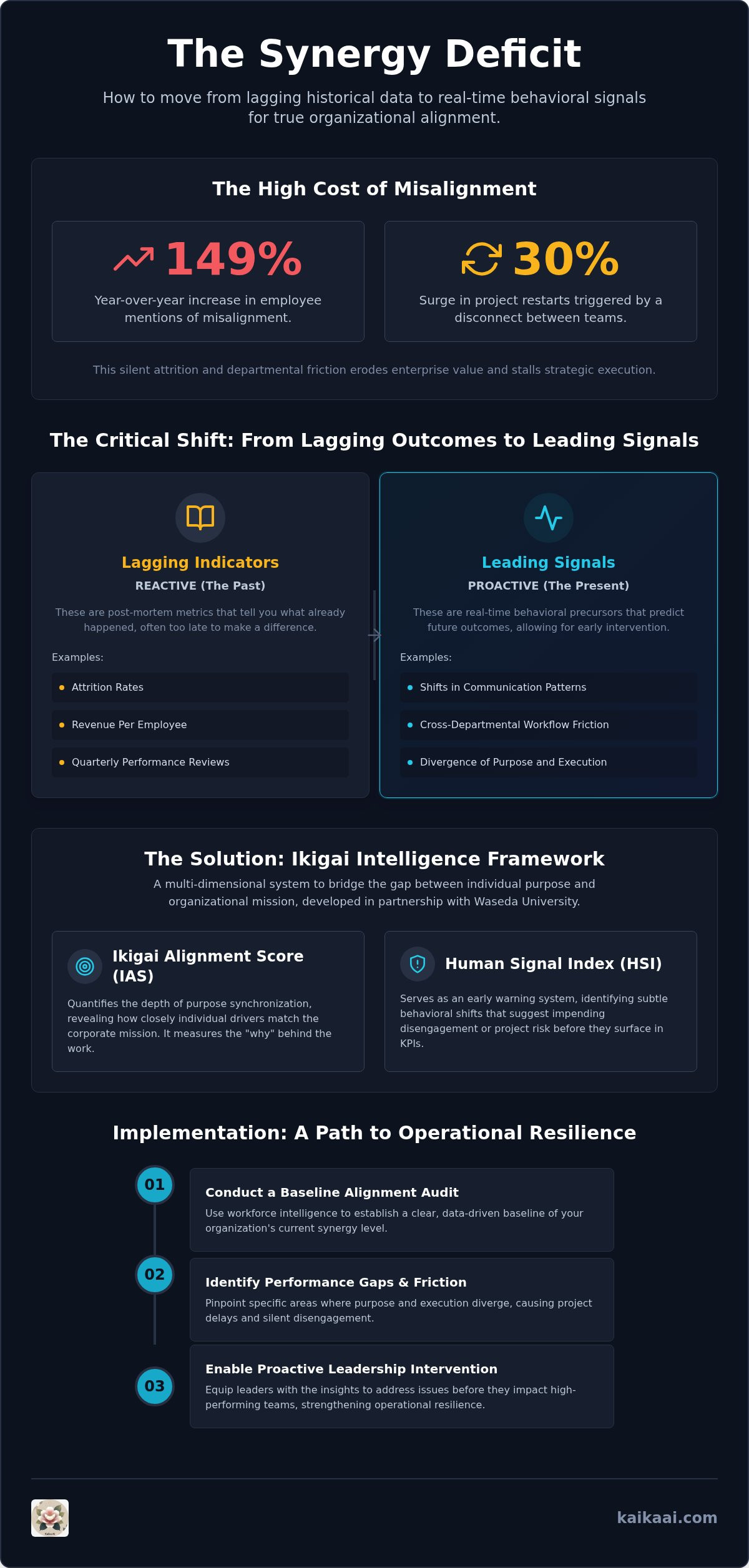
What if the structural friction stalling your global enterprise isn't a failure of talent, but a fundamental failure of visibility? A March 2026 report highlights a 149% year-over-year increase in employee mentions of misalignment, a trend that triggers a 30% surge in project restarts. This disconnect forces leadership to confront the heavy cost of silent attrition and departmental silos. Traditional management relies on lagging indicators, but modern internal synergy tracking requires a real-time behavioral lens to maintain organizational velocity. You've likely felt the frustration of stalled strategy execution and the inability to quantify how culture impacts your bottom line.
This article provides a strategic framework to synchronize individual purpose with corporate mission. You'll discover how to move beyond static KPIs toward a dynamic system that predicts performance gaps through early signal detection. We'll examine a data-driven method to align individual Ikigai with institutional objectives, reducing turnover and ensuring long-term structural integrity. By the end, you'll understand how to transform workforce intelligence into a measurable engine for collective evolution and operational resilience.
Key Takeaways
- Transition from lagging financial indicators to real-time behavioral signals that accurately reflect the synchronized velocity of your workforce.
- Leverage the Ikigai Intelligence Framework to bridge the gap between individual purpose and organizational mission, fostering deeper structural harmony.
- Adopt a systemic approach to internal synergy tracking that moves beyond post-merger integration into continuous, data-driven enterprise alignment.
- Execute a Data-Driven Kaizen strategy by conducting a baseline Alignment Audit to identify and rectify performance gaps before they impact execution.
- Strengthen operational resilience by identifying subtle behavioral signals, allowing leadership to intervene before silent attrition affects high-performing teams.
The Synergy Deficit: Why Traditional Tracking Fails Modern Enterprises
Internal synergy isn't a static state of agreement. It's the synchronized velocity of purpose and performance. Most executives view corporate synergy through the narrow lens of financial consolidation or post-merger cost savings. This perspective is dangerously incomplete. When you rely on revenue per employee or attrition rates, you're reading a post-mortem. These are lagging indicators. They tell you what happened last quarter, not why your strategy is stalling today. Effective internal synergy tracking requires a shift from historical reporting to real-time behavioral intelligence.
Before a high performer leaves or a project fails, there's a period of silent disengagement. This is the gap where synergy evaporates before leadership notices. Standard HR analytics often miss these subtle shifts in momentum. Workforce Alignment Intelligence serves as the necessary successor to these legacy systems. It moves beyond counting heads to measuring the structural integrity of the organization's mission. It identifies the "Signal before the silence," allowing leaders to intervene while the trajectory is still manageable.
The Illusion of Alignment in Large-Scale Organizations
Departmental silos don't just block communication. They create friction costs that erode enterprise value through redundant efforts and delayed decision-making. In global divisions, a mission-mismatch creates profound psychological strain. Employees feel the weight of working toward goals that don't resonate with their daily reality. Periodic surveys fail to capture this. They provide a static snapshot of a dynamic, living system. A March 2026 report found that project restarts increased by 30% due to these alignment gaps. You can't fix a moving target with a quarterly report.
Moving from Lagging Outcomes to Leading Signals
Leading signals are behavioral precursors to organizational outcomes. They are the tremors before the earthquake. By identifying patterns in how work actually flows, leadership can detect misalignment early. AI plays a critical role here by surfacing the human truth hidden beneath layers of workforce data. It identifies where purpose and execution diverge without compromising individual privacy. This data-driven clarity transforms internal synergy tracking from a theoretical exercise into a precision tool for executive governance. Workforce velocity is the speed of aligned execution.
The Architecture of Alignment: Tracking Synergy through the Ikigai Intelligence Framework
The Ikigai Intelligence Framework (IIF) functions as a sophisticated, multi-dimensional tracking system designed to bridge the chasm between individual purpose and organizational mission. It approaches alignment from a systems perspective, treating the enterprise as a unified organism where every component must resonate in harmony to achieve peak velocity. This framework isn't a mere collection of metrics. It's a rigorous methodology developed through an academic partnership with Waseda University, ensuring that the data used in internal synergy tracking maintains scientific validity and psychological depth.
By institutionalizing this framework, leadership gains a tool for profound institutional resilience. It transforms corporate governance from a reactive process into a proactive strategy of continuous synchronization. To explore how this methodology applies to your leadership structure, you can review the capabilities of the Workforce Alignment Intelligence Platform. This systemic approach ensures that every strategic move is backed by a deep understanding of the human energy driving the organization forward.
The Three Pillars of the Ikigai Intelligence Framework
The IIF architecture rests on three distinct indices that provide a granular view of organizational health. The Ikigai Alignment Score (IAS) quantifies the depth of purpose synchronization, revealing how closely individual drivers match the corporate mission. The Human Signal Index (HSI) serves as an early warning system, identifying behavioral shifts that suggest impending disengagement. Complementing these is the Employee Human Signal Index (EHSI), which monitors psychological strain and burnout risk. Together, these pillars provide a comprehensive map of the human energy powering the enterprise, allowing for precise interventions before performance degrades.
The Sugihara Bridge Model: Hybrid Intelligence in Practice
Technology alone cannot solve the mystery of human motivation. The Sugihara Bridge Model recognizes that AI, while powerful, often lacks the empathy required to interpret sensitive workforce signals. This hybrid approach pairs advanced algorithms with trained human consultants who validate AI-generated synergy data. This ensures that cultural nuances within global divisions are not lost in translation. It prevents the reduction of complex human behaviors into sterile data points, maintaining the essential balance between technical precision and philosophical insight. Using this model, internal synergy tracking becomes a culturally sensitive, human-centric endeavor that respects the individual while optimizing the whole.
Beyond M&A: Comparing Static KPIs with Real-Time Behavioral Signals
Most enterprises treat synergy as a discrete event, typically triggered by a merger or acquisition. This "Project Mindset" views alignment as a finish line to be crossed through cost-cutting and consolidated reporting. In contrast, a "Systemic Mindset" recognizes that internal synergy is a perishable asset requiring continuous calibration. When you rely on quarterly cadences, you miss the precise moment purpose begins to diverge from execution. The ROI of real-time tracking lies in the prevention of "Silent Attrition," where high-performing talent disengages long before they submit a resignation. This behavioral decay is a primary driver of the 25% higher rate of regrettable employee turnover observed in misaligned organizations.
Effective workforce alignment software acts as the necessary bridge between strategy and reality. It replaces the guesswork of manual reporting with objective, signal-based data. This transition is vital for internal synergy tracking because it captures the subtle shifts in organizational velocity that a balance sheet cannot detect. By monitoring these signals, leadership can maintain a state of permanent readiness rather than reacting to a crisis after the damage is done.
Static Scorecards vs. Dynamic Dashboards
Manual Excel-based synergy trackers are inherently flawed. They provide a lagging, fragmented view of a complex human system and cannot account for the rapid decay of alignment in high-stakes environments. Dynamic dashboards offer a living "heat map" of organizational health. By analyzing real-time productivity metrics, leadership can visualize exactly where friction exists in the workflow. This visibility allows for precise, surgical adjustments rather than broad, ineffective policy changes that often exacerbate disengagement.
Quantifying the Intangible: Purpose as a Performance Metric
Purpose isn't a "soft" metric; it's a foundational driver of operational output. There's a direct statistical correlation between Ikigai alignment and the resilience of a team. When individuals find profound meaning in their roles, the cost of attrition plummets and project restarts decrease. This "Human Truth" data provides the structural integrity needed for global scale. Kaika AI pilots achieved an 87% employee honesty rate through anonymous AI signaling, proving that psychological safety and data accuracy can coexist. This level of insight enables internal synergy tracking to move beyond speculation into the realm of predictive intelligence.
Implementing a Data-Driven Kaizen: Steps to Institutionalize Synergy Tracking
Institutionalizing synergy requires a departure from static reviews and manual checklists. Data-Driven Kaizen represents the iterative optimization of workforce alignment through a systematic, technology-enabled feedback loop. It's not a one-time project but a continuous state of refinement. To achieve this, leadership must move beyond the "Project Mindset" discussed earlier and embrace a framework that treats organizational health as a dynamic variable. Effective internal synergy tracking becomes the operational backbone of this evolution, ensuring that every adjustment is backed by objective behavioral data rather than executive intuition.
The transition to this model follows four critical steps designed to build structural integrity and cultural resonance:
- Step 1: Conduct an Alignment Audit. Every evolution begins with clarity. An initial audit establishes the necessary baseline by identifying where departmental silos and mission-mismatch currently erode enterprise value.
- Step 2: Deploy the Ikigai Intelligence Framework (IIF). Once baselines are set, enterprises deploy the IIF to capture real-time behavioral signals across global divisions. This provides the raw data for continuous synchronization.
- Step 3: Integrate AI-Driven Insights. Raw data must become strategic intelligence. Executives integrate these insights into their decision-making frameworks to ensure every tactical move supports the broader corporate mission.
- Step 4: Facilitate Collective Kaizen Workshops. The final step involves the human element. Trained human consultants facilitate workshops to ensure that data-driven insights translate into tangible behavioral shifts and cultural harmony.
To begin your journey toward systemic alignment, you can schedule an Alignment Audit to uncover the hidden friction points within your current organizational structure.
Phase-Based Strategic Integration
The journey toward enterprise-wide deployment follows a structured three-phase framework. This methodical approach ensures that metrics are customized for specialized divisions, recognizing that R&D and Sales require different alignment indicators to maintain velocity. By phasing the integration, leadership can demonstrate early wins and refine the tracking parameters before a full-scale rollout. For deeper implementation details on this methodology, consult our guide on continuous performance management software.
Enterprise-Grade Security and Privacy Standards
Privacy is the foundation of organizational trust. By adhering to rigorous Japanese privacy standards, the system ensures that global data collection remains ethical and transparent. Maintaining total anonymity is critical for achieving the 87% employee honesty rate observed in pilot programs. Building trust through transparent AI governance ensures that internal synergy tracking protects the individual while empowering the collective. This balance is essential for maintaining the long-term integrity of the data and the resilience of the workforce.
Operational Resilience: How Kaika AI Decodes the Signal Before the Silence
Kaika AI stands as the definitive partner for workforce resilience metrics. It provides a strategic vantage point that legacy systems cannot replicate. Many organizations maintain clean balance sheets while their human capital silently erodes. The "Signal before the silence" philosophy addresses this contradiction by identifying subtle shifts in momentum before they manifest as failure. This proactive governance ensures that internal synergy tracking isn't just a record of history. It's a predictive tool for institutional survival.
The development of the Employee Human Signal Index (EHSI) involved a dedicated team of Clinical Psychologists. Their expertise ensures that the system accurately identifies patterns of psychological strain and burnout. This rigor transforms workforce data into a reliable indicator of operational health. It moves the conversation from mere productivity to sustainable performance. Looking ahead, the organization remains focused on its long-term vision. We aim to become a globally recognized public company by 2032, targeting listings on the Tokyo Stock Exchange or the Australian Securities Exchange.
Surfacing Human Truth in High-Stakes Environments
The Ikigai Intelligence Framework identifies burnout patterns long before they lead to attrition. In high-stakes environments, the depth of alignment directly dictates psychological stamina. A pilot study involving 340 Tokyo-based participants demonstrated the effectiveness of this approach. The results confirmed that real-time visibility into purpose-synchronization allows for interventions that preserve performance. When employees feel their personal Ikigai resonates with the corporate mission, their resilience increases. This data-driven clarity reduces the ambiguity that often plagues global leadership. It provides a foundation of truth in an era of digital noise.
The Future of Workforce Alignment Intelligence
The transition from reactive HR to proactive organizational architecture is inevitable. The Sugihara Bridge Model plays a pivotal role in this evolution by blending AI precision with human wisdom. It develops a global leadership mindset that values both technical velocity and human harmony. This hybrid approach ensures that internal synergy tracking remains culturally nuanced and ethically grounded. As we approach a future defined by rapid technological shifts, the ability to synchronize purpose across an enterprise will be the ultimate competitive advantage. It's the difference between a fragmented workforce and a unified force of nature.
Take the first step toward a more resilient enterprise. Request early access to the Kaika AI platform today.
Mastering the Architecture of Aligned Execution
Achieving enterprise-wide synchronization requires a fundamental re-engineering of how leadership perceives organizational health. By adopting a systemic approach to internal synergy tracking, enterprises transform subtle behavioral signals into actionable strategic intelligence. This transition ensures that individual purpose remains synchronized with the corporate mission, effectively eliminating the friction that leads to silent attrition and stalled execution. You've seen how the Ikigai Intelligence Framework provides the visibility necessary to manage the human energy driving your global divisions.
Our methodology is grounded in academic rigor through a partnership with Waseda University and maintains strict compliance with Japanese privacy standards. With a pilot Net Promoter Score (NPS) of 72, we've demonstrated that data-driven clarity can coexist with human-centric values. You now have the tools to move from reactive management to a proactive state of operational resilience. It's time to replace the silence of disengagement with the signal of collective velocity.
Secure early access to the Kaika AI Workforce Alignment Platform to begin your evolution toward structural harmony. Your organization's potential is a function of its alignment. We invite you to unlock its full velocity today.
Frequently Asked Questions
What is internal synergy tracking in an enterprise context?
Internal synergy tracking is the systematic measurement of the synchronized velocity between individual purpose and organizational performance. It moves beyond counting output to analyzing the behavioral signals that determine if a workforce is moving in a unified direction. This process allows leadership to identify friction points within departmental silos before they erode enterprise value.
How does the Ikigai Intelligence Framework differ from traditional HR analytics?
Traditional HR analytics rely on lagging indicators like revenue per employee or attrition rates. The Ikigai Intelligence Framework (IIF) focuses on leading signals by quantifying the intersection of individual purpose and corporate mission. It provides a multi-dimensional view of organizational health, offering depth that standard spreadsheets can't replicate by surfacing the "why" behind performance trends.
Can AI really predict employee burnout and attrition risk?
AI identifies behavioral precursors to disengagement by surfacing tremors in workforce data that human managers often miss. By analyzing patterns of synchronization and velocity, the system detects psychological strain before it results in regrettable turnover. This predictive capability transforms corporate governance from reactive damage control into proactive resilience management, allowing for intervention before the talent leaves.
How does Kaika AI ensure employee privacy while tracking synergy signals?
Privacy is maintained through strict compliance with Japanese privacy standards and the use of anonymous data signaling. By stripping personal identifiers from the behavioral analysis, the platform fosters a safe environment for transparency. This approach resulted in an 87% honesty rate during pilot programs, ensuring data integrity without compromising individual trust or enterprise ethics.
What is the 'Signal before the Silence' philosophy?
This philosophy emphasizes identifying the tremors of misalignment before they lead to project failure or silent attrition. It's a shift in leadership mindset that prioritizes the early detection of behavioral shifts. By capturing the signal before the silence of disengagement sets in, executives can maintain organizational velocity and long-term structural integrity.
How do human consultants integrate with the AI platform in the Sugihara Bridge Model?
The Sugihara Bridge Model utilizes human consultants to interpret the nuances that AI might overlook. These experts validate technical insights and facilitate Collective Kaizen Workshops to drive behavioral change. This hybrid approach ensures that workforce intelligence remains empathetic, culturally sensitive, and practically applicable to the complexities of global leadership and human behavior.
What are the key metrics in the Ikigai Alignment Score (IAS)?
The IAS quantifies the depth of purpose synchronization by measuring how closely an employee's personal drivers align with their professional role. It evaluates the harmony between what an individual values and the organization's strategic objectives. This metric provides a clear baseline for internal synergy tracking and continuous performance optimization across diverse enterprise divisions.
Is internal synergy tracking only relevant during mergers and acquisitions?
Continuous alignment is necessary for any global enterprise, not just those undergoing mergers. While M&A provides a clear trigger, organic growth often leads to departmental drift and mission-mismatch. Regular internal synergy tracking ensures that every division remains synchronized, preventing the slow decay of culture and performance that often occurs in stable but siloed environments.
Disclaimer
# Disclaimer
The content published on this website is generated, curated, or enhanced using artificial intelligence (AI) and is intended for informational and educational purposes only. While we strive to provide accurate, relevant, and up-to-date information, we do not guarantee the completeness, accuracy, reliability, or suitability of any content.
The opinions, analyses, and recommendations presented should not be considered professional legal, financial, medical, HR, or business advice. Readers should seek qualified professional guidance before making decisions based on the information provided.
Some articles may include references to third-party organizations, products, services, statistics, or research. Such references are provided for informational purposes only and do not constitute endorsement or affiliation unless explicitly stated.
AutoSEO and its operators shall not be liable for any direct, indirect, incidental, or consequential loss or damage arising from the use of, or reliance upon, the information contained on this website.
Content on this website may be updated, modified, or removed at any time without prior notice.
By accessing and using this website, you acknowledge and agree to this disclaimer.


