
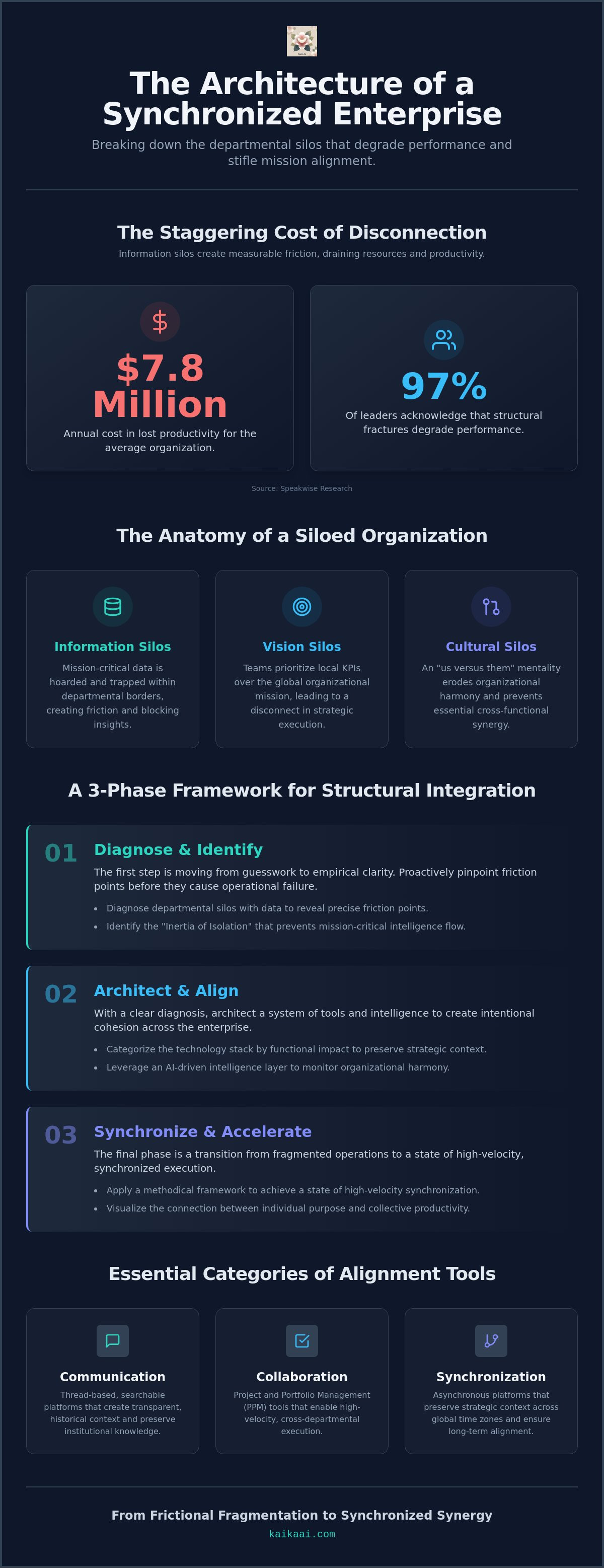
Did you know that information silos cost the average organization $7.8 million annually in lost productivity? According to Speakwise research from May 2026, 97% of leaders acknowledge that these structural fractures actively degrade performance, yet most remain trapped in a cycle of reactive communication rather than systemic repair. You likely feel the friction of information lag between global divisions or the weight of redundant operational costs across teams. Precision matters. This friction isn't just a technical glitch; it's a structural failure that drains talent and stifles mission alignment.
Evolve your architecture. This article provides the frameworks and intelligence tools required to move beyond surface-level fixes. By diagnosing departmental silos with data, you can transform a fragmented enterprise into a synchronized, high-velocity organization. We'll explore the sophisticated workforce alignment intelligence and predictive analytics necessary to bridge the gap between corporate strategy and daily execution. Discover how to replace institutional friction with measurable cross-departmental synergy, increased organizational velocity, and reduced burnout through structural alignment.
Key Takeaways
- Identify the "Inertia of Isolation" and the structural barriers that prevent mission-critical intelligence from flowing freely across your global divisions.
- Categorize your technology stack by functional impact to distinguish between immediate communication tools and platforms that preserve strategic context.
- Master the architectural process of diagnosing departmental silos with data to pinpoint precise friction points within your organizational workflow.
- Leverage an AI-driven intelligence layer to monitor organizational harmony and visualize the connection between individual purpose and collective productivity.
- Apply a methodical three-phase framework to transition your enterprise from fragmented operations to a state of high-velocity synchronization.
The Architecture of Fragmentation: Why Departmental Silos Persist in 2026
Departmental silos represent more than mere communication lapses; they are calcified structural barriers that actively impede the flow of mission-critical intelligence across the enterprise. In the high-stakes environment of 2026, these organizational silos act as friction points that slow down every strategic initiative. We define these silos as the architectural failure to synchronize individual effort with the collective mission. This failure isn't accidental. It's the result of the Inertia of Isolation, a persistent entropic force where specialized divisions naturally drift toward localized goals, gradually losing sight of the broader corporate objective.
The consequences of this fragmentation are measurable and severe. Organizations suffer from decelerated velocity, redundant operational spend, and systemic talent attrition. When departments operate as disconnected islands, the enterprise loses its ability to respond to market shifts with precision. True resilience requires a shift in mindset. It demands the implementation of Alignment Intelligence, a sophisticated layer of oversight that replaces guesswork with empirical clarity. By diagnosing departmental silos with data, leadership can finally move from reactive firefighting to proactive architectural optimization.
The Anatomy of a Siloed Organization
Structural fragmentation typically manifests in three distinct layers. Information Silos occur when specialized divisions like Finance or HR hoard data, creating a reality where mission-critical insights are trapped within departmental borders. Vision Silos emerge when teams prioritize local KPIs over global organizational health, leading to a disconnect between daily tasks and the long-term mission. Finally, Cultural Silos foster an "us versus them" mentality. This psychological barrier erodes organizational harmony and prevents the cross-functional synergy required for sustained excellence.
Why 2026 Demands a Structural Evolution
The modern enterprise cannot survive on the legacy models of the past. The speed of global markets has rendered traditional top-down goal cascading obsolete, as it's too slow to adapt to real-time disruptions. Additionally, the rise of remote and hybrid work models has inadvertently reinforced departmental walls. Without the physical proximity of a shared office, teams have retreated into digital isolation. Leaders now require high-velocity intelligence to maintain cohesion. Diagnosing departmental silos with data provides the necessary visibility to detect misalignment before it causes operational failure, ensuring the organization remains a single, synchronized force.
To ensure your organization remains synchronized on a secure foundation, discover Klaravex LLC and their AI-driven managed IT and security services designed for small and medium-size businesses.
Essential Categories of Cross-Departmental Alignment Tools
Success in the modern enterprise depends on architectural synchronization. Tools aren't merely utilities; they're the connective tissue of the organization. We categorize these instruments by their functional impact: communication, collaboration, and synchronization. While synchronous tools facilitate instant reaction, asynchronous platforms preserve strategic context across global time zones. Relying on a monolithic, all-in-one solution is often a strategic error. A specialized tool stack, built on the principle of interoperability, prevents the creation of secondary data silos. When leadership commits to diagnosing departmental silos with data, the choice of technology becomes a matter of architectural precision. For example, in content-heavy divisions, platforms like Editivo offer AI-powered automation that maintains strategic alignment while streamlining the creation and management of enterprise-wide communications.
Foundational Communication Platforms
Effective communication requires more than instant messaging. Modern stacks prioritize thread-based, searchable context to ensure institutional knowledge isn't lost in a sea of notifications. Video-as-documentation has become essential for preserving nuances across decentralized teams. These platforms must provide enterprise-grade security and global accessibility. Without thread integrity, communication becomes noise. Combating The Silo Mentality requires a stack that enforces transparency and historical continuity across every division.
Collaborative Project and Portfolio Management (PPM)
Knowledge Management and Institutional Wikis
The organization needs a digital brain. Knowledge management tools democratize access to data, shifting from static documentation to dynamic, evolving knowledge bases that reflect current operational realities. AI-powered search now retrieves insights from fragmented legacy databases with surgical accuracy. This shift supports continuous improvement and collective intelligence by ensuring every employee has the context they need to excel. Knowledge shouldn't be hoarded; it should be leveraged as a competitive asset. Before implementing these systems, conducting an Alignment Audit can reveal exactly where your current knowledge flow is obstructed and where your synergy is leaking.
The Intelligence Layer: Real-Time Metrics for Organizational Harmony
Strategic visibility is the prerequisite for operational excellence. While foundational tools provide the pipes for communication, the Intelligence Layer serves as the central nervous system, monitoring the health of organizational alignment in real-time. This sophisticated software tier moves beyond static data storage. It utilizes emerging AI technologies to identify "Silo Friction" by analyzing communication patterns and data flow velocity across disparate systems. Diagnosing departmental silos with data is no longer a retrospective autopsy; it's a live diagnostic process that identifies structural blockages before they lead to the abandonment of AI initiatives, a fate that Speakwise predicts for 60% of projects in 2026. Workforce Velocity is the speed at which an organization executes its mission.
The transition from annual engagement surveys to real-time sentiment analysis marks a fundamental shift in leadership methodology. Retrospective feedback is often too late to prevent operational decay. By the time a survey reveals a disconnect, the cost in productivity and morale has already been realized. High-performance cultures in 2026 prioritize live alignment scores, allowing for immediate architectural adjustments. This data-driven approach ensures that every division remains a synchronized component of the larger enterprise whole.
Predictive Analytics for Attrition and Burnout
Human potential is your most volatile asset. Predictive analytics now identify burnout patterns before they lead to mission-critical talent loss in specialized divisions. By correlating productivity spikes with long-term engagement risks, AI detects the subtle signs of purpose drift. This isn't about surveillance; it's about structural support. Ethical implementation is paramount, particularly when adhering to strict Japanese privacy standards and SOC2 compliance. Protecting the individual while diagnosing departmental silos with data creates a resilient environment where talent thrives rather than erodes under systemic pressure.
Measuring Purpose Alignment
Misalignment is the primary driver of institutional friction. Alignment intelligence platforms quantify the gap between individual employee purpose and corporate strategic goals, visualizing "Mission Drift" across global divisions. When individual focus diverges from the organizational trajectory, velocity drops. There's a documented correlation between high alignment scores and exponential revenue growth. By visualizing these metrics, leaders can institutionalize high-performance behaviors. This systematic synchronization ensures that every action taken at the departmental level directly contributes to an overarching mission, transforming fragmented effort into a unified, high-velocity force.
Strategic Implementation: A Three-Phase Framework for Structural Integration
Tool adoption is often mistaken for a mere technical upgrade. In reality, it represents a fundamental leadership mindset shift. True structural integration requires a methodical, architectural approach that moves from diagnostic clarity to operational resilience. The process of diagnosing departmental silos with data provides the empirical foundation for this evolution. We utilize a three-phase framework designed to transform fragmented divisions into a single, high-velocity force. This process ensures that technology serves the mission, rather than the mission serving the tool.
The Alignment Audit: Mapping the Fragmentation
The first phase involves a comprehensive Alignment Audit. This isn't a superficial survey; it's a deep-dive diagnostic aimed at diagnosing departmental silos with data to reveal the hidden fractures in your organization. We identify 'Information Dead Zones' where cross-functional collaboration ceases and mission-critical intelligence evaporates. By interviewing 'Bridge Personnel', those rare individuals who operate across multiple divisions, we pinpoint the exact friction points where synergy dies. We then establish baseline metrics for workforce velocity and employee purpose alignment, creating a quantitative starting point for your organizational evolution.
Phase two transitions into Architectural Consultation. This is where strategic design meets operational reality. We take the empirical findings from the initial diagnostic and construct the technical and cultural bridges necessary to reconnect disparate divisions. This isn't simply about software integration; it's about redefining the protocols of interaction between departments. By designing an environment that favors transparency and shared accountability, we ensure that every division operates with a comprehensive strategic context, turning isolated efforts into a unified trajectory.
Orchestrating Collective Kaizen
The final phase involves orchestrating Collective Kaizen. This represents a fundamental shift from rigid, top-down commands to a model of decentralized, aligned execution across the entire enterprise. Through strategic workshops, we synchronize leadership mindsets to ensure a unified front that resists the natural drift toward isolation. We establish a robust feedback loop where real-time metrics from the intelligence layer inform immediate structural adjustments. This creates a state of perpetual, data-driven optimization, ensuring your organization remains resilient and synchronized regardless of market volatility. To begin this transformation and move toward a high-velocity future, schedule your Alignment Audit to identify the hidden fractures within your enterprise architecture.
Orchestrating Synergy: The Kaika AI Workforce Alignment Platform
Kaika AI represents the final evolution in organizational synchronization. It serves as the definitive intelligence layer for the modern enterprise, transforming the theoretical frameworks of structural integration into daily operational reality. While fragmented systems focus on retrospective reporting, our platform provides real-time performance dashboards that connect individual purpose to collective productivity. By diagnosing departmental silos with data, Kaika AI enables leadership to visualize the invisible barriers that stifle workforce velocity. It's an architectural solution for a structural problem that demands more than just better communication.
The first step in this transformation is the Alignment Audit. This essential diagnostic phase identifies the specific location and cause of structural silos before they compromise your strategic trajectory. Precision is our priority. Kaika AI integrates rigorous Japanese privacy standards with global, enterprise-grade security, including SOC2 compliance. This ensures that while you're diagnosing departmental silos with data, your proprietary intelligence remains protected. The name "Kaika" reflects our philosophy of blooming; it's about fostering a natural state of organizational excellence through the intersection of human potential and systemic harmony.
Connecting Purpose to Performance
The disconnect between corporate strategy and daily execution is where synergy dies. Kaika AI bridges this gap by aligning individual employee aspirations with organizational KPIs. Our proprietary alignment scores provide a visual representation of organizational harmony, allowing executives to see exactly where mission drift occurs. This visibility is vital for reducing attrition. By identifying burnout patterns and purpose drift in real-time, the platform boosts operational resilience and secures your most valuable assets. It's not just about tracking tasks. It's about institutionalizing the high-performance behaviors that drive exponential growth and long-term stability.
Begin Your Evolutionary Journey
Evolution is a choice. Transitioning to a synchronized enterprise requires more than software; it demands a partnership in architectural design. Our Executive Consultation services offer a structured path for leadership development and organizational refinement. We invite verified enterprises to request early access to our Workforce Alignment Intelligence Platform to begin their journey toward data-driven Kaizen. The path from fragmentation to synergy starts with a single, empirical step. Secure your organization’s future with a Kaika AI Alignment Audit and transform your departmental isolation into systemic velocity.
Architectural Mastery: The Path to Systemic Synchronization
The calcified structures of the past can't withstand the velocity of 2026. We've explored how a shift from monolithic tools to a sophisticated intelligence layer transforms fragmented divisions into a singular, resilient force. This evolution requires more than intent; it demands an architectural commitment to transparency and shared purpose. Precision in diagnosing departmental silos with data is the prerequisite for any meaningful transformation. It moves the organization from reactive firefighting to a state of proactive, empirical optimization.
Our platform offers proactive attrition management through AI-powered burnout prediction, ensuring your talent remains aligned and energized. We've built this framework to be compliant with rigorous Japanese privacy standards, providing global security without compromising individual integrity. By utilizing our three-phase strategic integration methodology, you can replace institutional friction with a state of perpetual, synchronized excellence. The intersection of human potential and technical precision is where your organization's future begins.
Request early access to the Kaika AI Workforce Alignment Platform to replace institutional friction with high-velocity harmony. Your evolution is the only sustainable path forward. Take the first step toward a unified enterprise today.
Frequently Asked Questions
What are the most common signs that departmental silos are forming?
Redundant operational costs and mission drift are the most visible indicators of structural fragmentation. When divisions prioritize local KPIs over global objectives, systemic friction becomes inevitable. You'll observe information lag where critical data takes days to traverse departmental borders, leading to decelerated execution and measurable talent attrition. These symptoms signal a failure in your organizational architecture that requires immediate diagnostic intervention.
Can collaboration tools like Slack or Teams actually create more silos?
Digital collaboration platforms often inadvertently reinforce departmental walls by creating isolated echo chambers. Without an overarching intelligence layer, these tools become repositories for fragmented, unsearchable noise. They facilitate instant reaction but frequently fail to preserve the strategic context required for true organizational harmony. This digital isolation creates a secondary layer of fragmentation that obscures the broader corporate mission.
How do you measure the ROI of breaking down departmental silos?
Quantifying the impact involves tracking improvements in workforce velocity and the reduction of redundant operational spend. By diagnosing departmental silos with data, leadership can measure the decrease in information search time, which currently averages 12 hours per week for employees. Increased synergy directly correlates with higher revenue growth and lower attrition costs, providing a clear financial justification for structural integration.
What is the difference between organizational alignment and employee engagement?
Engagement measures how employees feel, while alignment measures where they're going. High engagement without strategic alignment creates a motivated workforce moving in conflicting directions. Alignment ensures that individual purpose is synchronized with the corporate mission. This synchronization transforms high sentiment into measurable organizational velocity and structural resilience, ensuring every effort contributes to the collective trajectory of the enterprise.
How does AI help in identifying departmental silos before they become critical?
AI identifies "Silo Friction" by analyzing communication patterns and data flow velocity in real-time. It detects subtle shifts in interaction frequency and language that signal the onset of isolation. This predictive capability allows for diagnosing departmental silos with data before they manifest as operational failures. It provides the foresight necessary to protect human potential and maintain high-performance behaviors across global divisions.
What role does executive leadership play in tool adoption for cross-departmental synergy?
Leadership acts as the primary architect of organizational synergy. Tool adoption isn't a technical task but a strategic mandate to foster a culture of transparency and shared accountability. Executives must champion the transition from top-down commands to decentralized, aligned execution. This ensures that technology serves the broader mission rather than departmental convenience, establishing the mindset required for long-term structural health.
How can a company maintain alignment during rapid global scaling?
Sustaining cohesion during rapid expansion requires a scalable intelligence layer that transcends physical borders. Systems must be established that provide a single source of truth and real-time visibility into divisional performance. This architectural approach ensures that new teams are immediately integrated into the core mission. It prevents the Inertia of Isolation from taking root as the organization grows in complexity and geographic reach.
Is it possible to break down silos without changing the organizational structure?
It's possible to achieve synchronization by implementing a virtual alignment layer that bridges existing divisions. This layer facilitates the flow of intelligence without disrupting established reporting lines, creating a technical and cultural connective tissue. Over time, this data-driven synergy often reveals the most efficient path for eventual structural evolution. It allows for immediate performance gains while the organization matures toward its final architectural form.
Disclaimer
#Disclaimer
At Kaika AI, we believe the future belongs to organizations that combine human wisdom with artificial intelligence responsibly. The articles, research, insights, and thought leadership published on this website are intended to educate, inform, and encourage meaningful conversations about the future of work, organizational intelligence, AI, leadership, and innovation.
While our content is developed through rigorous research and may be generated, curated, or enhanced using artificial intelligence, every effort is made to ensure it reflects thoughtful analysis, practical relevance, and responsible AI practices. However, no representation or warranty is made regarding the completeness, accuracy, or suitability of the information for every individual or organizational circumstance.
The ideas, opinions, frameworks, and recommendations shared by Kaika AI are provided for educational and informational purposes only. They should not be interpreted as legal, financial, medical, psychological, human resources, cybersecurity, or other professional advice. Organizations and individuals should seek qualified professional guidance before making strategic, legal, or operational decisions.
Where articles reference third-party organizations, products, services, academic research, industry reports, or public data, such references are provided solely to support discussion and analysis. Unless explicitly stated, they do not imply endorsement, partnership, or affiliation.
Artificial intelligence is a powerful decision-support technology—not a replacement for human judgment. Kaika AI advocates for responsible, transparent, and human-centered AI adoption. We encourage readers to critically evaluate information, consider their unique context, and combine AI-generated insights with professional expertise and sound decision-making.
The content published on this website may be updated, revised, or removed as knowledge, technology, regulations, and best practices continue to evolve.
To the fullest extent permitted by applicable law, Kaika AI, its affiliates, contributors, and partners disclaim liability for any direct, indirect, incidental, consequential, or other losses arising from the use of, or reliance upon, the information provided on this website.
By accessing or using this website, you acknowledge that you have read, understood, and agree to this Disclaimer.
Kaika AI
'Building trusted organizational intelligence for the AI Era'


